
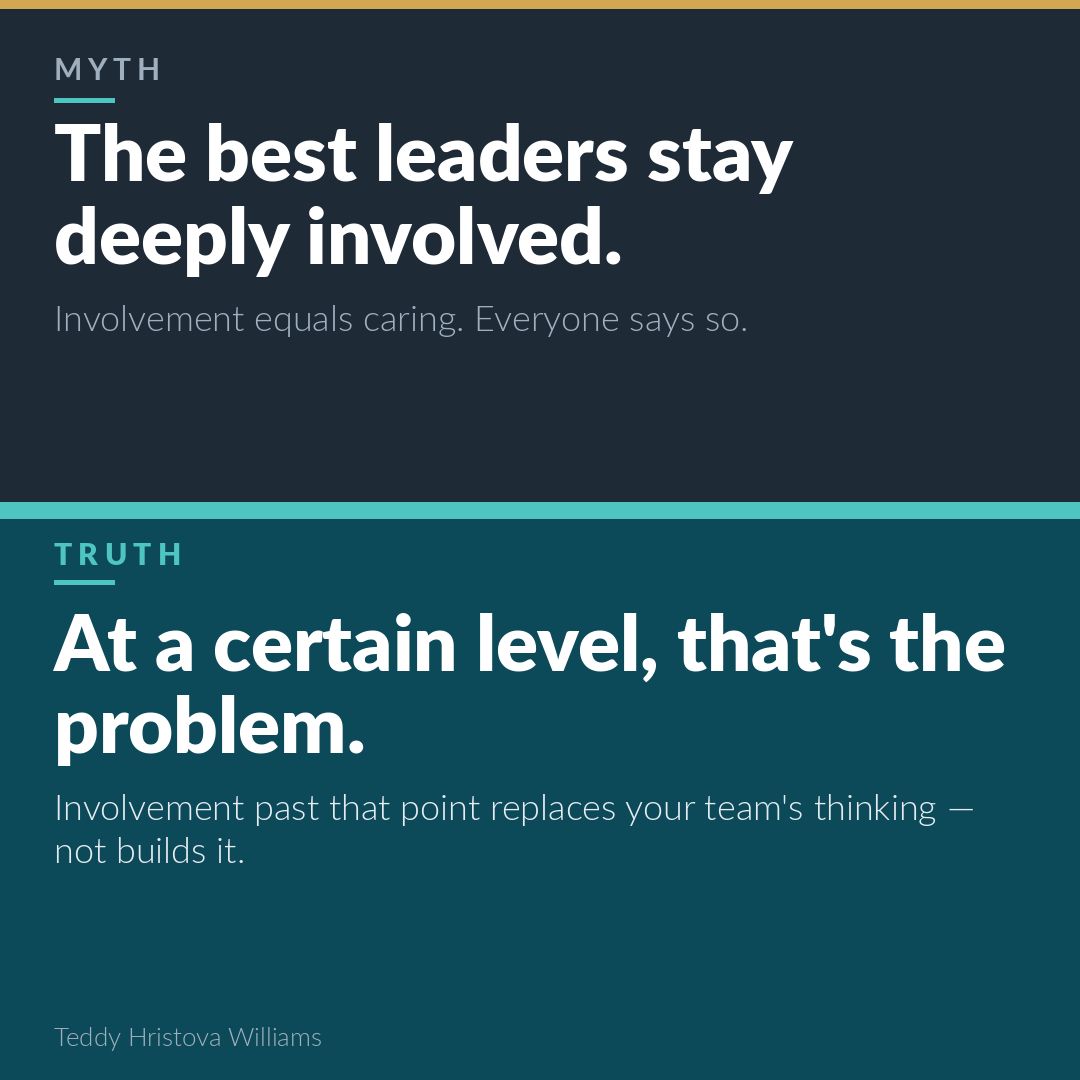
In a recent LinkedIn post, Teddy Hristova Williams delves into a common leadership misconception, arguing that deep involvement, while often lauded, can become a hindrance rather than a help at senior levels. Williams challenges the notion that constant oversight equates to effective leadership, proposing instead that the nature of a leader’s involvement is more critical than its quantity.
Williams begins by dissecting the dual nature of leadership involvement:
“There’s a version of involvement that builds teams. And a version that quietly dismantles them.”
This distinction, according to Williams, hinges not on the leader’s passion or dedication, but on where they place their ultimate responsibility. The core of the argument suggests that true leadership growth occurs when leaders own the mission and empower their teams to execute the tasks required to achieve it.
The Difference Between Building and Replacing Capability
Teddy Hristova Williams posits that a key differentiator between successful and struggling leadership lies in the scope of responsibility a leader assumes. When a leader takes ownership of both the overarching mission and the granular tasks, they inadvertently create a dependency that can stifle team growth and autonomy.
As Teddy Hristova Williams notes:
“The leader who owns the mission and trusts the team to execute builds something that grows. The leader who owns the mission AND the tasks builds something that depends entirely on them.”
This approach, while perhaps stemming from good intentions, leads to opposite outcomes. The former fosters an environment where the team develops its own problem-solving capabilities and resilience, ensuring the organization can thrive independently of constant managerial input. The latter, conversely, traps the leader in a cycle of task management, preventing the team from developing critical skills and ultimately limiting the organization’s scalability.
Shifting the Focus from Involvement to Empowerment
The central question, as posed by Teddy Hristova Williams, is not about the presence of the leader, but the *impact* of their involvement. Is the leader’s engagement serving to build the team’s capacity, or is it inadvertently stepping in to *replace* that capacity?
Williams emphasizes this point:
“The question isn’t whether you’re involved. It’s whether your involvement is building capability or replacing it.”
This perspective encourages leaders to reflect on their daily actions and decision-making processes. It advocates for a strategic shift from micro-management to macro-empowerment, where leaders focus on setting clear direction, providing resources, and fostering an environment of trust, allowing their teams the space to learn, grow, and ultimately succeed. By stepping back from task-level ownership, leaders can free themselves to focus on strategic vision and development, while simultaneously empowering their teams to become more competent and self-sufficient.
📝 About This Content
This article is based on insights shared by Teddy Hristova Williams on LinkedIn.
📅 Originally posted on June 23, 2026 | View original post on LinkedIn →