
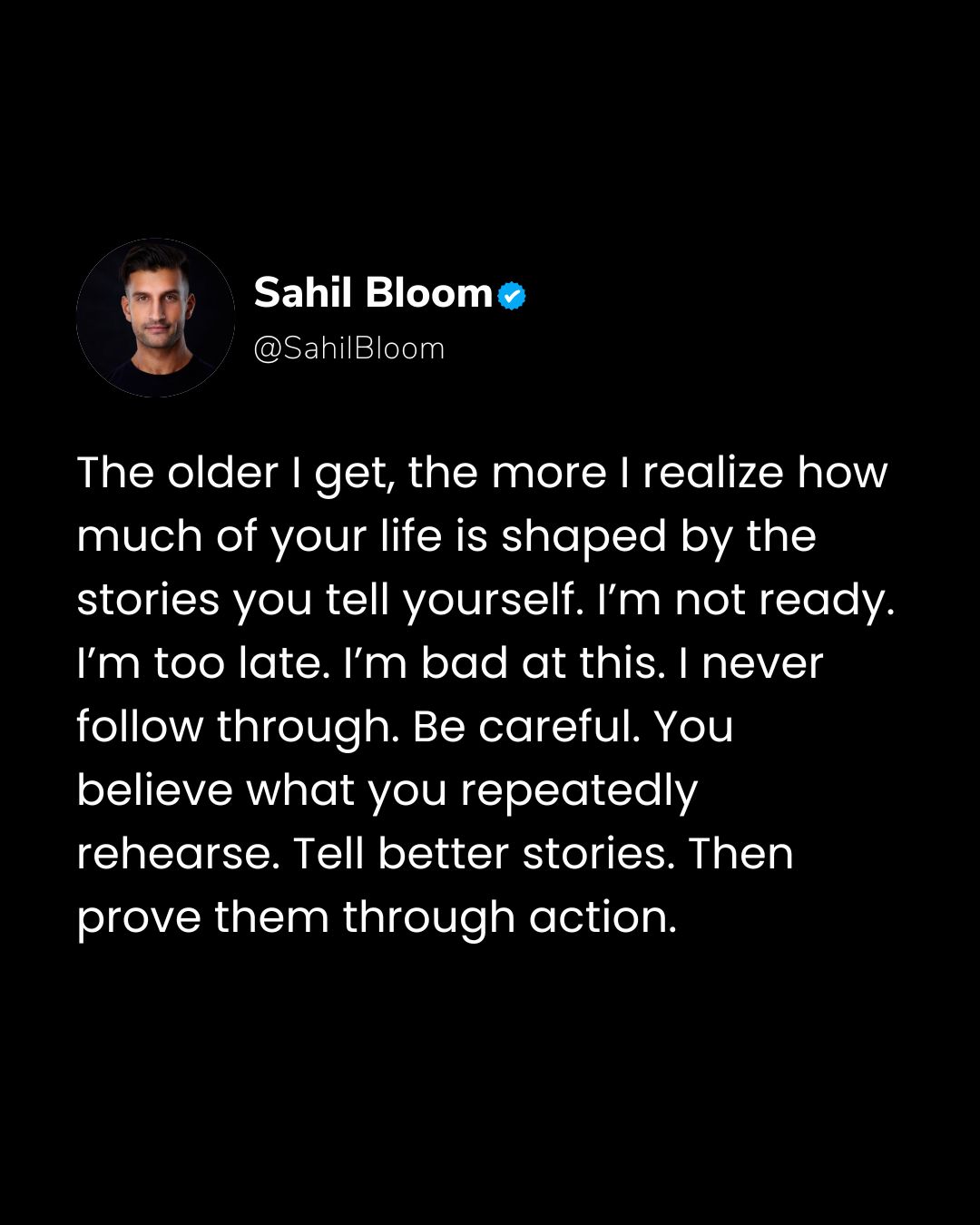
In a recent LinkedIn post, Sahil Bloom discusses the profound impact of the internal narratives we construct about ourselves and our experiences, arguing that these self-told stories, rather than external events, are the primary architects of our lives. Bloom contends that many individuals perpetuate limiting beliefs through small, often unnoticed, self-deceptions that solidify into perceived facts over time.
Bloom highlights how common internal refrains such as “I’m not ready,” “I’m too late,” or “I’m bad at this” can become deeply ingrained.
“You say them so often they stop sounding like opinions. They start sounding like facts.”
This self-perpetuating cycle, according to Bloom, dictates the trajectory of one’s life. He explains that the stories we choose to believe and repeatedly tell ourselves shape our core beliefs, which in turn guide our actions and ultimately construct the reality we inhabit.
The Story vs. The Event
A central theme in Sahil Bloom’s analysis is the distinction between an event and the narrative surrounding it. He posits that the same failure or setback can lead to vastly different outcomes depending on the interpretation applied by the individual.
“Same failure. Two people. One says: ‘I knew I’d mess this up.’ The other says: ‘Now I know what doesn’t work.'”
This stark comparison, as presented by Bloom, underscores the idea that resilience and growth are not inherent qualities but are cultivated through the stories we tell ourselves about adversity. The individual who reframes failure as a learning opportunity, rather than a confirmation of inadequacy, is positioned for a fundamentally different future, Bloom argues.
Breaking the Cycle of the “Old Script”
Bloom’s post further elaborates on the tendency for people to operate on autopilot, running on a script that has been established by past narratives without critical examination. He suggests that many people fail to question the “narrator” within, allowing outdated or negative self-perceptions to dictate their present and future.
“Most people never question the narrator. They just let the old script run on repeat. Year after year. Decade after decade.”
According to Sahil Bloom, the solution is not necessarily a new external strategy but an internal one: a conscious effort to rewrite one’s personal narrative. He advocates for actively choosing and cultivating a more empowering and constructive story.
From Story to Action
The final, crucial step in Sahil Bloom’s framework involves translating the new narrative into tangible action. He emphasizes that a revised story must be substantiated by corresponding behaviors to effect real change.
“You don’t need a new strategy. You need a new story. Tell a better one. Then prove it through action.”
In essence, Bloom’s message on LinkedIn is a call to self-awareness and intentionality. By recognizing the power of our internal dialogue and consciously choosing to craft more empowering stories, we can fundamentally alter our beliefs, actions, and ultimately, the lives we build.
📝 About This Content
This article is based on insights shared by Sahil Bloom on LinkedIn.
📅 Originally posted on July 11, 2026 | View original post on LinkedIn →