
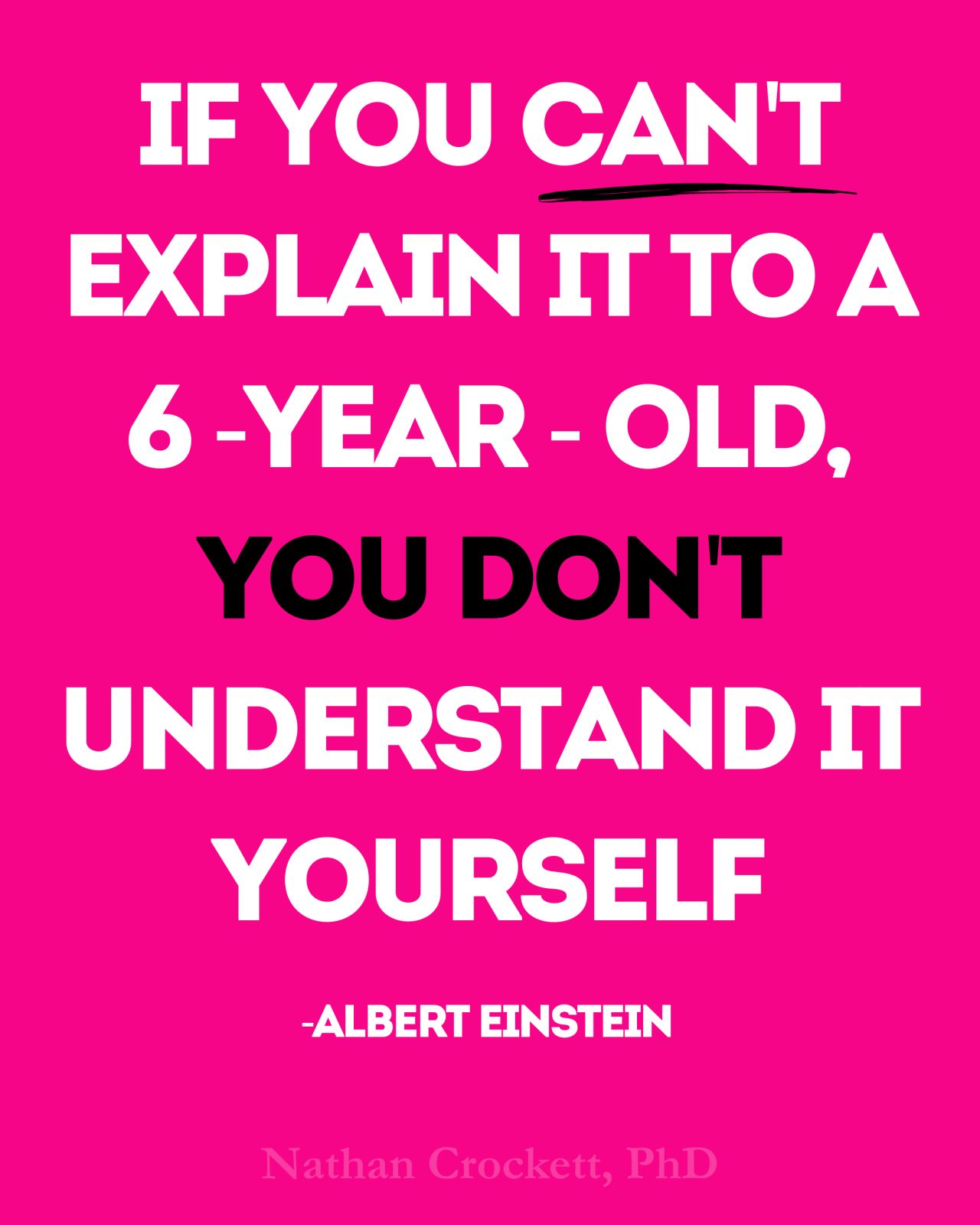
In a recent LinkedIn post, Nathan Crockett, PhD delves into the crucial distinction between complexity and genuine understanding, arguing that true intelligence is demonstrated through clarity, not jargon. He challenges the common misconception that using big words equates to intelligence, a point he illustrates with a powerful quote attributed to Albert Einstein.
“If you can’t explain it to a 6-year-old, you don’t understand it yourself.”
Crockett asserts that professionals across all fields often fall into the trap of confusing complexity with credibility. This leads to the use of opaque language, excessive padding in communications, and presentations that sound impressive but lack substantive meaning. As Nathan Crockett, PhD notes, “We’ve confused complexity with credibility.” This tendency, he suggests, hinders effective communication and genuine knowledge transfer.
The Misconception of Complexity as Credibility
Nathan Crockett, PhD elaborates on how the professional world often prioritizes sounding knowledgeable over actually being understood. This can manifest in various ways, from dense academic language to corporate buzzwords that obscure rather than illuminate. He points out that true understanding is not measured by the volume of information one possesses, but by the ability to distill that information into an accessible form.
Distilling Ideas for Effective Teaching
According to Nathan Crockett, PhD, the hallmark of true mastery of a subject lies in the ability to simplify it. “If you really grasp an idea, you can strip it down. Hold it up. And hand it to someone else without all the fluff,” he writes. This perspective emphasizes that effective teaching and communication require breaking down complex concepts into their fundamental components, making them digestible for a wider audience. Crockett draws a parallel to the teachings of Jesus, who, as he highlights, used simple stories and analogies like seeds, sheep, and coins, rather than obscure academic language, to convey profound truths.
“Jesus didn’t speak in footnotes. – He used stories. – Seeds. – Sheep. – Coins.”
The True Goal: Transferring Knowledge, Not Impressing
The core message from Nathan Crockett, PhD is a call to shift the focus from self-aggrandizement to effective knowledge transfer. He argues that the primary responsibility of anyone in a position to share information—whether a CEO, teacher, pastor, or parent—is not to appear brilliant, but to make truth useful and accessible. “Your job isn’t to sound brilliant. – Your job is to make truth useful,” he states emphatically.
Actionable Communication Strategies
Crockett advocates for direct and simple communication. He advises individuals to “Explain it simply. – Say it straight. – Let people get it.” This approach, he believes, is far more impactful than attempting to impress an audience with sophisticated language. The ultimate goal, in Nathan Crockett, PhD’s view, should be to transfer understanding, not merely to elicit admiration. “Don’t aim to impress. Aim to transfer,” he concludes, suggesting that this focus on clarity and utility is where true genius resides.
“That’s where the real genius lives.”
By championing simplicity and clarity, Nathan Crockett, PhD encourages a more effective and inclusive method of communication that prioritizes understanding and practical application over intellectual posturing.
📝 About This Content
This article is based on insights shared by Nathan Crockett, PhD on LinkedIn.
📅 Originally posted on February 19, 2026 | View original post on LinkedIn →