
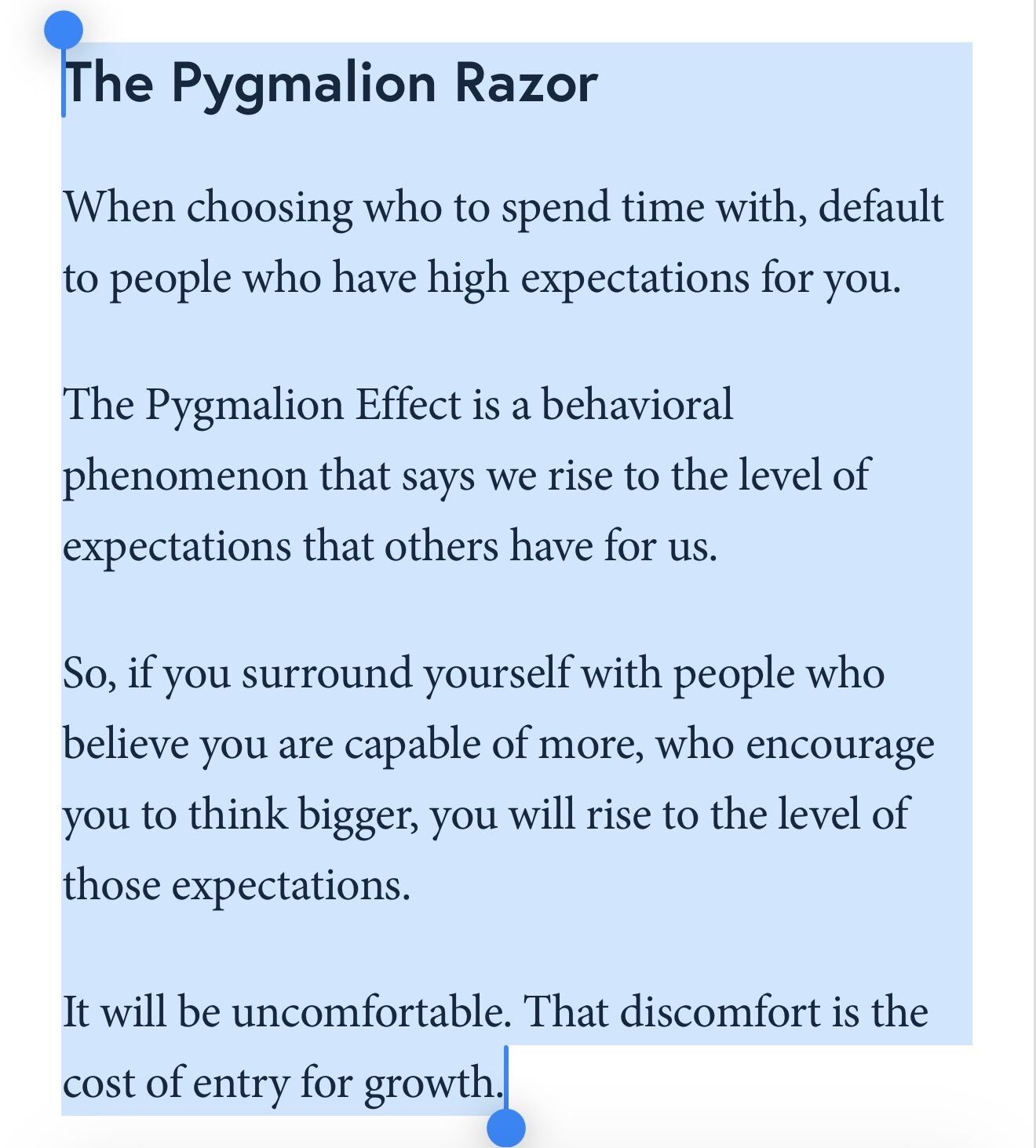
In a recent LinkedIn post, Sahil Bloom discusses the powerful psychological principle known as the “Pygmalion Effect” and introduces a concept he terms the “Pygmalion Razor.” Bloom argues that strategically choosing to associate with individuals who hold high expectations for us is a critical, albeit uncomfortable, catalyst for personal and professional growth.
The core of Bloom’s insight lies in the observation that people tend to perform at the level of expectations set for them by others. He highlights this phenomenon, stating:
“The Pygmalion Effect is a behavioral phenomenon that says we rise to the level of expectations that others have for us.”
Bloom extends this by proposing the “Pygmalion Razor” as a guiding principle for social and professional circles. This razor suggests a deliberate choice: actively seek out and spend time with people who expect more from you. According to Bloom, this is not about seeking validation, but about leveraging external belief to fuel internal development.
The Uncomfortable Truth of Growth
Bloom does not shy away from the challenging nature of this approach. He acknowledges that surrounding oneself with those who push boundaries and demand more can be an uncomfortable experience. However, he frames this discomfort not as a deterrent, but as an essential component of the growth process.
As Sahil Bloom notes:
“It will be uncomfortable. That discomfort is the cost of entry for growth.”
In his analysis, Bloom implies that this discomfort is a signal of progress. It signifies that individuals are being stretched beyond their current capabilities, a necessary step for expanding their potential. The “Pygmalion Razor” encourages embracing this friction as a sign that one is on the right path toward achieving a higher level of performance and capability.
Applying the Pygmalion Razor
While Bloom’s post is concise, the implication for application is clear: a mindful audit of one’s social and professional environment is crucial. He suggests that by consciously curating relationships with individuals who possess high expectations, one can create a self-fulfilling prophecy of success.
According to Sahil Bloom, the strategy is straightforward:
“When choosing who to spend time with, default to people who have high expectations for you.”
This principle underscores the importance of mentorship, supportive peer groups, and leadership that challenges rather than coddles. By positioning oneself within an ecosystem of high achievers and believers, individuals are more likely to internalize those expectations and subsequently elevate their own performance. Sahil Bloom’s concept provides a practical framework for individuals looking to proactively foster their own development by leveraging the power of external belief systems.
📝 About This Content
This article is based on insights shared by Sahil Bloom on LinkedIn.
📅 Originally posted on May 24, 2026 | View original post on LinkedIn →