
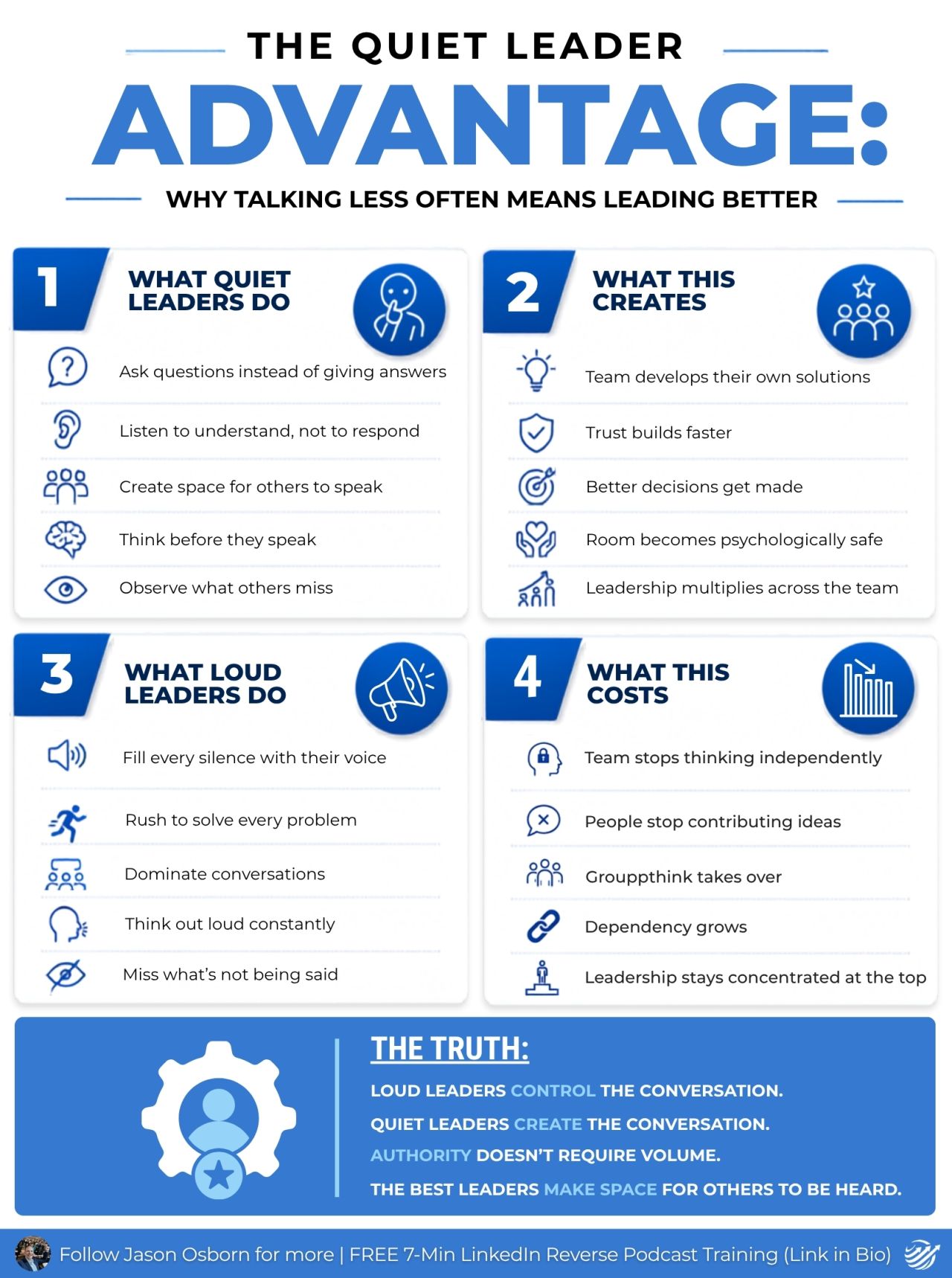
In a recent LinkedIn post, Jason Osborn explores the often-underestimated power of “quiet leadership,” arguing that leaders who speak less can often achieve more impactful results. Osborn challenges the conventional assumption that effective leadership is always characterized by a loud, commanding presence.
He highlights that some of the most effective leaders are those who are not the most vocal in meetings. This isn’t due to a lack of ideas, but rather a strategic understanding that silence and thoughtful pauses can be more powerful than constant speech. As Osborn puts it:
“Most people assume leadership sounds like something. A confident voice. A commanding presence. Someone who fills the room. But some of the most effective leaders are the ones you barely hear from in a meeting.”
The Strategic Value of Silence
Osborn details several key practices employed by what he terms “quiet leaders.” These leaders prioritize asking questions over providing immediate answers, listen intently to understand rather than just to formulate a response, and carefully consider their words before speaking.
A core tenet of this leadership style, according to Osborn, is creating an environment where others feel empowered to contribute. This involves actively making space for team members to voice their thoughts and solutions. Osborn notes this approach fosters a more collaborative atmosphere:
“They create space for others to talk. And they notice what’s not being said just as much as what is.”
The Outcomes of Quiet Leadership
The benefits of this less-is-more approach, as outlined by Osborn, are manifold. When leaders step back, teams are more likely to develop their own solutions independently. This not only fosters innovation but also builds trust, as individuals feel genuinely heard and valued. Osborn argues that this inclusive process leads to better decision-making because a wider range of perspectives is considered.
Furthermore, Osborn suggests that this style cultivates leadership qualities throughout the team, rather than concentrating them solely at the top. He states:
“The team starts developing their own solutions. Trust builds faster because people feel genuinely heard. Better decisions get made because more perspectives make it in.”
Contrasting with “Loud Leaders”
Osborn contrasts the quiet leader with the “loud leader,” who tends to dominate conversations, rush to solve every problem, and inadvertently fill every silence with their voice. While this might seem decisive, Osborn warns of the significant costs associated with this style. He points out that loud leaders can stifle independent thinking within their teams, discourage contributions due to lack of space, and potentially fall prey to groupthink.
According to Osborn, this can lead to increased dependency on the leader and, paradoxically, a heavier workload for the leader themselves as they attempt to manage every aspect. Osborn summarizes this dynamic by stating:
“Loud leaders control the conversation. Quiet leaders create it.”
The Power of Authority Beyond Volume
Ultimately, Osborn’s message is that true leadership authority does not necessarily correlate with volume or constant vocal presence. Instead, he advocates for a leadership style that intentionally creates space for others, allowing better leadership to emerge organically from within the team. This perspective emphasizes the profound impact of thoughtful restraint and active listening in fostering a thriving, innovative, and self-sufficient team environment.
📝 About This Content
This article is based on insights shared by Jason Osborn on LinkedIn.
📅 Originally posted on August 10, 2026 | View original post on LinkedIn →