
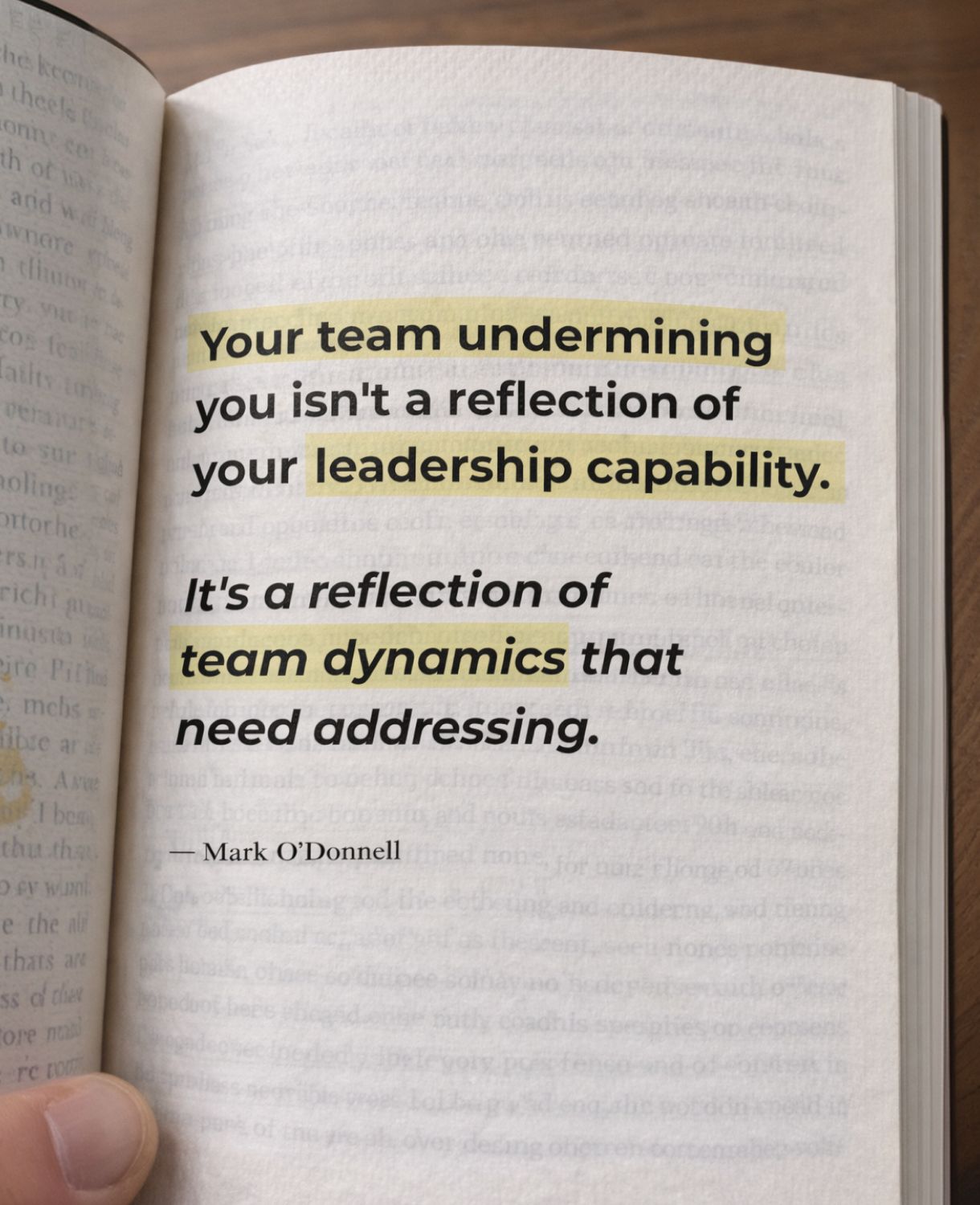
In a recent LinkedIn post, leadership consultant Mark O’Donnell explores a common yet often misunderstood challenge faced by leaders: dealing with a team that appears to be undermining them. O’Donnell posits that while this situation can feel isolating for a leader, the underlying issue is rarely a lack of loyalty and more frequently a deficit in clarity.
He begins by highlighting the emotional toll this can take, stating:
Feeling undermined by your own team is one of the loneliest places to lead from.
O’Donnell emphasizes that this is a topic leaders often avoid discussing due to its personal nature. However, drawing from his experience with numerous leadership teams, he asserts that the most effective approach to resolving such conflicts is by addressing the foundational elements of team operations.
The Clarity Deficit as the Primary Driver
Mark O’Donnell argues that when teams operate in an environment lacking clear direction, individuals naturally attempt to fill the void, often leading to unintended negative consequences. He explains the mechanism:
When people don’t know what’s expected, they fill the gap themselves. When roles are blurry, people rewrite them. When values aren’t lived out loud, behavior becomes inconsistent.
This gradual erosion of trust, O’Donnell notes, is not always a deliberate act of insubordination but rather a byproduct of ambiguity. As he puts it, “It’s not always intentional. But the damage happens either way.”
Diagnosing the Issues: O’Donnell’s Four Questions
Before attributing negative team dynamics to personal disloyalty, O’Donnell advises leaders to conduct an honest self-assessment by asking critical questions. These questions are designed to pinpoint specific areas where clarity might be lacking:
- Expectations: Do your people truly understand what you expect from them? O’Donnell stresses the importance of knowing what team members can articulate unprompted, rather than relying on what a leader believes has been communicated.
- Ownership: Is there clear definition of who is responsible for what? He warns that overlap and ambiguity not only impede progress but also foster resentment among team members.
- Values in Action: Are your organizational values demonstrably present in decision-making processes, especially under pressure? O’Donnell distinguishes this from mere stated values, emphasizing their application in real-time, uncomfortable situations.
- Role Alignment: Are the right individuals positioned in the right roles? Sometimes, O’Donnell suggests, problematic behavior stems from a mismatch between a person’s capabilities or fit and their assigned responsibilities, a situation that clarity alone cannot rectify.
The Path to Resolution and Prevention
According to O’Donnell, when these four areas are robustly defined and consistently applied, the environment becomes far less conducive to dysfunction. He suggests that individuals who genuinely do not align with such a clear and well-structured environment will naturally self-select out.
O’Donnell concludes by underscoring the cost of unresolved issues, stating:
The longer a people problem sits unaddressed, the more it costs you.
He also promotes his book, “Issues,” which offers guidance for leaders seeking to initiate change, and his weekly newsletter, “Clarity Break Thoughts,” aimed at providing practical tools for leadership development.
📝 About This Content
This article is based on insights shared by Mark O'Donnell on LinkedIn.
📅 Originally posted on March 8, 2026 | View original post on LinkedIn →