
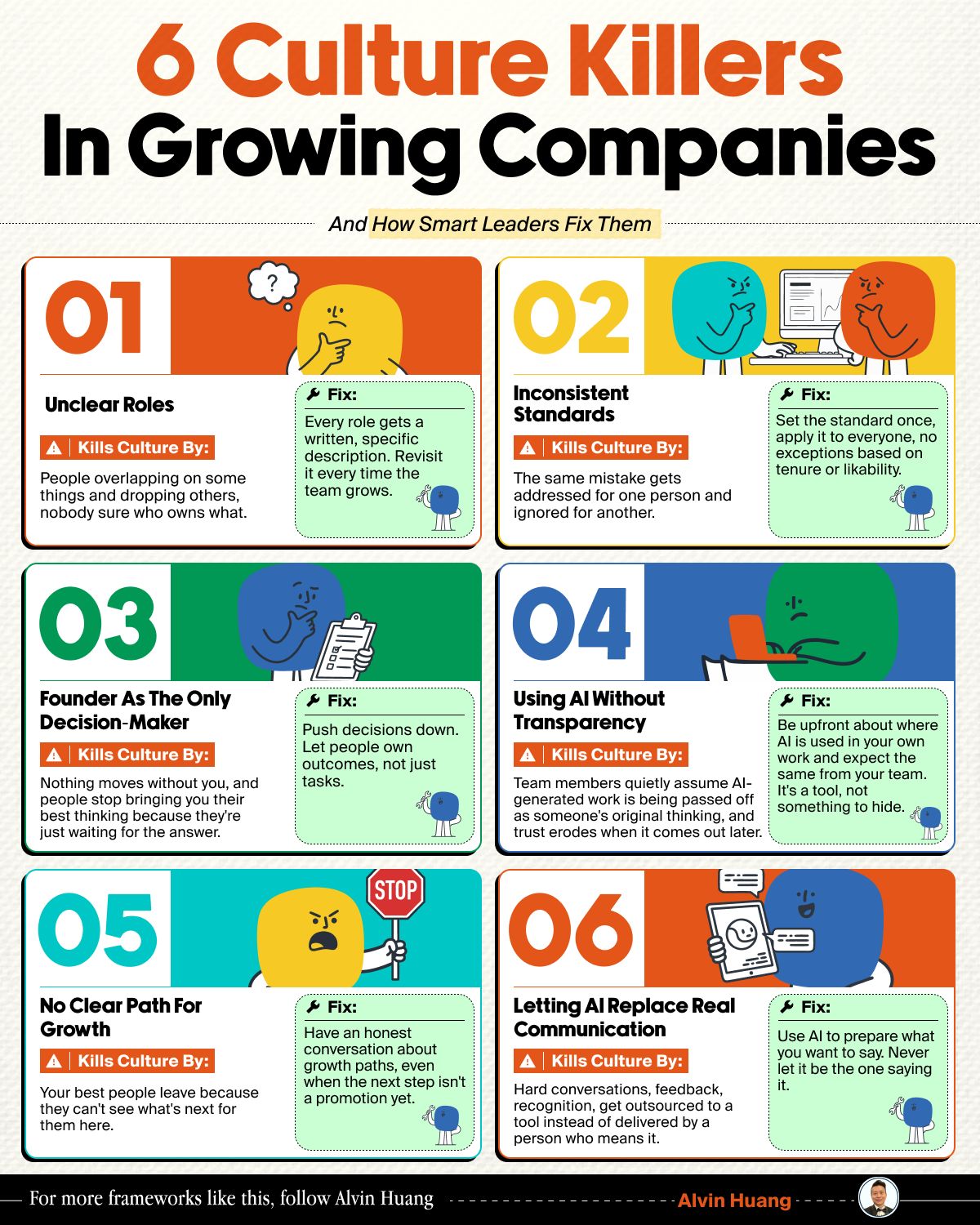
In a recent LinkedIn post, Alvin Huang explores the subtle, often overlooked factors that can lead to the departure of valuable employees, arguing that it’s rarely a single major incident but rather a cumulative effect of unresolved issues.
Huang shares an anecdote about a founder who lost a key team member without understanding why. Upon investigation, they uncovered a pattern of minor, persistent problems that, when combined, created an untenable work environment. As Alvin Huang notes:
“It’s never one bad moment that costs you your best person. It’s these 6 small things you never got around to fixing… Each one was too small to flag on its own. But when stacked together, they were enough to push someone out the door.”
The Cumulative Impact of Unaddressed Issues
Huang identifies six recurring themes he observes among founders, particularly those in the early stages of their company’s growth. He emphasizes that addressing these issues is crucial for retaining top talent and fostering a healthy company culture.
1. Unclear Roles and Responsibilities
One of the primary issues Huang highlights is the lack of clearly defined roles, leading to overlap in some areas and gaps in others. This ambiguity can cause confusion and frustration. Alvin Huang suggests a straightforward fix:
“Give every role a written, specific description, and revisit it every time the team grows.”
This proactive approach ensures accountability and clarity as the team expands.
2. Inconsistent Standards
Another significant problem is the inconsistent application of standards. When mistakes are addressed for some employees but ignored for others, it breeds resentment and a sense of unfairness. Huang argues for impartiality:
“Set the standard once and apply it to everyone, no exceptions for tenure or likability,” Alvin Huang advises.
3. Founder as the Bottleneck for Decisions
Huang points out the common trap of founders becoming the sole decision-makers. This not only slows down progress but also discourages team members from offering their best ideas, as they anticipate their input will be overridden or that decisions will always circle back to the founder. The solution, according to Huang, is delegation:
“Push decisions down. Let people own outcomes, not just tasks.”
4. Lack of Transparency with AI Usage
In the current landscape, the use of AI presents new challenges. Huang cautions against using AI without transparency, as it can erode trust if team members suspect AI-generated work is being passed off as original human effort. He advocates for openness:
“Be upfront about where AI is used in your own work, and expect the same from your team. It’s a tool, not something to hide,” Huang writes.
5. Absence of a Clear Growth Path
The best employees often leave when they cannot see a future for themselves within the company. Huang stresses the importance of proactive career development conversations. He suggests having honest discussions about growth trajectories, even if a promotion isn’t immediately available.
6. AI Replacing Genuine Communication
Finally, Huang warns against allowing AI to substitute for essential human interaction, such as delivering feedback, offering recognition, or handling difficult conversations. He proposes a balanced approach:
“Use AI to prepare what you want to say. Never let it be the one saying it.”
Alvin Huang concludes by noting that implementing these fixes is relatively quick, taking less than an hour each, but the cost of losing a top performer due to neglecting them is far more significant and takes much longer to rectify.
📝 About This Content
This article is based on insights shared by Alvin Huang on LinkedIn.
📅 Originally posted on September 11, 2026 | View original post on LinkedIn →