
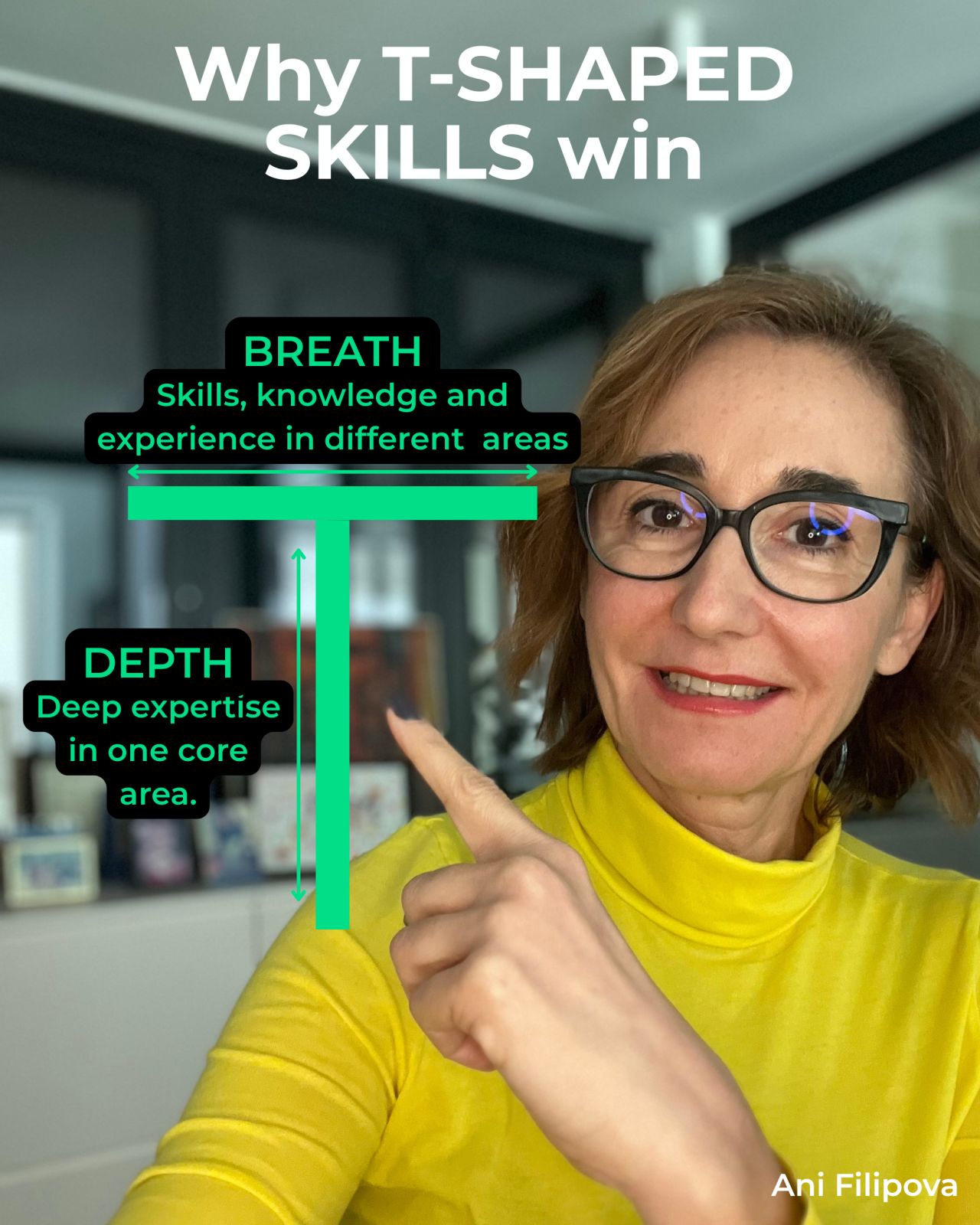
In a recent LinkedIn post, Ani Filipova tackles the often-vague advice given about career relevance, arguing for a more concrete approach: becoming “T-shaped.” Filipova contends that common platitudes like “staying curious” or “embracing change” are insufficient on their own, likening them to generic self-care tips. Instead, she proposes the T-shaped model as a practical framework for professionals at any career stage to avoid obsolescence.
Deconstructing the ‘T-Shape’ Model
Filipova breaks down the T-shaped concept using the visual of the letter ‘T.’ The vertical bar represents deep expertise in a primary area – what an individual is known and trusted for. The horizontal bar signifies breadth, encompassing adjacent skills that are not necessarily mastered but are sufficient to connect ideas, make informed decisions, and create leverage beyond one’s core domain.
To illustrate, Filipova provides examples across various professions:
- A software developer with deep AI expertise and breadth in UX, delivery, and business context.
- A marketing professional strong in campaign strategy, with supporting knowledge in data, psychology, and financial thinking.
- A senior leader whose depth is in decision-making, complemented by an understanding of technology trends, data literacy, and change management.
- A portfolio careerist focused on executive coaching, with breadth in content creation, product development, community building, and public speaking.
According to Filipova, this blend of depth and breadth is crucial for career adaptability. “Specialists struggle when their niche dries up. Generalists struggle to stand out. T-shaped people adapt,” she writes.
Why ‘T-Shaped’ Professionals Excel
Filipova argues that the T-shaped model offers a distinct advantage over pure specialization or broad generalization. Specialists risk becoming obsolete if their niche diminishes, while generalists may find it hard to differentiate themselves. T-shaped individuals, however, can navigate these challenges effectively.
“They go deep when required and zoom out when it matters,” Filipova explains. This adaptability is key, especially in a rapidly evolving professional landscape. She further emphasizes the resilience this model provides:
“And if their depth becomes redundant (which happens more often than people admit), they don’t panic. They pivot from a position of strength.”
Strategies for Cultivating a T-Shape
Filipova outlines practical steps for professionals to develop their T-shape without getting overwhelmed. She advises honesty about one’s core strengths and skill gaps, noting that individuals often fall into the ‘I’ (all depth) or ‘—’ (all breadth) categories, both of which can hinder career progression.
A key recommendation is the application of the 80/20 rule: dedicating 80% of effort to deepening core skills and 20% to building complementary adjacent skills. Filipova highlights the distinct career benefits of each component: “Depth gets you hired and gets you projects. Breadth gets you promoted and paid differently.”
Crucially, Filipova cautions against diluting one’s primary expertise. “Breadth only works if your depth stays sharp,” she warns. Professionals should rebalance their focus to deepen their core skill if it begins to wane, before expanding further.
Future-Proofing Through Adaptability
The core message of Filipova’s post is that true future-proofing comes not from predicting what’s next, but from developing the capacity to adapt to any future.
“You don’t future-proof yourself by predicting the future. You future-proof yourself by becoming someone who can adapt to any future.”
She concludes that a strong T-shape inherently provides this adaptability, positioning professionals to thrive regardless of industry shifts or technological advancements. Filipova also notes her upcoming “Portfolio Career Accelerator” program for those seeking to build such a multifaceted career.
📝 About This Content
This article is based on insights shared by Ani Filipova on LinkedIn.
📅 Originally posted on January 4, 2026 | View original post on LinkedIn →