
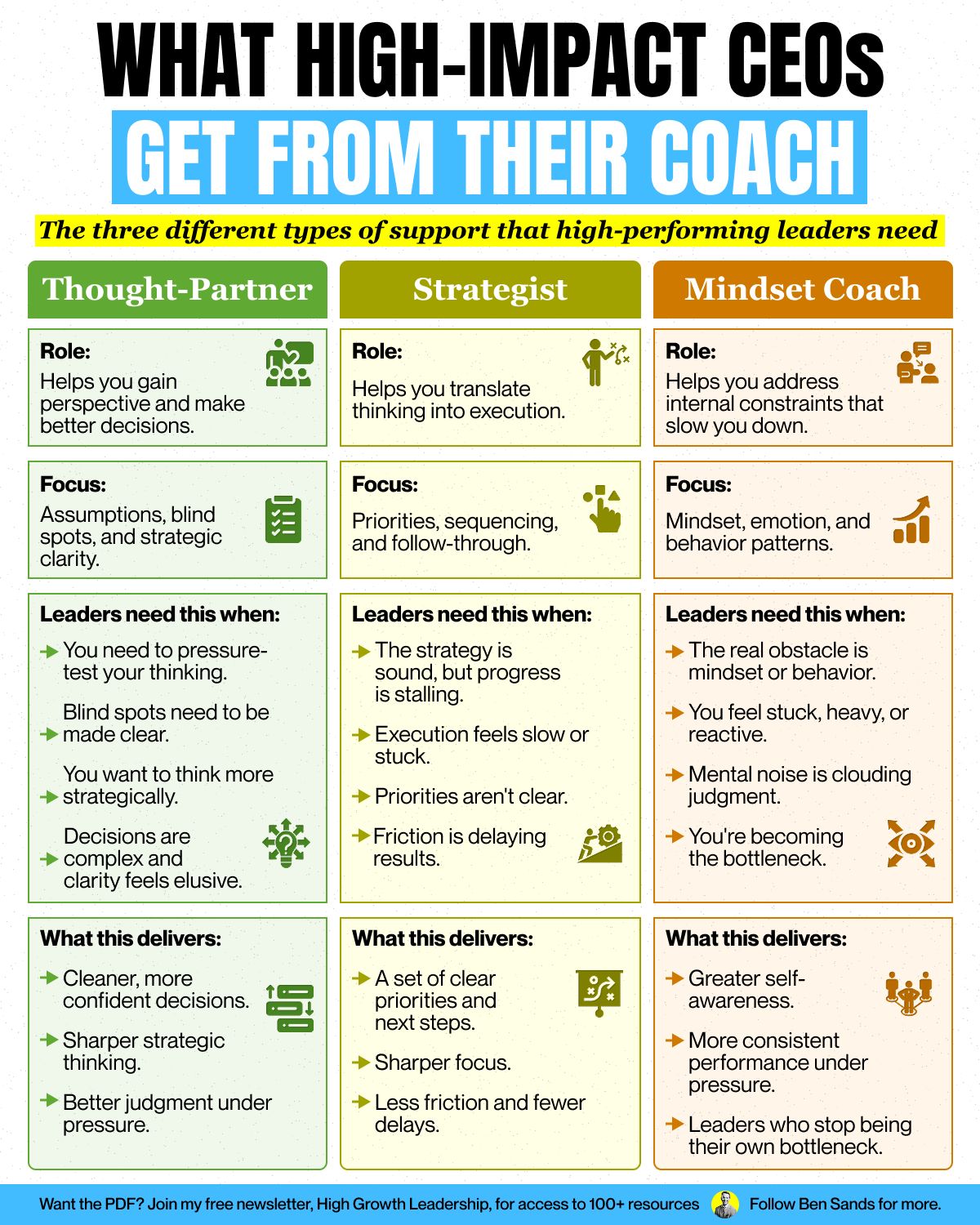
In a recent LinkedIn post, Ben Sands discusses the critical distinction between ineffective and momentum-generating support for business leaders, emphasizing that great CEO coaching is not a one-size-fits-all solution. Sands argues that leaders often don’t need more advice, but rather the precisely tailored support relevant to their current challenges.
He highlights that the wrong kind of help can impede progress, while the right kind fosters movement. As Ben Sands notes:
“Great CEO coaching is never one-size-fits-all. Because leaders rarely need more advice. They need the right kind of support for the problem they’re actually facing.”
Sands outlines three distinct roles he regularly embodies in his work with leaders, each serving a unique function to address different types of leadership hurdles.
Understanding the Three Roles of Leadership Support
Ben Sands identifies that effective support can be categorized into three primary roles: Thought-Partner, Strategist, and Mindset Coach. He explains that recognizing which role is most appropriate for a given situation is key to unlocking progress.
1. The Thought-Partner Role
According to Ben Sands, the Thought-Partner role is crucial when leaders are grappling with complex decisions and struggling to find clarity. This function is primarily about providing perspective.
As Sands details, a strong thought-partner assists leaders by:
- Pressure-testing assumptions
- Identifying blind spots
- Expanding strategic thinking
- Facilitating cleaner, more confident decisions
This collaborative approach helps leaders navigate ambiguity and refine their decision-making processes.
2. The Strategist Role
When a leader’s strategy is fundamentally sound but execution is faltering, Ben Sands steps into the role of a Strategist. This function is focused on driving movement and action.
In this capacity, Sands helps leaders to:
- Clarify priorities and immediate next steps
- Eliminate friction and overcome delays
- Strengthen focus and ensure follow-through
- Effectively convert ideas into tangible actions
Ben Sands points out that this role is about ensuring that well-conceived plans translate into real-world results.
3. The Mindset Coach Role
Sands asserts that when the primary obstacle isn’t strategy or tactics, but rather internal factors like thinking, emotion, or behavior, the Mindset Coach role becomes essential. He emphasizes that many leadership challenges are, at their core, human challenges.
This form of coaching, according to Ben Sands, often helps leaders to achieve:
- Reduced mental noise and distraction
- Greater self-awareness
- Improved decision quality, especially under pressure
- Overcoming personal bottlenecks that hinder progress
He states:
“When the real constraint isn’t strategy or tactics — but thinking, emotion, or behavior.”
This holistic approach addresses the internal landscape that significantly impacts leadership effectiveness.
Diagnosing the Right Support
Ben Sands concludes his post by stressing that many coaching engagements miss their mark not due to a lack of expertise, but because they attempt to solve the wrong problem with the wrong type of assistance. He encourages leaders to critically assess their current situation.
As Sands advises:
“If leadership feels heavier than it should right now… It’s worth asking: “What constraint am I actually dealing with?” And just as important: “What kind of support would move things forward?””
By accurately identifying the core constraint and seeking the appropriate form of support, leaders can overcome obstacles and build momentum, ultimately making their leadership journey more effective and less burdensome.
📝 About This Content
This article is based on insights shared by Ben Sands on LinkedIn.
📅 Originally posted on February 28, 2026 | View original post on LinkedIn →