
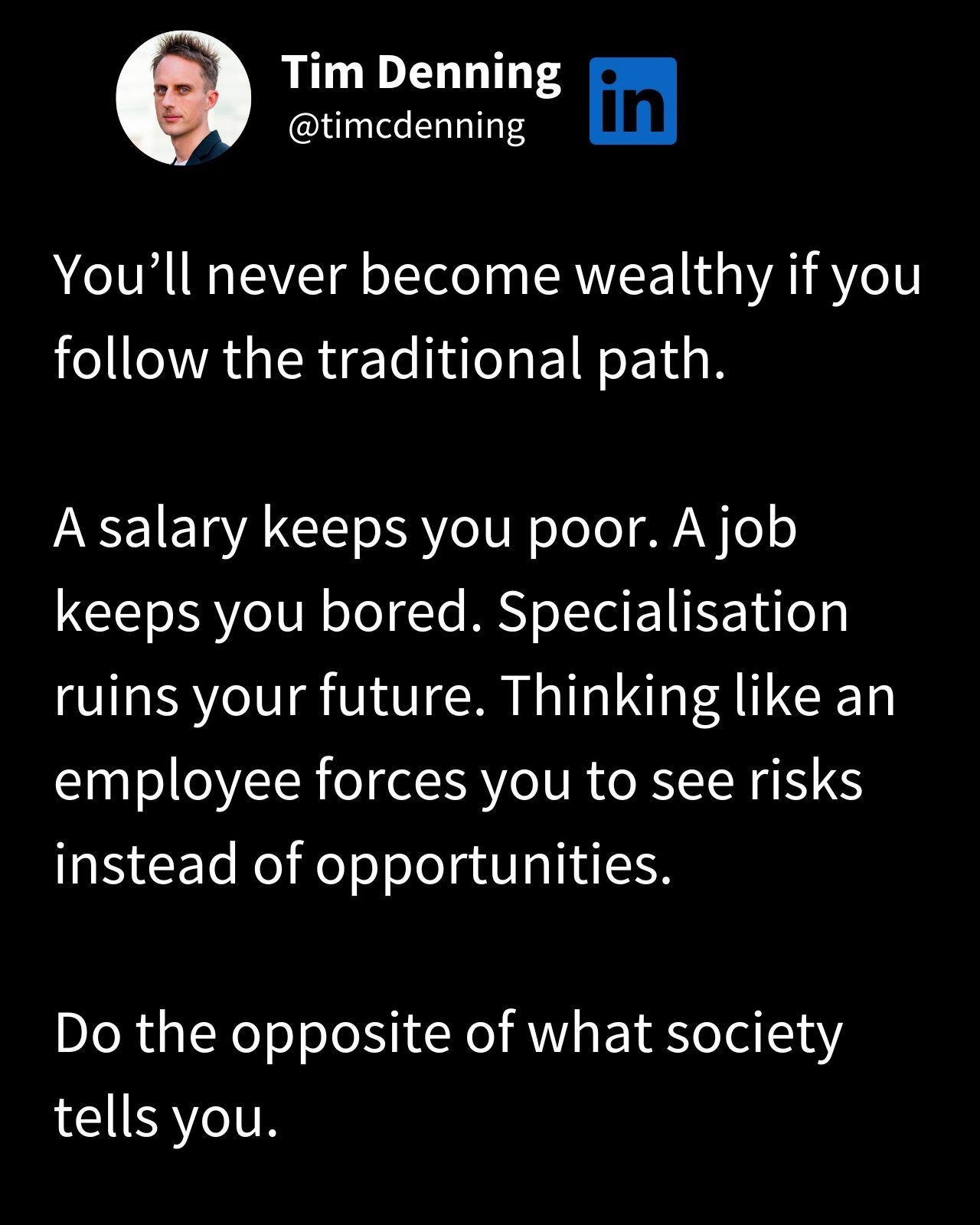
In a recent LinkedIn post, Tim Denning challenges conventional wisdom regarding career progression and wealth accumulation, arguing that the widely accepted ‘traditional path’ is, in fact, a deliberate design to keep individuals comfortable but ultimately unfulfilled and financially stagnant. Denning, a prominent voice on career and finance, asserts that societal expectations often lead individuals down a route that prioritizes security over true wealth creation and personal satisfaction.
Denning recounts his own experience following the prescribed societal script: obtaining a degree, securing a job, and climbing the corporate ladder. This, he states, led him to a state of financial precarity, describing a period where he was “counting coins for groceries broke. Avoiding phone calls from debt collectors broke.” He posits that this outcome is not due to insufficient income but because the salary offered is merely enough to prevent an employee from leaving, effectively commodifying one’s time rather than building ownership.
“A salary keeps you poor. Not because the money is bad. Because it’s just good enough.”
The Illusion of Stability in Employment
A core tenet of Denning’s argument is that employment, while often perceived as stable, fosters a sense of stagnation and lack of fulfillment. He contends that many jobs are designed to keep employees occupied with tasks that lack genuine purpose or impact, leading to exhaustion without meaningful progress. This constant activity, he suggests, is not career building but rather “maintaining someone else’s machine.”
Specialization vs. Adaptability
Furthermore, Denning critiques the emphasis on specialization in career development. He argues that in a rapidly changing world, specialized skills can quickly become obsolete, leaving individuals vulnerable to disruption. In contrast, he champions the adaptability of generalists, stating, “Generalists adapt. Specialists pray.” This perspective suggests that a broader skill set and a willingness to pivot are more valuable long-term assets than deep, narrow expertise.
“Employees trade hours for dollars. Owners trade value for equity.”
Risk Perception and Opportunity
Denning also addresses the differing mindsets between employees and owners regarding risk. He observes that employees tend to focus on potential failures, asking, “What if I fail?” Conversely, owners are more inclined to consider the upside, inquiring, “What if I succeed?” This difference in perspective, according to Denning, leads employees to pursue safety, which he labels the riskiest strategy in the long run, as “safe” jobs and companies can disappear unexpectedly. He concludes that the perceived safety of employment is merely an illusion.
“The path that feels dangerous is often the safest.”
Embracing the Unconventional Path
To counter the pitfalls of the traditional route, Denning advocates for an unconventional approach. He advises individuals to do the opposite of societal norms: diversify instead of specializing, build their own ventures rather than climbing a corporate ladder, embrace calculated risks over minimizing them, and transition from being an employee to becoming an owner. He suggests that the path that appears more challenging or risky is often the one that leads to greater safety and success.
“Stop following the traditional path. It was designed to keep you exactly where you are.”
Tim Denning’s insights, shared on LinkedIn, offer a provocative re-evaluation of common career and financial strategies, encouraging readers to question established norms and consider alternative routes to achieving wealth and fulfillment.
📝 About This Content
This article is based on insights shared by Tim Denning on LinkedIn.
📅 Originally posted on January 30, 2026 | View original post on LinkedIn →