
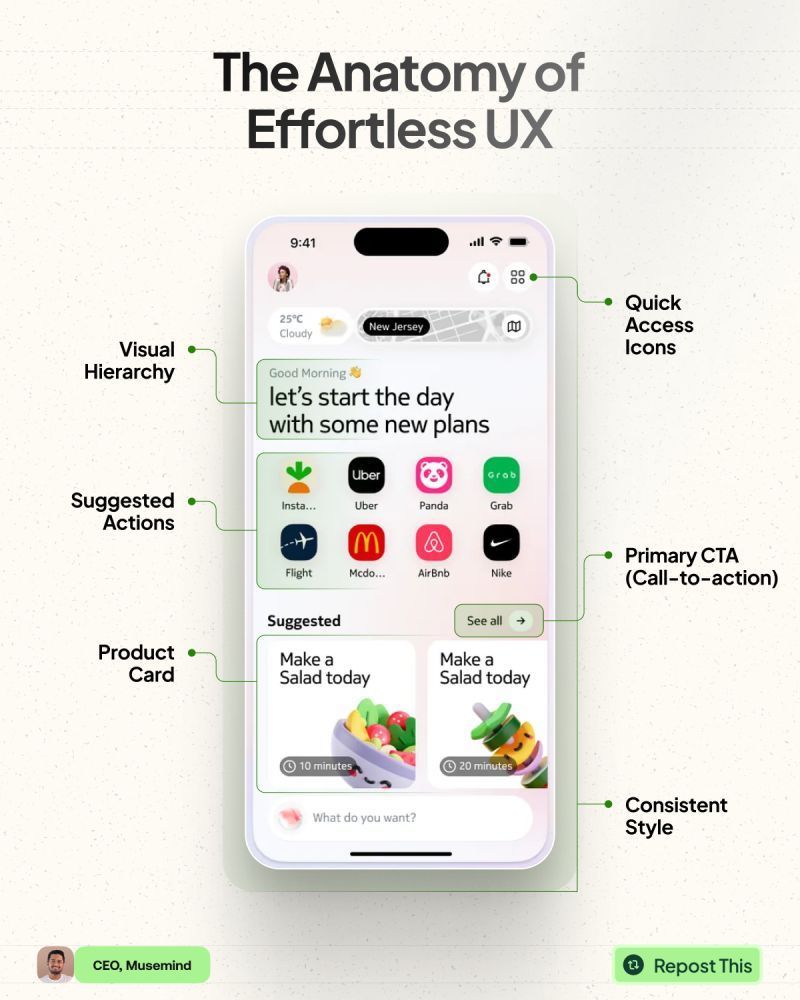
In a recent LinkedIn post, Nasir Uddin challenges common perceptions of user experience (UX) design, asserting that flawed UX is rarely due to external factors like client briefs or tight deadlines. Instead, Uddin argues, the root cause lies in a lack of intentionality from the designers themselves.
Uddin directly confronts the tendency to blame external constraints, stating:
“Everyone blames:
– Client.
– Brief.
– Timeline.But no one blames themselves.”
This provocative statement sets the stage for Uddin’s core argument: that genuine UX design begins long before any visual elements are created, emphasizing empathy and curiosity as the foundational pillars. Uddin suggests that focusing on trendy layouts, complex design systems, or mere aesthetics can distract from the fundamental purpose of design – solving user problems.
The Missing Ingredient: Intentionality in Design
Nasir Uddin contends that the perceived failings in UX are not a matter of insufficient tools or resources, but rather a deficit in deliberate thought and purpose. According to Uddin, the pursuit of an effortless user experience requires a deep-seated intention that permeates every stage of the design process.
He elaborates on this point, noting:
“Bad UX isn’t a lack of tools.
It’s a lack of intention.”
Uddin’s perspective suggests that designers must cultivate a mindset of deep understanding and user-centricity from the outset. This involves actively questioning assumptions, seeking to understand user needs through empathy, and maintaining a curious approach to problem-solving. He posits that superficial design elements, while potentially visually appealing, cannot compensate for a lack of underlying purpose or a failure to address user struggles effectively.
Defining Effortless UX
According to Uddin, the ultimate goal of effective UX design is to create an experience that feels seamless and intuitive to the end-user. He describes this ideal state as:
“Invisible.
Calm.
Natural.”
This feeling of effortlessness, Uddin explains, is the hallmark of truly successful design. His own team’s work, which he refers to as “The Anatomy of Effortless UX,” is built upon this principle. Every design decision, from the choice of colors to the structuring of user flows, is guided by the intent to foster human clarity rather than contributing to visual clutter or cognitive load.
The Story Told by Every Pixel
Nasir Uddin emphasizes that in his team’s approach, the focus is squarely on the user’s journey and their perception of the experience. He states, “Because every pixel tells a story. And that story must feel effortless.” This philosophy underscores the belief that even the smallest design elements should contribute to an overall positive and frictionless interaction. By prioritizing intention and user empathy, designers can move beyond merely creating aesthetically pleasing interfaces to crafting experiences that genuinely resonate with and serve their users.
Uddin invites further discussion, encouraging those who resonate with the idea of effortless UX to share their own challenges. This open call suggests a commitment to collaborative problem-solving and a desire to advance the practice of user experience design through shared insights and experiences.
📝 About This Content
This article is based on insights shared by Nasir Uddin on LinkedIn.
📅 Originally posted on June 28, 2026 | View original post on LinkedIn →