
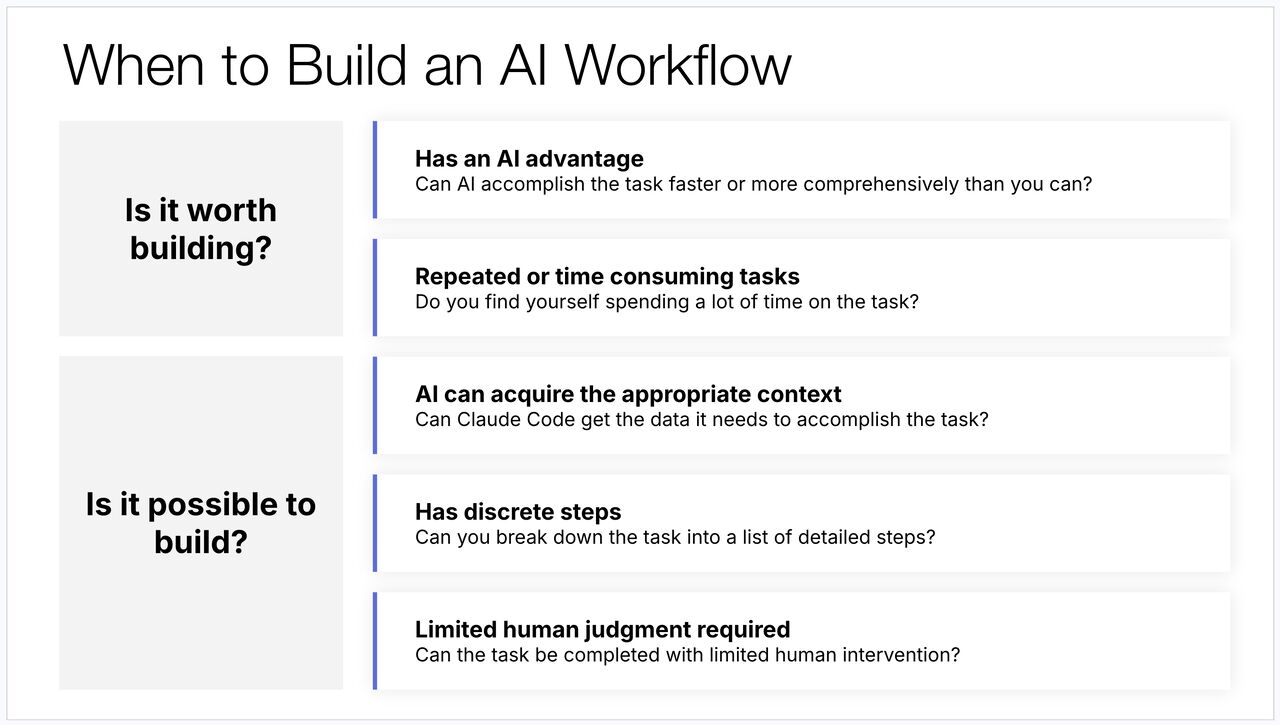
In a recent LinkedIn post, Sachin Rekhi explores a practical framework for determining which workflows are suitable for automation using Artificial Intelligence. Rekhi, a proponent of leveraging AI for productivity, outlines two fundamental questions business leaders should ask before embarking on AI workflow development: “Is it worth building?” and “Is it possible to build?” This journalistic coverage aims to dissect Rekhi’s insights for a business audience.
Assessing the Value Proposition of AI Workflows
Rekhi’s initial focus is on the “worth” of an AI workflow, emphasizing that AI should offer a distinct advantage over human capabilities. The primary benefit, he argues, lies in AI’s ability to perform tasks significantly faster or more comprehensively than humans can. As an example, Rekhi points to the synthesis of customer interviews, a task where AI’s speed and thoroughness provide a clear justification for its use.
“AI is far faster and actually more comprehensive than my own efforts, so it’s a great scenario to leverage it for.”
Beyond unique advantages, Rekhi also highlights the automation of frequently occurring or time-consuming tasks as a strong indicator of value. Offloading such repetitive duties, like weekly status updates, frees up valuable time for individuals to focus on higher-leverage activities. “The ability to offload these tasks to AI becomes a meaningful way to earn time back for higher leverage tasks,” Rekhi states.
Determining the Feasibility of AI Workflow Implementation
Once the value proposition is established, Rekhi shifts to the critical question of feasibility. He identifies several key challenges that must be addressed for an AI workflow to succeed. The foremost hurdle is acquiring the necessary context and data for the AI to operate effectively. Rekhi notes that while various methods exist for data acquisition, such as APIs and local files, significant limitations can still impede workflow success if the AI cannot access the required information.
“If the AI can’t get the data it needs, the workflow will ultimately fail.”
Furthermore, Rekhi stresses the importance of breaking down a workflow into discrete, definable steps. He argues that if the process cannot be clearly articulated by a human, it is unlikely an AI will be able to interpret and execute it. The final prerequisite for a feasible AI workflow, according to Rekhi, is minimizing the need for human intervention. If human judgment remains paramount to the task’s completion, the workflow is unlikely to be successful.
The Role of Human Judgment in AI Workflows
Rekhi’s analysis implicitly underscores the current limitations of AI in tasks requiring nuanced human judgment. While AI excels at speed and data processing, complex decision-making and qualitative assessments often remain in the human domain. “The last thing you want to ensure is that the task can be accomplished with limited human intervention,” he writes, implying that workflows heavily reliant on human oversight are poor candidates for automation.
By presenting these two core questions – worth and possibility – Sachin Rekhi offers a clear and actionable heuristic for professionals looking to strategically implement AI automation. His insights guide businesses toward identifying opportunities where AI can genuinely enhance productivity without overstepping its current capabilities.
📝 About This Content
This article is based on insights shared by Sachin Rekhi on LinkedIn.
📅 Originally posted on March 31, 2026 | View original post on LinkedIn →