
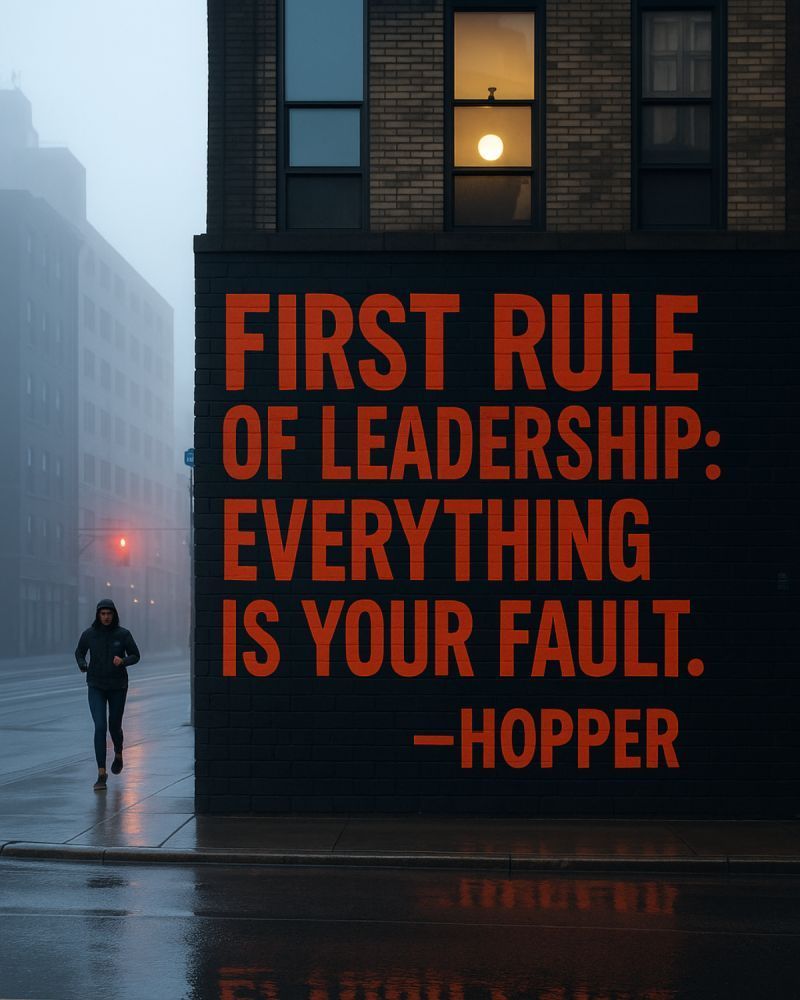
In a recent LinkedIn post, Kobi Omenaka delves into a foundational, albeit often challenging, principle of effective leadership: the idea that ultimate responsibility rests with the leader. Omenaka frames this not as a burden to be shirked, but as the very essence of the role, urging leaders to embrace accountability as a core tenet of their practice.
Omenaka begins by stating the ‘First rule of leadership: Everything is your fault.’ This assertion immediately sets a tone of unflinching honesty, challenging conventional notions of leadership that might seek to deflect blame. The post elaborates on this by detailing specific scenarios where this principle applies, from dips in team morale to missed deadlines and miscommunicated messages.
“When morale dips, it’s on you. When the deadline’s missed, it’s on you. When the message lands wrong, even if you didn’t write it… It’s still on you.”
This stark declaration, as Omenaka points out, is not about unfairness but about the inherent nature of leadership. The leader’s role, according to Omenaka, involves carrying the weight of these challenges so that the team can operate more effectively and with greater focus. This means accepting blame proactively, even before acknowledging successes.
The Leader’s Burden: Responsibility Over Image
Omenaka contrasts this proactive accountability with behaviors that undermine leadership. The post explicitly rejects ‘hiding behind the team when performance drops,’ ‘passing the buck when things go sideways,’ and ‘waiting to be praised when things work.’ These actions, in Omenaka’s view, are antithetical to true leadership, which prioritizes the well-being and success of the team over the leader’s personal image.
“Because leadership isn’t about protecting your image. It’s about protecting your people.”
This sentiment underscores a critical distinction Omenaka makes: leadership is fundamentally about service and protection, not self-preservation or ego. The leader’s primary function is to shield their team from undue criticism and to foster an environment where they can thrive, even in the face of adversity.
Embracing the ‘Dirty Work’ of Leadership
The post further emphasizes that effective leaders are not those who maintain a pristine facade, but those willing to engage in the difficult, often unglamorous, aspects of management. Omenaka argues that true leadership involves stepping into the fray, taking the hits, and demonstrating resilience by continuing to lead and problem-solve the next day.
“The best leaders aren’t the ones who look clean. They’re the ones willing to get dirty, take the hit, and still show up the next day.”
This willingness to ‘get dirty’ is presented as a hallmark of strong leadership. It signifies a commitment to the team and the mission that transcends personal comfort or the desire for accolades. According to Omenaka, this is the essence of ownership – not just claiming victories, but steadfastly owning the challenges.
Actionable Takeaways for Leaders
Omenaka concludes the post with a direct call to action, reiterating the core message: ‘Everything is your fault. Own it. Grow from it. And lead like it’s all yours to fix.’ This encourages leaders to view every situation as an opportunity for growth and improvement, driven by their ultimate responsibility.
The post, which also includes a playful nod to a film for bonus points and a promotional link to a free podcast guesting course, clearly aims to provoke thought and encourage a higher standard of leadership accountability within the business community. Kobi Omenaka’s insights serve as a potent reminder that the path of leadership is paved with responsibility, demanding a commitment that goes beyond mere management to genuine ownership and protection of one’s team.
📝 About This Content
This article is based on insights shared by Kobi Omenaka on LinkedIn.
📅 Originally posted on February 10, 2026 | View original post on LinkedIn →