
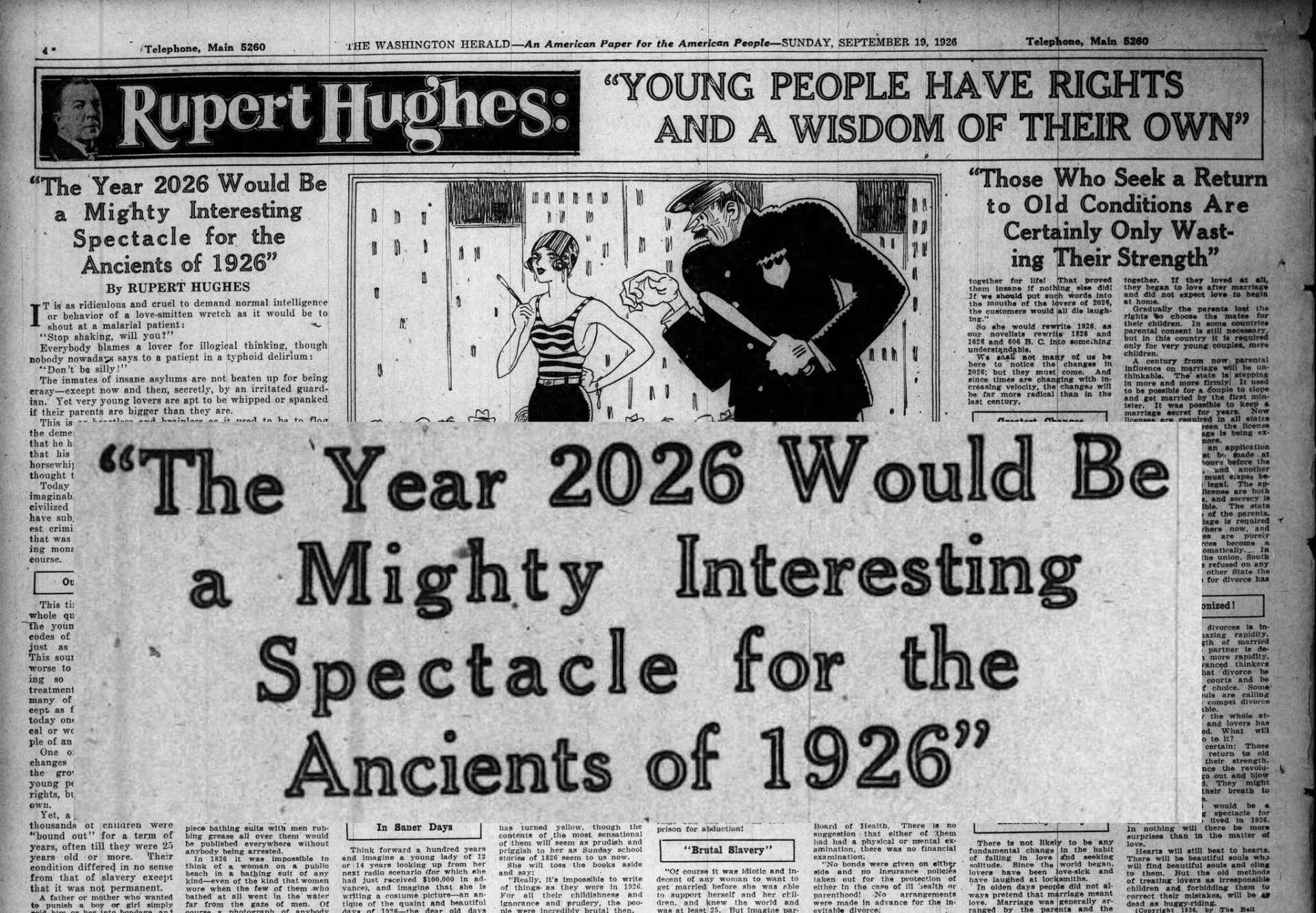
In a recent LinkedIn post, Jason Feifer delves into the fascinating, and often inaccurate, predictions made about life in 2026 by people in 1926. Feifer, an entrepreneur and founder of the Entrepreneur’s Enigma newsletter, uses historical forecasts to illustrate the inherent difficulty in anticipating future developments.
Historical Predictions and Their Misses
Feifer meticulously reviewed numerous articles from 1926 that attempted to foresee our current reality. He highlights several key predictions that diverged significantly from actual outcomes. For instance, he notes the 1926 projection that the Earth’s population would peak at 5 billion, a figure far below the current 8.3 billion. Another striking miss was the prediction that all food would be manufactured in factories, leading to the disappearance of beef.
“They said we’d make all food in factories and beef would disappear.”
The forecasts also extended to transportation and energy. Feifer points out that the visionaries of 1926 anticipated that all travel would be conducted via airplanes, rendering cities obsolete due to the ease of movement. They also foresaw a complete shift to solar energy, with oil becoming a relic of the past.
Social and Personal Life Predictions
Beyond technological and environmental forecasts, the 1926 predictions also touched upon societal norms and personal lives. Feifer shares that these articles suggested people would universally live past 100, with 75 being considered young. Socially, they predicted a casual approach to marriage and divorce, likening them to easily terminable business contracts.
“They said marriage and divorce will all be casual — more like a business contract you can enter and exit.”
Feifer observes that while some predictions held a kernel of truth, many were significantly off the mark. This mixed bag of accuracy, as he points out, underscores a fundamental truth about forecasting.
The Impossibility of Certainty and the Path Forward
Central to Feifer’s analysis is the assertion that predicting the future with certainty is an impossible task. He argues that too many variables are in play, and progress rarely follows a linear path. Innovations that once seemed unimaginable become commonplace, while other expected developments fail to materialize.
“That’s because it’s truly impossible to predict what comes next — in our lifetime, or the next. Too many factors change. Progress is not linear.”
According to Feifer, the key takeaway from these historical predictions is not to become fixated on what we *think* will happen. Instead, he advocates for a mindset of openness and adaptability.
Embracing the Unknown
Feifer encourages readers to view the unknown not as a source of anxiety, but as an opportunity. He suggests that rather than trying to anticipate every future event, individuals and businesses should focus on proactive building, rapid reaction, and embracing the unexpected.
“Your job isn’t to anticipate everything. It’s to proactively build the future, react fast, and view the unknown as an opportunity.”
In essence, Jason Feifer’s post serves as a compelling reminder that while we can plan and strategize, the future will invariably surprise us. His insights suggest that the most effective approach is to cultivate resilience, agility, and a forward-looking perspective, ready to adapt to whatever unfolds.
📝 About This Content
This article is based on insights shared by Jason Feifer on LinkedIn.
📅 Originally posted on January 2, 2026 | View original post on LinkedIn →