
In a recent LinkedIn post, 🌀 Luca Rossi explores a critical, often overlooked, dimension of engineering management: navigating change. While the immediate responsibilities of an Engineering Manager (EM) typically fall into two clear categories—execution and people management—Rossi argues that a third, more subtle, yet fundamental aspect is managing transitions, whether they involve new processes, organizational shifts, or product reorientations.
The Hidden Dimension of Change Management
Rossi posits that at its core, the EM role is about guiding both people and execution through periods of change. This perspective reframes many traditional EM responsibilities. As 🌀 Luca Rossi notes:
Everything else – technical acumen, business insight, stakeholder engagement – ultimately boils down to how you embrace or hold back change in both your team’s work and mindset.
This highlights that even technical prowess or strategic understanding serves the ultimate goal of facilitating adaptation within a team and its work. Rossi suggests that an EM’s effectiveness is intrinsically linked to their ability to foster an environment that can successfully navigate shifts.
Mapping Engineering Manager Archetypes
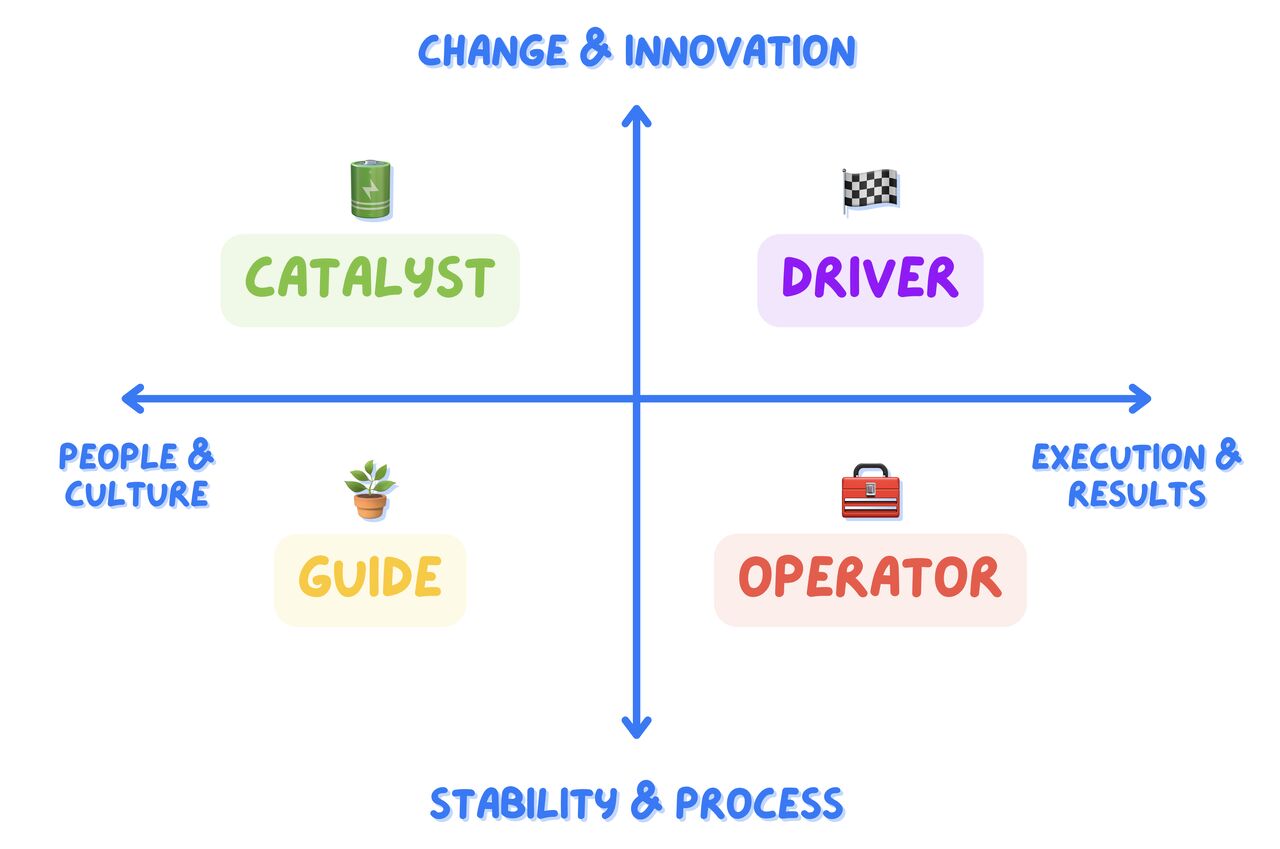
Building on this understanding of change as a central theme, 🌀 Luca Rossi introduces a framework for understanding different EM approaches. By plotting managers along two axes—how they handle stability versus change, and whether they prioritize execution versus people—Rossi maps four classical leadership archetypes, adapted for the engineering management context. This 2×2 matrix provides a clear visual for diverse management styles.
The Four Archetypes Defined
According to Rossi, these archetypes represent distinct strategies for balancing the core responsibilities of management with the imperative of navigating change:
- Operator (Stability + Execution): This archetype focuses on predictability and operational control, emphasizing robust plans and minimal surprises.
- Guide (Stability + People): Prioritizing team culture and nurturing talent, this manager acts as a mentor, focusing on relationships and psychological safety.
- Driver (Change + Execution): Embracing velocity and ambition, this manager thrives on delivering new features and driving technical or product transformation rapidly.
- Catalyst (Change + People): This archetype excels at inspiring teams through storytelling and cultural shifts, guiding them to embrace new directions and adapt to evolving priorities.
🌀 Luca Rossi explains the Driver archetype’s focus on transformation:
Embodying velocity, ambition, and technical or product transformation. These managers thrive on pushing the envelope, delivering new features or bold initiatives quickly.
Similarly, the Catalyst is described as focusing on inspiration and adaptation:
Focuses on storytelling, cultural shifts, and strategic influence. Catalysts excel at inspiring teams to embrace new directions and adapt to evolving org priorities.
Rossi’s analysis suggests that understanding these archetypes can help engineering leaders better recognize their own tendencies and those of their peers, ultimately leading to more effective management of both people and projects through the inevitable changes inherent in the tech industry.
📝 About This Content
This article is based on insights shared by 🌀 Luca Rossi on LinkedIn.
📅 Originally posted on September 14, 2026 | View original post on LinkedIn →