
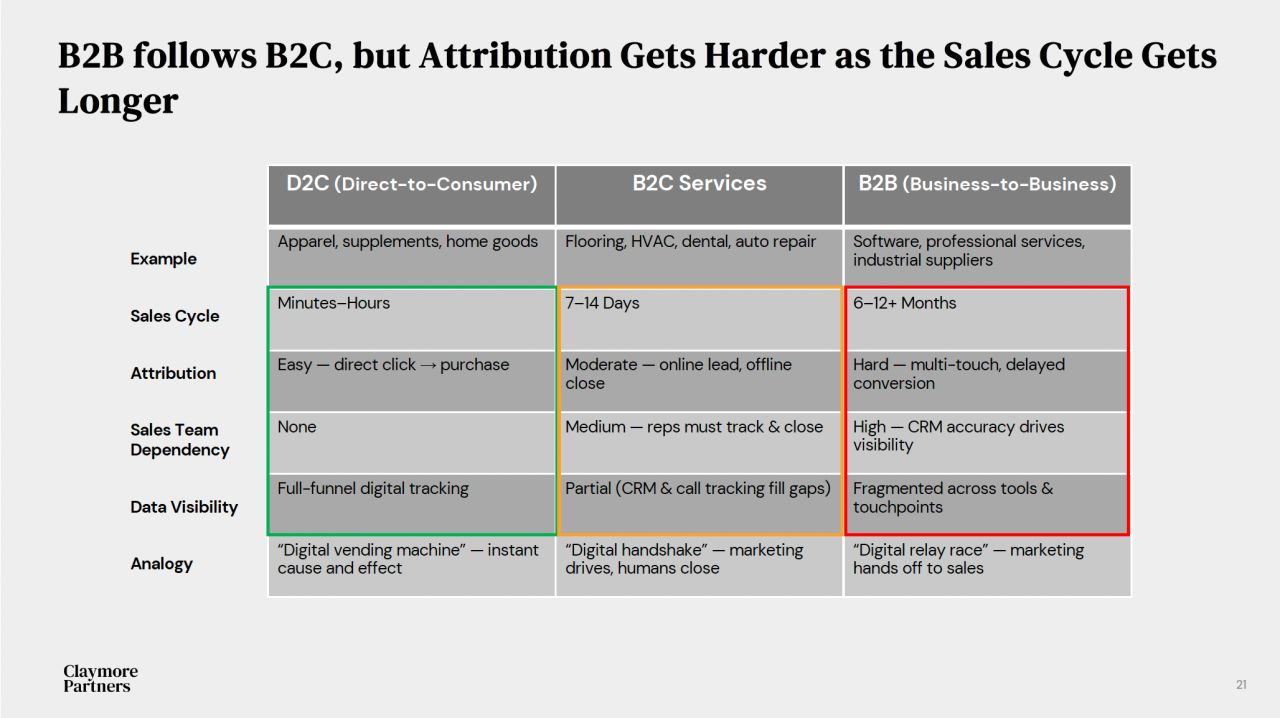
In a recent LinkedIn post, Lee McCabe discusses the significant, yet often overlooked, digital opportunities within the B2B sector. While much attention is given to AI and digital transformation, McCabe argues that many B2B companies are still operating with outdated marketing strategies.
McCabe highlights a common pitfall where strategies effective in direct-to-consumer (D2C) or business-to-consumer (B2C) markets fail when applied to B2B’s longer sales cycles. He points out the ensuing issues:
B2B is where the digital upside still hides in plain sight. […] The playbook that works in D2C or B2C collapses the moment your sales cycle stretches beyond a quarter. Attribution breaks. CRMs get messy. And every marketing meeting ends with: “Did this actually drive revenue?”
The post details how, despite substantial investments in marketing technology (MarTech), many businesses struggle with basic lead tracking. McCabe observes companies with extensive tech stacks from providers like HubSpot, Marketo, and Salesforce, alongside multiple analytics platforms, yet they still resort to managing leads in spreadsheets and lack clear insights into what’s effective.
The “Plumbing” Problem in B2B Digital Marketing
McCabe posits that the challenge isn’t a lack of digital capability but rather a failure to establish the foundational infrastructure, or “plumbing,” necessary for effective digital marketing in B2B environments. He explains that the complexity of B2B deals, which can span 6-12 months and involve numerous stakeholders, obscures clear cause-and-effect relationships in data.
This data ambiguity, as McCabe points out, leads to a reliance on anecdotal evidence rather than concrete insights and presentations that resemble wishful thinking more than actionable dashboards.
Every B2B deal I see has the same blind spot: no one can prove marketing ROI.
He identifies the inability to prove marketing return on investment (ROI) as a pervasive blind spot in the B2B landscape.
The Path to Full-Funnel Visibility
Despite these challenges, McCabe offers a hopeful outlook, asserting that these issues are solvable with current technology. He notes that the necessary tools for achieving full-funnel visibility are readily available.
Leveraging Existing Technology
McCabe lists several key technologies that can bridge the gap:
- CRM integrations
- Call tracking solutions
- Lead attribution tools
- Marketing automation platforms
- Real-time reporting systems
According to McCabe, the critical missing element is not technology itself, but leadership that embraces a data-driven culture.
The Crucial Role of Sales Leadership
McCabe emphasizes that the transformation hinges on a specific leadership role: the sales leader. He argues that effective sales leaders are instrumental in fostering a culture of discipline and data integrity.
Because every bit of this hinges on one role……the sales leader. The kind who builds a culture of discipline and data. Who enforces CRM hygiene, demands follow-up consistency, and treats attribution like financial reporting.
These leaders, as McCabe describes, enforce rigorous CRM hygiene, ensure consistent follow-up processes, and treat marketing attribution with the same seriousness as financial reporting. This approach, he suggests, is the key to unlocking significant B2B growth.
Ultimately, McCabe concludes that when marketing and sales departments align around a unified source of truth, the B2B growth engine can achieve results comparable to B2C, but with the added advantage of higher value transactions and greater accountability.
📝 About This Content
This article is based on insights shared by Lee McCabe on LinkedIn.
📅 Originally posted on November 26, 2025 | View original post on LinkedIn →