
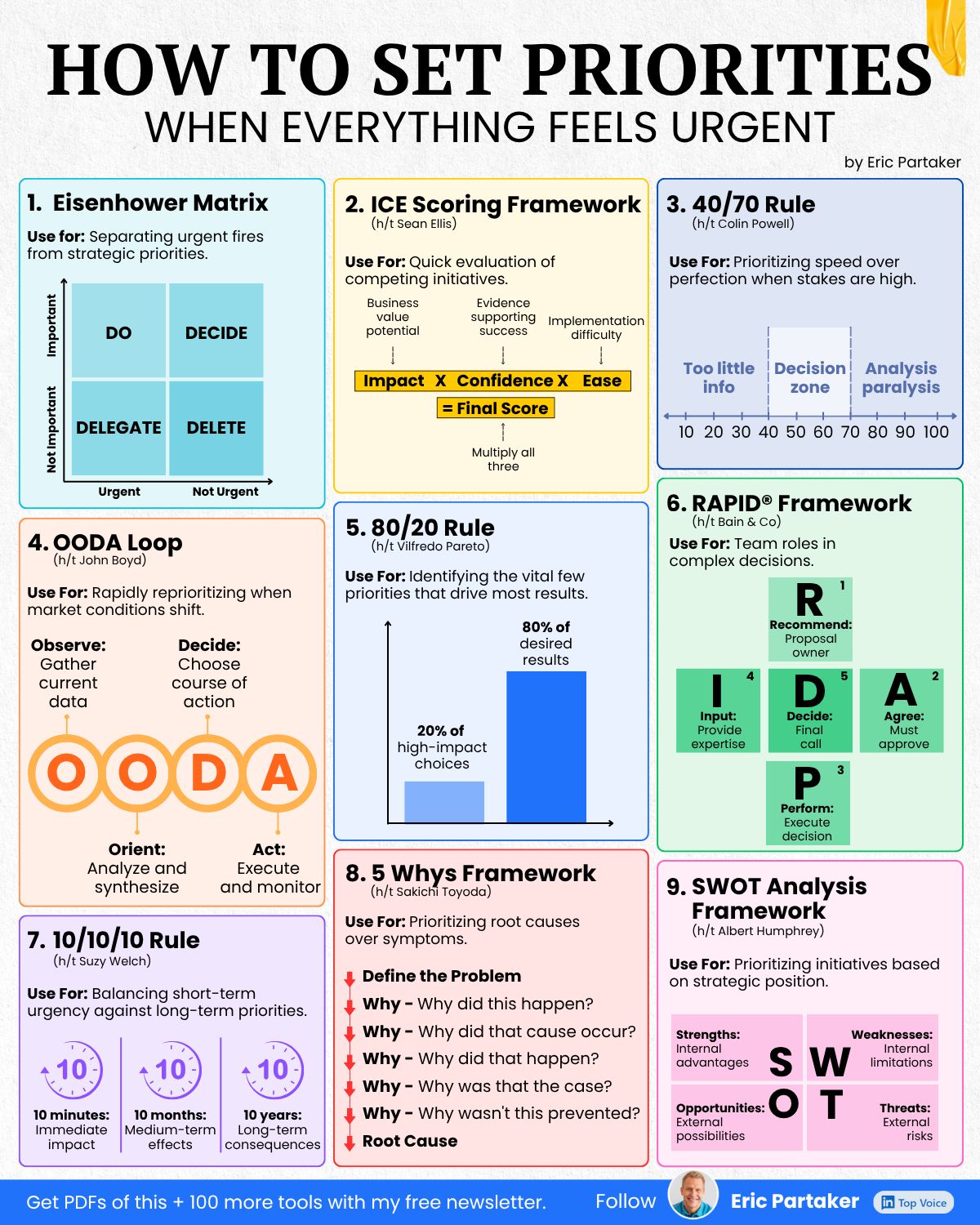
In a recent LinkedIn post, Eric Partaker tackles a common challenge faced by many chief executives: the paradox of increasing success leading to an overwhelming sense of urgency. Partaker highlights how the demands on a CEO’s time multiply with growth, creating a constant barrage of seemingly critical tasks.
He states:
“Every CEO I know struggles with the same paradox. The more successful you become, the more everything feels urgent.”
Partaker argues that in such high-pressure environments, relying on gut instinct is insufficient. Instead, he advocates for the use of structured frameworks to navigate the deluge of demands. “A framework forces you to think, not just react,” Partaker explains, emphasizing that under stress, our natural inclination is to respond to whatever is most vociferous, not necessarily what is most important.
Dissecting the “Urgency Paradox”
The core of Partaker’s message revolves around differentiating between tasks that are genuinely important and those that merely appear urgent. He points out that the constant clamor for attention from various business functions—hiring, board meetings, customer issues, investor relations, product launches, and strategic initiatives—can blur the lines of true priority.
According to Partaker, this is where established prioritization methodologies become invaluable. He specifically references the Eisenhower Matrix as a powerful tool for CEOs:
“Most ‘urgent’ tasks aren’t actually important. They’re just noise dressed up as necessity.”
This simple 2×2 grid, Partaker suggests, helps leaders to critically assess where their time is being allocated and identify activities that consume energy without contributing significantly to overarching business goals.
Leveraging Frameworks for Effective Decision-Making
Beyond the Eisenhower Matrix, Partaker also touches upon other potent principles. The 80/20 rule (Pareto principle) is mentioned for its stark clarity in revealing how a disproportionate amount of output often stems from a small fraction of input. Similarly, he introduces the 40/70 rule, a concept that encourages action when a sufficient, though not perfect, amount of information is available.
Partaker underscores the importance of having pre-defined decision-making processes in place, particularly when faced with high-stakes situations. He posits:
“In the heat of battle, you need pre-made decisions about how you’ll decide.”
This proactive approach, Partaker believes, is crucial for maintaining strategic focus and preventing the paralysis that can arise when every demand feels equally pressing. His central thesis is a powerful reminder: “When everything feels urgent, nothing is.”
Partaker’s insights offer a practical roadmap for leaders seeking to regain control of their schedules and ensure their efforts are aligned with their most critical objectives, rather than being swept away by the tide of constant, but often superficial, urgency.
📝 About This Content
This article is based on insights shared by Eric Partaker on LinkedIn.
📅 Originally posted on April 16, 2026 | View original post on LinkedIn →