
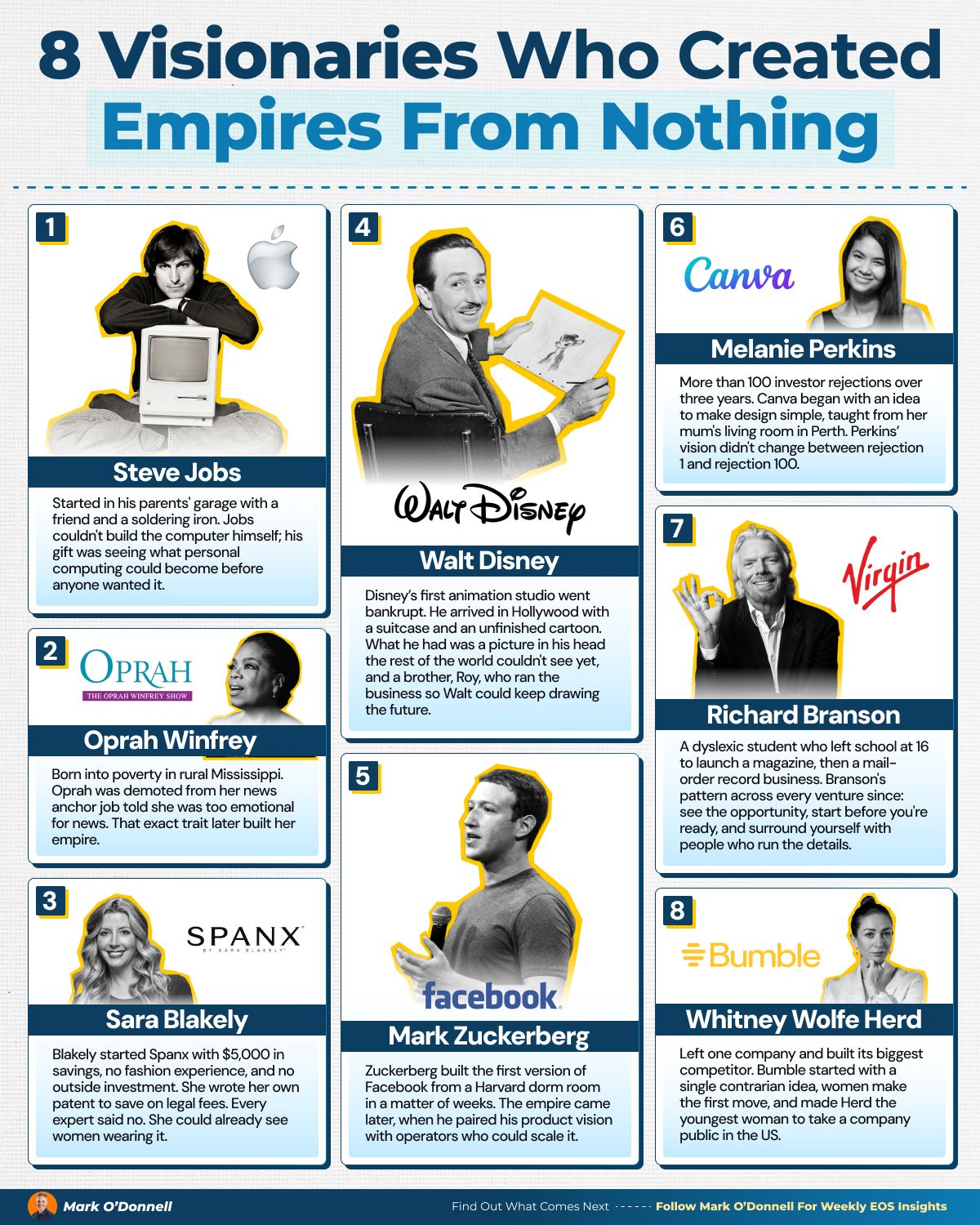
In a recent LinkedIn post, Mark O’Donnell explores the foundational role of the “Visionary” in entrepreneurship, highlighting how great ideas, even those started with “nothing but a clear picture in their head,” require a complementary “Integrator” role to achieve significant scale.
O’Donnell emphasizes that while the initial spark of innovation often comes from a singular vision, the execution and growth are rarely solitary efforts. He introduces the concept of the Visionary and Integrator seats as defined in the Entrepreneurial Operating System (EOS), suggesting that the pairing of these distinct leadership functions is crucial for turning ambitious ideas into successful businesses.
“None of them scaled it on their own. In EOS, Visionary is an actual seat with defined responsibilities. Big ideas, big relationships, culture, creative problem-solving, and seeing what doesn’t exist yet. These eight lived in that seat.”
The post then delves into the journeys of eight prominent founders, illustrating this dynamic. O’Donnell points out that figures like Steve Jobs, despite his unparalleled vision for personal computing, relied on others to build the machines. Similarly, Walt Disney, who arrived in Hollywood with limited resources, had a brother, Roy, who managed the business operations, allowing Walt to focus on creative output.
The Power of a Clear Vision
Mark O’Donnell argues that the common thread among these successful entrepreneurs is the clarity of their initial vision. This vision, he explains, was so potent that it could guide others even in the absence of immediate resources or established infrastructure.
O’Donnell highlights Sara Blakely’s journey with Spanx, noting her perseverance despite a lack of industry experience and investor backing. According to O’Donnell, Blakely’s ability to “already picture it working” was key, even when “Every expert waved her off.”
“The vision was identical at rejection 100 and rejection 1.”
This sentiment is echoed in the story of Melanie Perkins and Canva. O’Donnell shares that Perkins faced over 100 investor rejections, yet her vision for the design platform remained unwavering, demonstrating the resilience required to pursue a groundbreaking idea.
From Vision to Execution: The Integrator’s Role
A central theme in O’Donnell’s analysis is the necessity of the “Integrator” role to complement the Visionary. He asserts that the greatest ideas need practical implementation and operational expertise to scale.
Richard Branson, for instance, is presented as someone who consistently “spot[s] the opening, start[s] before you’re ready, [and] bring[s] in people to run the details.” This approach, O’Donnell suggests, exemplifies the Visionary who understands the need for operational partners.
“There’s an important thread here: the vision started each company, and then the pairing scaled it.”
Mark O’Donnell further elaborates on this synergy, stating, “In EOS terms, every Visionary needs an Integrator to turn ideas into execution. When those two seats click, you get Rocket Fuel.” This analogy underscores the explosive growth potential when vision and execution are harmoniously aligned.
Identifying Your Leadership Seat
Concluding his post, O’Donnell prompts readers to consider their own roles within their ventures, asking, “Which seat is you: Visionary, Integrator, or honestly both at once?” This question encourages self-reflection on leadership styles and the potential need for complementary partners.
The article serves as a compelling reminder that while a visionary idea can launch a business, it is the effective pairing of that vision with strong operational execution—the Integrator—that ultimately drives lasting success and significant market impact.
📝 About This Content
This article is based on insights shared by Mark O'Donnell on LinkedIn.
📅 Originally posted on July 16, 2026 | View original post on LinkedIn →