
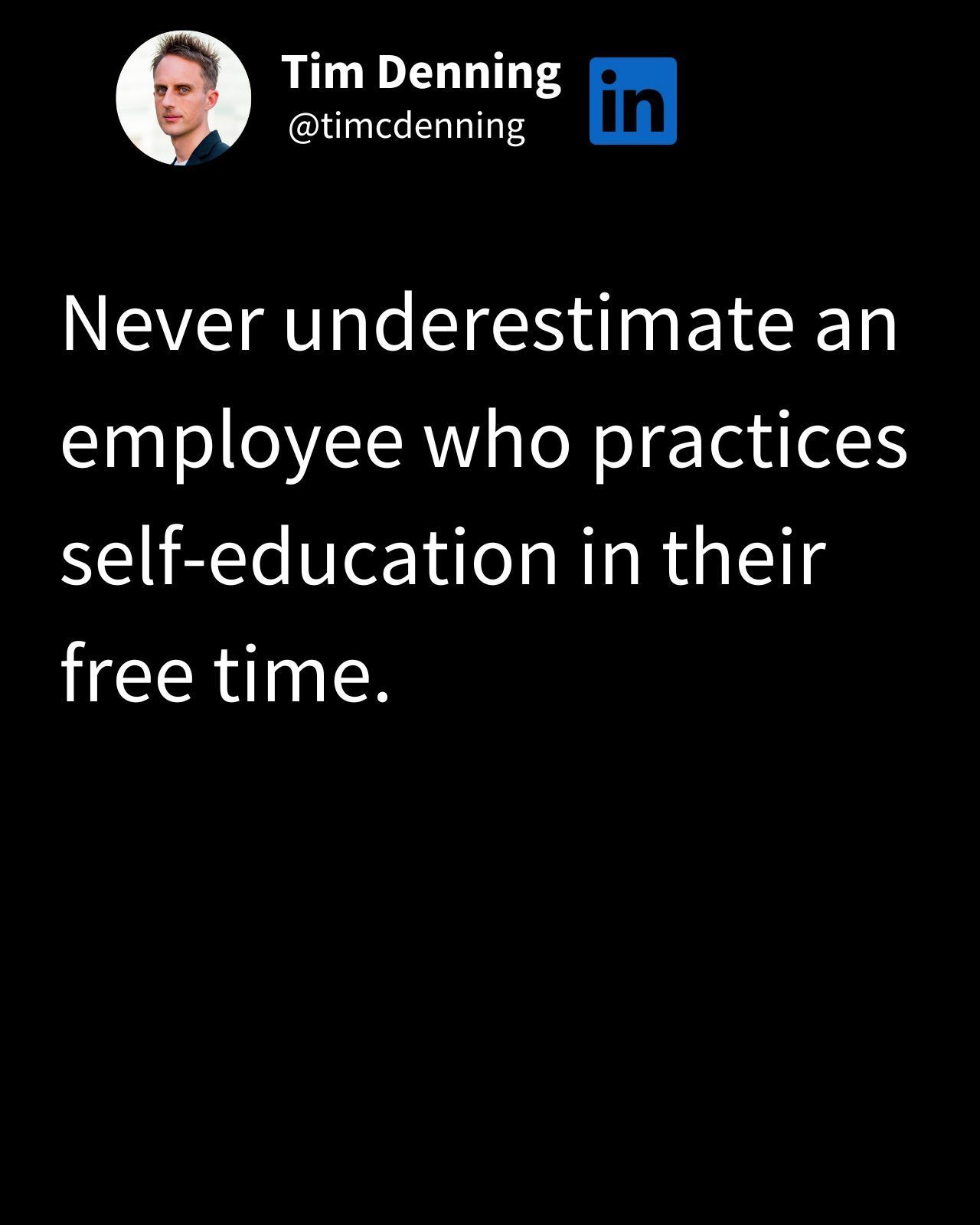
In a recent LinkedIn post, Tim Denning discusses the critical difference between merely completing formal education and embracing a lifelong commitment to self-directed learning for professional growth. Denning argues that many individuals, after obtaining a degree and entering the workforce, tend to cease their educational pursuits, a path he contrasts with that of accomplished individuals who integrate learning into their daily routines.
Denning shares a personal anecdote from his early career in finance, where he initially found his role uninspiring. A pivotal moment occurred when his supervisor introduced him to the concept of learning from experts outside his immediate field, providing him with books and suggesting conferences. This guidance, Denning explains, significantly accelerated his professional development.
“Most individuals get a degree, enter the workplace, then cease learning.
Accomplished individuals turn after-work education into a routine. They enjoy learning and challenging themselves.”
The Transformative Power of Self-Education
The insights shared by Denning highlight a common pitfall in professional development: stagnation after formal schooling. He emphasizes that true advancement often comes from actively seeking knowledge and challenging oneself beyond the confines of a job description or industry norms. According to Denning, this proactive approach to learning is not just beneficial but essential for long-term career success and personal evolution.
Denning recounts how following his supervisor’s advice led him to attend a Tony Robbins seminar, an experience he describes as mind-altering. This event, he suggests, was instrumental in overcoming psychological struggles and fundamentally shifted his perspective on the nature of education itself.
“It transformed my mind. I was permanently changed. It assisted me in recovering from psychological struggles. Education isn’t a single-time event.”
Leveraging Self-Education for Career Advancement
Denning strongly advocates for the strategic use of self-education as a tool to enhance one’s profession and increase personal value in the marketplace. He points out that by continuously acquiring new skills, insights, and perspectives, professionals can differentiate themselves and open doors to new opportunities.
Challenging the Status Quo
The core message from Denning’s post is a call to action for professionals to move beyond passive learning. He argues that the modern professional landscape demands adaptability and a willingness to continuously evolve. This can be achieved through various means, including reading widely, attending workshops, seeking mentorship, and engaging with thought leaders online.
“Utilize self-education to enhance your profession and boost your worth.”
By framing education as an ongoing process rather than a finite stage, Tim Denning encourages readers to take ownership of their learning journey. His post serves as a potent reminder that the most significant professional growth often happens outside the traditional classroom, driven by curiosity and a persistent desire to improve.
📝 About This Content
This article is based on insights shared by Tim Denning on LinkedIn.
📅 Originally posted on January 3, 2026 | View original post on LinkedIn →