
The rapid advancement of AI language models like ChatGPT, Claude, and CoPilot has ushered in a new era of information access and content generation. However, a critical question remains largely unanswered: how consistent are these powerful tools when presented with the exact same prompts? Understanding this variability is crucial for businesses and individuals relying on AI for research, content creation, and decision-making.
Rand Fishkin, a prominent figure in the marketing and SEO community, recently highlighted a significant gap in our understanding of AI model behavior. He observed that while these tools are increasingly sophisticated, there’s a distinct lack of empirical data quantifying the diversity of responses they produce for identical queries. This absence of data is not just a minor inconvenience; it’s a frustration that hinders a full appreciation of AI’s reliability and predictability.
The Need for Empirical Data on AI Response Variability
The core of the issue lies in the inherent nature of large language models (LLMs). These models are trained on vast datasets and employ complex algorithms that can lead to probabilistic outputs. This means that even with the same input, the specific sequence of tokens generated can differ, resulting in varied answers. While this can sometimes lead to more creative or nuanced responses, it also raises concerns about consistency, especially in professional contexts where accuracy and uniformity are paramount.
Fishkin points out that this lack of concrete data is particularly vexing. Without knowing how many different answers users can expect for a single question, it’s difficult to set realistic expectations or develop strategies to mitigate potential inconsistencies. Are we looking at minor phrasing differences, or entirely divergent information?
A Call to Action: Crowdsourcing AI Consistency Data
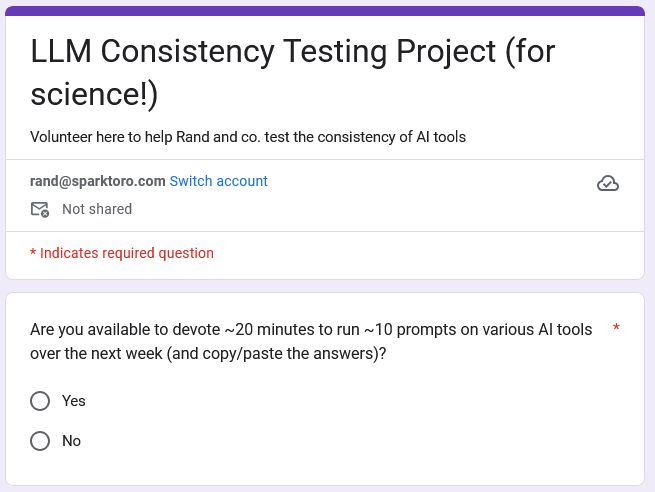
To address this critical data void, Rand Fishkin is spearheading a community-driven initiative. Recognizing that the available data is insufficient, he’s inviting individuals to contribute their time and insights to a collaborative research effort. The goal is straightforward yet ambitious: to systematically collect and analyze the responses from leading AI models.
How You Can Contribute
The project requires participants to dedicate approximately 20 minutes over the course of the next week. The task involves:
- Entering sample prompts into various AI tools (ChatGPT, Claude, CoPilot).
- Copying and pasting the generated responses into a designated survey.
This crowdsourced data will be invaluable. Fishkin, along with his engineer friend Scott H., who has volunteered to assist with the technical aspects, plans to aggregate, visualize, and publish the findings. This collective effort aims to provide the business and tech communities with much-needed clarity on AI response variability.
Why This Research Matters
The implications of this research are far-reaching:
- For Businesses: Understanding AI consistency can inform strategies for using AI in customer service, content generation, market research, and internal knowledge management. It helps in assessing the risks and benefits associated with AI integration.
- For Developers: The data can provide valuable feedback for improving the predictability and reliability of future AI model iterations.
- For Users: It empowers individuals to better understand the tools they are using, leading to more informed interactions and a more accurate assessment of the information received.
By pooling our resources and time, we can collectively shed light on a crucial aspect of AI technology, moving beyond anecdotal evidence to data-backed insights. This initiative by Rand Fishkin is a testament to the power of community collaboration in advancing our understanding of emerging technologies.
📝 About This Content
This article is based on insights shared by Rand Fishkin on LinkedIn.
📅 Originally posted on October 17, 2025 | View original post on LinkedIn →