
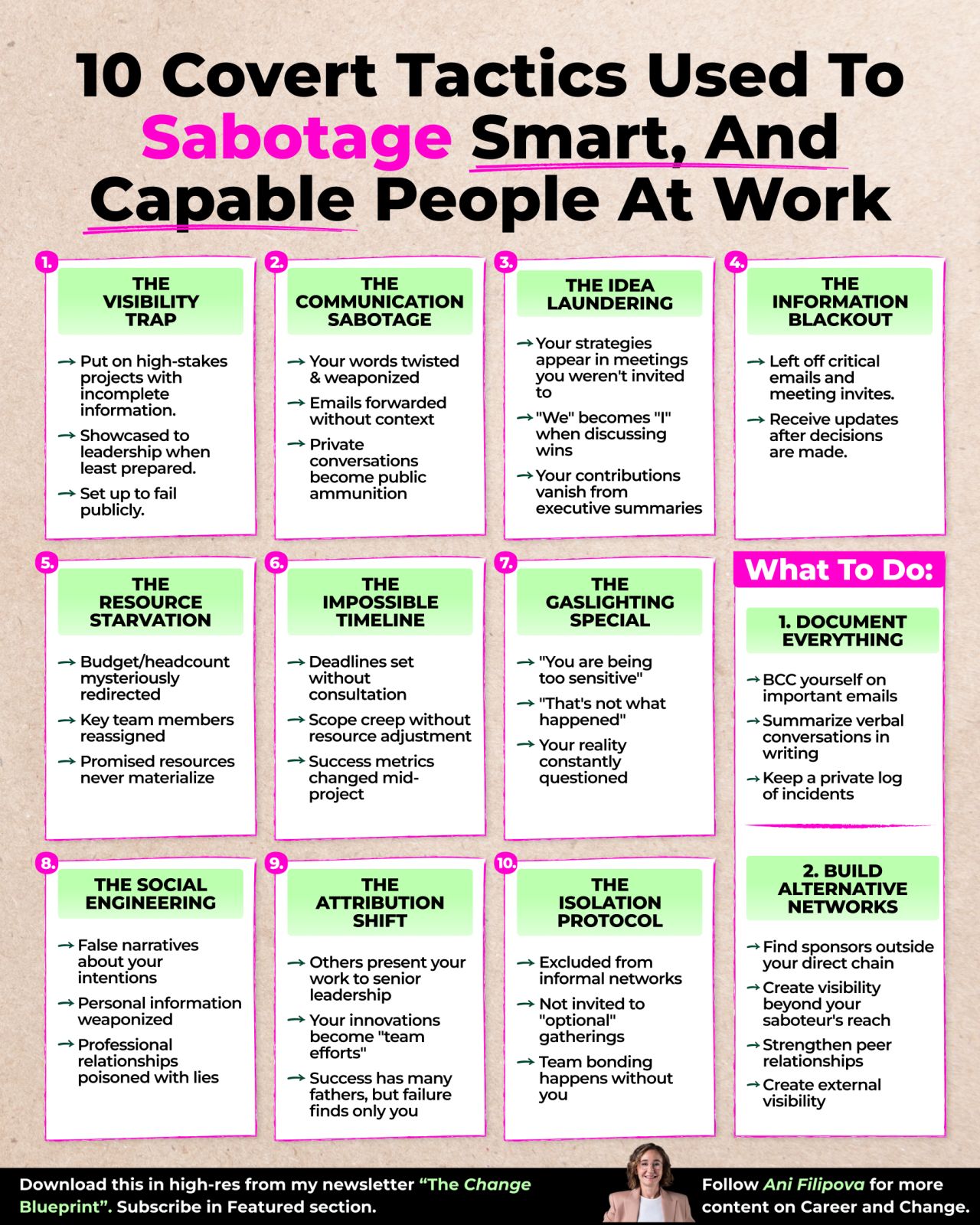
In a recent LinkedIn post, Ani Filipova delves into the insidious nature of workplace sabotage, highlighting how it is often perpetrated by individuals who appear supportive.
Filipova argues that these saboteurs mask their intentions with smiles and seemingly helpful gestures, making them difficult to identify. She writes:
“The people most committed to your failure often wear the warmest smiles. The saboteur appears helpful. They are ‘concerned’ about you. They want to ‘mentor’ you. They are ‘protecting’ you from failure.”
According to Filipova, this deceptive approach can lead targets to question their own competence and become overly grateful for minimal recognition. She outlines several tactics employed by these individuals, including the visibility trap, communication sabotage, idea laundering, and information blackouts.
The Subtle Tactics of Sabotage
Filipova details a comprehensive list of ten tactics used by workplace saboteurs. These range from subtle manipulations like the ‘visibility trap,’ where an individual’s contributions are downplayed or hidden, to more overt actions such as ‘resource starvation’ and ‘information blackouts.’ She emphasizes that recognizing these patterns is crucial for self-preservation.
Filipova notes the psychological impact of these tactics:
“Because of all this: → You question your own competence → You work harder to prove yourself → You become grateful for crumbs → You apologize for existing”
The post further explores the concept of internalized sabotage, where individuals begin to adopt the saboteur’s tactics themselves, often by silencing their own voices before external pressure mounts.
Strategies for Protection and Resilience
To combat these undermining behaviors, Filipova proposes actionable strategies focused on documentation, building support networks, and trusting one’s instincts.
Creating a Paper Trail
Filipova advises creating a ‘paper trail’ as a primary defense mechanism. This includes BCC’ing oneself on important emails, summarizing verbal conversations in writing, and maintaining a private log of incidents with dates. As Filipova points out, this documentation serves as objective evidence and can be vital in confronting or mitigating the effects of sabotage.
Building External Support
Another key recommendation is to ‘build your escape routes.’ This involves finding sponsors or mentors outside of the immediate reporting line and strengthening peer relationships across different departments. Filipova suggests that increasing visibility beyond the reach of a potential saboteur can create crucial leverage and alternative pathways for recognition and support.
Trusting Your Instincts
Filipova also stresses the importance of overcoming self-gaslighting. She encourages readers to trust their gut feelings, stating, “That feeling something’s off? It is usually correct.” By validating their instincts and avoiding the tendency to explain away red flags, individuals can more effectively identify and respond to undermining behaviors.
The Root Cause: Fear, Not Hate
Filipova concludes by addressing the underlying motivation behind sabotage, suggesting it stems from fear rather than malice. She posits that saboteurs often act out of a fear that another person’s success might diminish their own standing or perceived value.
The post ends with a call to action, urging readers to identify which sabotage tactics might be affecting them and to share the corresponding number. Filipova also promotes her ‘Portfolio Career Accelerator’ as a means for individuals to proactively build career resilience.
📝 About This Content
This article is based on insights shared by Ani Filipova on LinkedIn.
📅 Originally posted on November 25, 2025 | View original post on LinkedIn →