
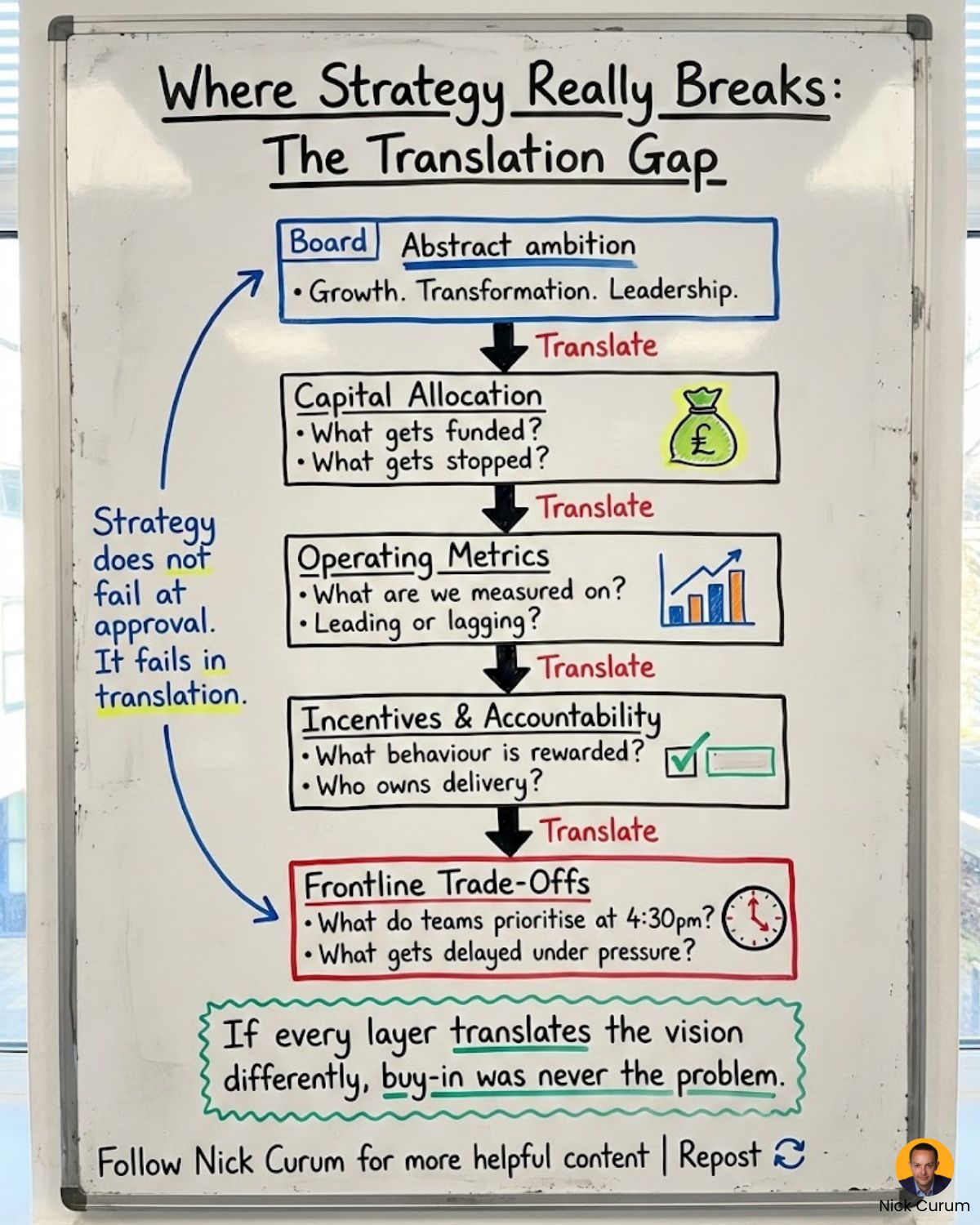
In a recent LinkedIn post, Nick Curum explores a critical organizational challenge he terms ‘Translation Drift,’ arguing that it is the primary reason many corporate strategies fail to materialize. Curum posits that the issue lies not with leadership or initial planning, but in the subsequent layers of an organization where the approved strategy gets diluted or misinterpreted.
Curum highlights the common misconception that strategy failure stems from a lack of buy-in. Instead, he asserts that the true culprit is the compounding gap between what a board approves and what is actually implemented on the ground. He states:
“The quiet, compounding gap between what the board approved and what actually runs the organisation.”
This ‘Translation Drift,’ as Curum defines it, occurs across four distinct layers within an organization. He meticulously breaks down how strategic intent can be lost at each stage, leading to a disconnect between strategic goals and operational reality.
The Four Layers of Translation Drift
Curum’s analysis identifies specific points where a strategy can falter. He argues that these are not indicators of weak leadership or poor planning, but systemic translation failures.
Capital Allocation
The first point of divergence, according to Curum, is in capital allocation. Finance departments may fund initiatives that reflect a slightly different vision than what was initially approved by the board. This subtle shift in financial priorities can steer the organization away from its intended strategic path.
Operating Metrics
Following capital allocation, Curum points to operating metrics as another critical area where translation breaks down. He notes that operational teams often measure progress using metrics that do not accurately reflect the core strategic objectives. This can lead to teams optimizing for the wrong outcomes.
“Operating Metrics — ops measures something else entirely”
Incentives
Curum further argues that existing incentive structures can perpetuate the problem. Even if a new strategy is introduced, old behaviours may continue to be rewarded, creating a disincentive to adopt and execute the new strategic direction. As Curum puts it:
“Incentives — yesterday’s behaviour still gets rewarded”
Frontline Trade-Offs
Perhaps the most impactful layer, in Curum’s view, is the daily decision-making at the frontline. When faced with competing priorities or immediate pressures, teams may inadvertently choose short-term survival or operational expediency over the long-term strategic goals. Curum vividly describes this as:
“Frontline Trade-Offs — teams choose survival over strategy at 4:30pm”
A Diagnostic Test for Translation Drift
To help leaders identify if their organization is suffering from Translation Drift, Curum proposes a straightforward diagnostic test. He advises leaders to examine four key areas:
- Where did the budget actually move? (Capital Allocation)
- What behavior is being measured? (Operating Metrics)
- What behavior gets rewarded? (Incentives)
- What gets dropped at 4:30 PM? (Frontline Trade-Offs)
Curum challenges leaders with a pointed question: “Would I correctly guess your strategy from those four answers alone?” If the answer is no, he contends that Translation Drift is undermining the organization’s strategy, emphasizing that strategic decisions are ultimately driven by budgets and daily behaviors, not just slide decks.
Curum’s insights offer a valuable framework for executives to diagnose and address the often-unseen forces that can derail even the best-laid strategic plans.
📝 About This Content
This article is based on insights shared by Nick Curum on LinkedIn.
📅 Originally posted on February 21, 2026 | View original post on LinkedIn →