
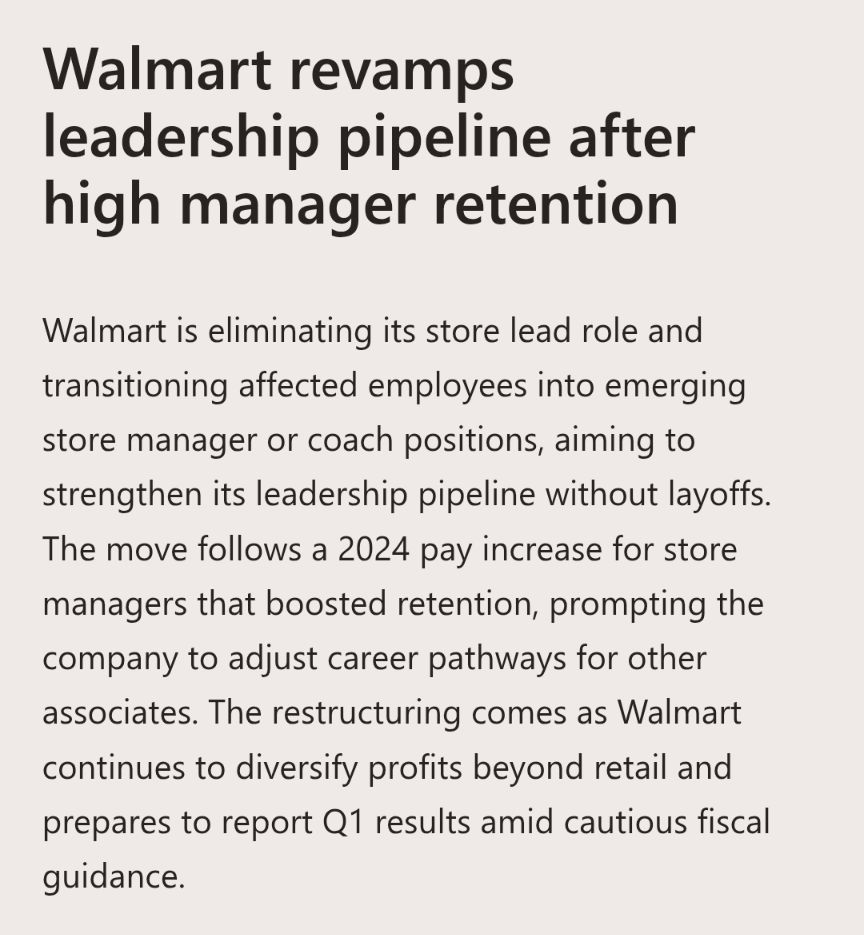
In a recent LinkedIn post, Ben Eubanks highlights an unexpected consequence of Walmart’s successful efforts to improve retention among its store leaders. Rather than simply celebrating the reduced turnover, Eubanks points out that this success has created a new set of operational challenges, forcing the retail giant to rethink its leadership development strategies.
Eubanks notes that Walmart’s initiative to boost retention, which included offering significant financial incentives, has led to managers staying in their roles longer than anticipated. This has, in turn, resulted in fewer openings at higher leadership levels.
“Managers are staying in their roles longer than expected.”
As Ben Eubanks explains, many organizations view retention as the ultimate goal, focusing solely on preventing employees from leaving. However, he argues that strong retention can lead to a cascade of secondary issues.
The Second-Order Effects of Strong Retention
Ben Eubanks breaks down these subsequent challenges, which include:
- Reduced promotion opportunities
- Leadership bottlenecks
- Blocked internal mobility
- Frustrated high-potential employees
- Slowdowns in succession planning
He humorously references the concept of ‘#talenthoarding’ as a potential, albeit unintended, outcome of this success. Eubanks emphasizes that Walmart’s approach to this situation is particularly noteworthy because they are treating their leadership structure not as a static organizational chart, but as a dynamic talent system that requires continuous regeneration.
Success creates a new constraint. And Walmart’s response matters because they aren’t treating leadership like a static org chart. They’re treating it like a talent system that has to continuously regenerate itself.
Rethinking Leadership Pipelines: From Ladders to Farm Systems
According to Ben Eubanks, this mindset shift is crucial, especially as artificial intelligence continues to reshape the workplace. He contrasts traditional leadership development models with a more progressive approach.
The Traditional ‘Ladder’ Model
Eubanks describes the conventional method as a ‘ladder,’ where there is a single opening at each rung, and individuals must wait for their turn to advance. This approach, he suggests, is becoming increasingly outdated.
The ‘Farm System’ Approach
In contrast, Eubanks advocates for a ‘farm system’ model, drawing parallels to professional sports. This involves:
- Providing more developmental opportunities.
- Encouraging rotational exposure across different roles.
- Building greater bench strength within the organization.
- Creating multiple pathways for growth before a top role becomes available.
He references the insights from Dr. Linda Reese’s book, ‘The Myth of Fit,’ suggesting that the common explanation for leaders failing in their initial year—a lack of ‘fit’—often overlooks the organization’s responsibility to provide adequate support and onboarding.
There’s also a broader lesson here for frontline employers. Walmart appears to be reframing these Frontline leader roles as high-impact business leadership positions worth real investment.
Elevating Frontline Leadership
Ben Eubanks also points out a broader implication for frontline employers. He observes that Walmart seems to be elevating frontline leadership roles, recognizing them as significant business leadership positions that warrant substantial investment. This strategic reframing, as Eubanks highlights, yields several positive outcomes:
- Improved retention rates
- Enhanced operational consistency
- Stabilized customer experiences
- Increased internal mobility
- Expanded leadership tenure
Ultimately, Eubanks concludes his analysis by posing a critical question that organizations must consider: “Eventually, the question stops being: ‘How do we keep managers?’ And becomes: ‘How do we keep developing people when managers stop leaving?’” This reframing, according to Eubanks, signifies a more mature and sustainable approach to talent management.
📝 About This Content
This article is based on insights shared by Ben Eubanks on LinkedIn.
📅 Originally posted on May 10, 2026 | View original post on LinkedIn →