
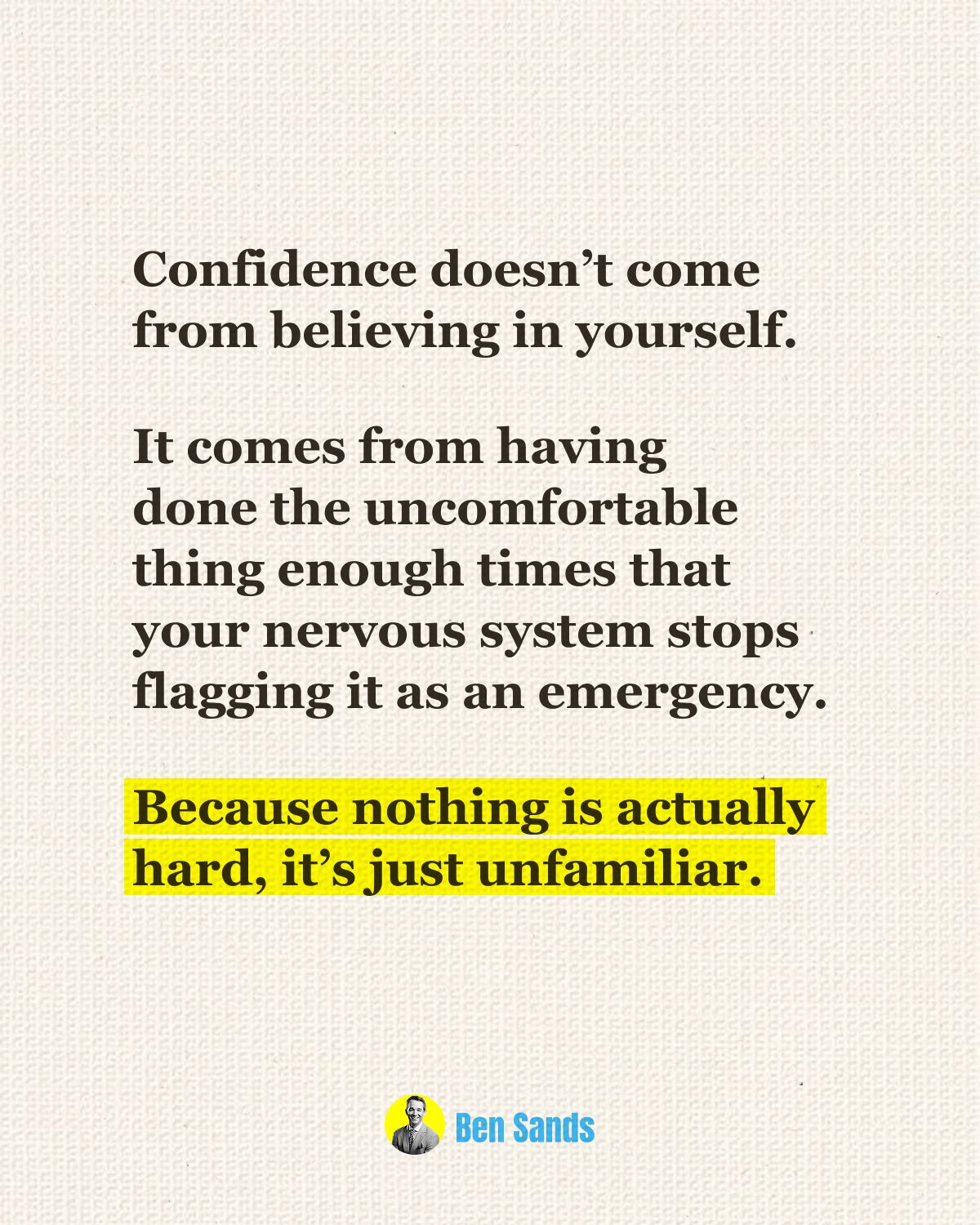
In a recent LinkedIn post, Ben Sands tackles a common misconception among leaders: the belief that confidence is a prerequisite for action. Instead, Sands argues that confidence is an outcome of consistent action and exposure to unfamiliar situations, rather than a feeling that must be present before taking a step.
Sands begins by challenging the notion that CEOs or leaders lack confidence, suggesting the real deficit is in practice. He posits that leaders often delay critical actions, such as difficult conversations or feedback, because their brains perceive these tasks as “hard” – a label Sands reframes as merely “unfamiliar.” This unfamiliarity triggers a protective response, leading to avoidance.
“You can’t think your way to higher confidence. You need to act.”
The core of Sands’s argument is a reframing of perceived difficulty. He contends that what feels “hard” is typically just “new,” and that “new” only becomes “normal” through repeated exposure. This process, he explains, is how confidence is genuinely built.
The Cycle of Avoidance and the Path to Confidence
Sands outlines how the fear of the unfamiliar can lead leaders to avoid necessary actions. This might manifest as delaying conversations, softening feedback, or sticking to known territories, not due to a lack of capability, but as a self-protective mechanism. He emphasizes that this is a systemic response, not a character flaw.
Breaking the Pattern of “Hard”
To overcome this, Sands proposes a shift in perspective and a series of actionable steps. The key, he writes, is to recognize that these challenging situations are simply “new” and require repetition to become comfortable.
“It’s not hard. It’s just new. And ‘new’ only becomes ‘normal’ through repetition.”
Sands suggests several strategies for leaders aiming to build greater confidence:
- Have the conversation you’ve been avoiding: He advises against over-preparation or scripting, encouraging direct engagement.
- Say what feels uncomfortable: Sands notes that hesitation often stems from overestimating the negative consequences.
- Take the small risk in a low-stakes moment: He advocates for gradual exposure rather than grand leaps.
- Reflect instead of retreat: Leaders should compare their expectations with actual outcomes after the action.
- Do it again: This is the crucial step where confidence is solidified.
Through consistent application of these steps, Sands believes a leader’s system recalibrates, transforming what once felt like pressure into an expected part of the role.
Assessing Leadership Readiness
Sands prompts leaders to question whether their current work methods foster growth or maintain comfort. He offers a practical tool for self-assessment, a “Leadership Readiness Quiz,” designed to help individuals identify habits that either support or hinder their progress.
“If you want to lead with more confidence, start here: Have the conversation you’ve been avoiding… Say what feels uncomfortable… Take the small risk in a low-stakes moment… Reflect instead of retreat… Do it again.”
By consistently engaging with the unfamiliar and reflecting on the outcomes, leaders can gradually build a more robust and authentic sense of confidence. Sands concludes by asking his audience to consider what currently feels “hard” but might simply be “unfamiliar,” inviting further reflection on their own leadership journeys.
📝 About This Content
This article is based on insights shared by Ben Sands on LinkedIn.
📅 Originally posted on May 11, 2026 | View original post on LinkedIn →