
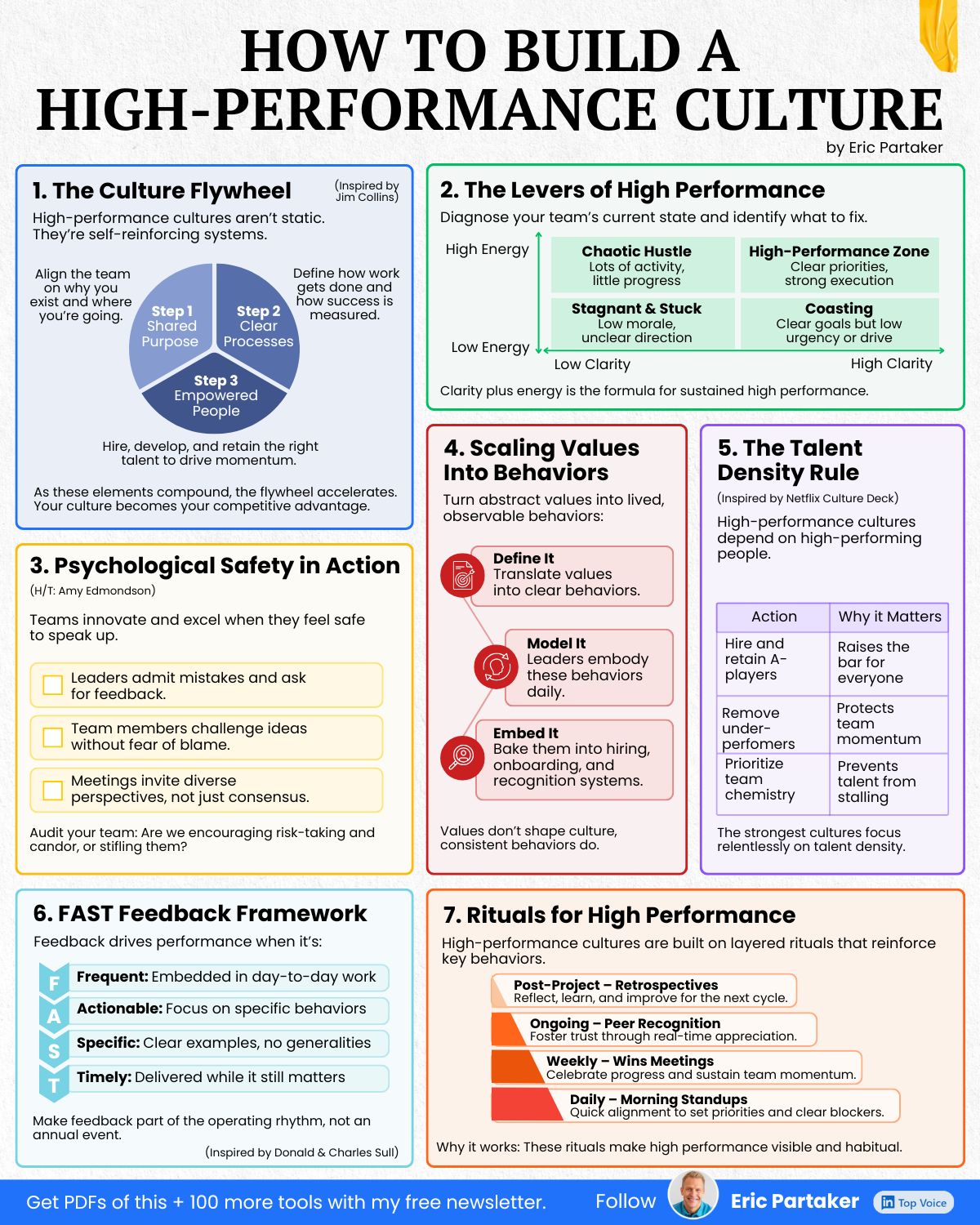
In a recent LinkedIn post, Eric Partaker discusses what he identifies as the single most crucial element differentiating the best teams he has encountered. Contrary to common assumptions, Partaker argues that it is not raw talent, access to funding, or even achieving product-market fit that separates elite teams. Instead, he posits that the core differentiator is a deeply ingrained culture that transforms ordinary individuals into extraordinary performers.
Culture as the “Real Work”
Partaker challenges the conventional view of culture as a secondary consideration, often relegated to the status of “dessert” after the primary business objectives are met. He asserts, “But culture IS the real work.” This perspective reframes organizational culture not as a peripheral benefit but as the fundamental engine of performance. He illustrates this with a flywheel analogy, explaining the interconnectedness of purpose, processes, and people:
“Purpose creates direction → Processes create clarity → People create momentum.
Break one link and everything stops.”
This interconnectedness, according to Partaker, means that any weakness in one area can cripple the entire system. He prompts leaders to diagnose their team’s current state using a four-zone model: “Lost and exhausted,” “Organized chaos,” “Perfect plans, zero action,” and “Unstoppable force.” Partaker suggests that most teams languish in the lower-performing “red” or “orange” zones.
The #1 Culture Killer: Fear
The primary obstacle preventing teams from reaching peak performance, Eric Partaker identifies, is fear. He elaborates on how fear manifests within an organization, creating an environment where genuine progress is stifled. “Speaking up is dangerous. Challenging ideas feels risky. ‘Keeping the peace’ kills progress,” he writes. This climate of fear, Partaker argues, is a direct result of leadership actions or inactions.
Leadership’s Role in Cultivating Culture
To counteract the negative effects of fear and foster a high-performance culture, Partaker emphasizes the critical role of leadership. He advocates for leaders to “go first” by modeling desired behaviors. This includes actively owning mistakes publicly, normalizing dissent, and rewarding the reporting of bad news rather than punishing it. Partaker criticizes the disconnect between stated values and actual practices, stating:
“Innovation” while punishing failure? Empty.
“Move fast” with five approvals? Please.
He stresses the importance of converting abstract values into observable behaviors that are consistently demonstrated. Furthermore, Partaker addresses the impact of different performance levels within a team, making a stark observation about mediocrity:
“Hard truth: B-players don’t just underperform. They lower the bar for everyone. A-players work with A-players or they leave. You can’t build excellence with mediocrity.”
Building Momentum Through Rituals
Partaker outlines a strategy for cultivating a thriving culture through consistent and specific feedback mechanisms and team rituals. He advocates for feedback to “flow like water” – being daily, specific, and immediate, starkly contrasting this with less effective annual, vague, or delayed feedback. He suggests building compounding rituals such as daily stand-ups that focus on unblocking issues, weekly celebrations of wins to maintain energy, recognition that fosters connection, and retrospectives aimed at continuous improvement.
In conclusion, Eric Partaker’s insights underscore that a robust culture is not a soft skill but a strategic imperative and the most sustainable competitive advantage. He frames it as “the only advantage that can’t be copied,” urging leaders to prioritize its development.
📝 About This Content
This article is based on insights shared by Eric Partaker on LinkedIn.
📅 Originally posted on January 20, 2026 | View original post on LinkedIn →