
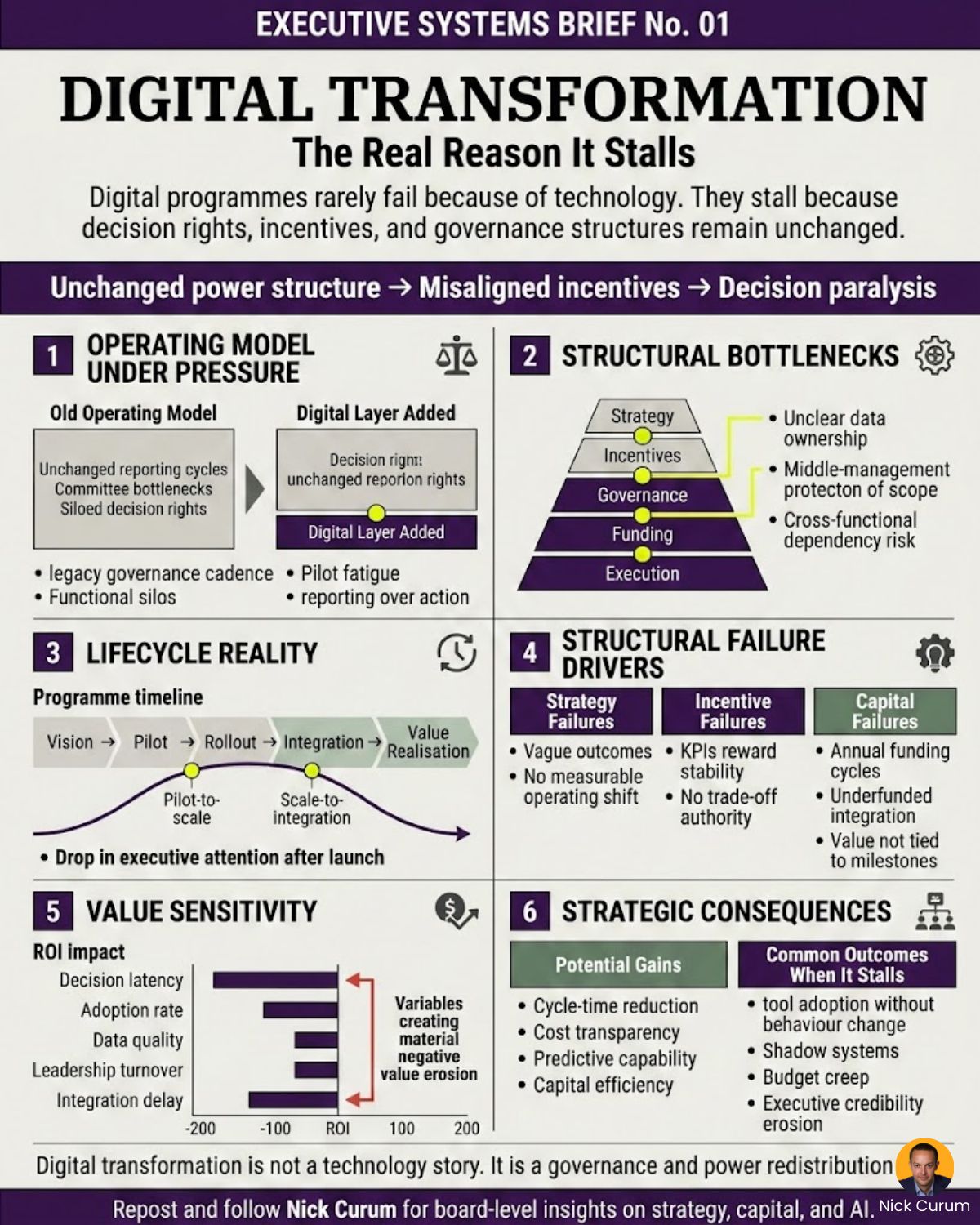
In a recent LinkedIn post, Nick Curum discusses a provocative idea: digital transformations should be “killed” by week six if fundamental organizational shifts haven’t occurred. Curum argues that many initiatives, often labeled as transformations, are merely “pilot theatre” if they don’t lead to tangible changes in power structures, incentives, and decision-making.
Curum’s central thesis challenges the common perception that technology is the primary barrier to successful digital change. Instead, he posits that the real obstacle lies in the organization’s willingness and ability to redistribute power.
“The uncomfortable truth: Most organisations don’t fail at digital. They fail at redistributing power.”
The post outlines key indicators that should be evident by week six of a transformation program. These include changes in decision rights, rewritten incentives, clear ownership by a senior leader, funding that matches ambition, and the retirement of legacy systems. If these elements remain stagnant, Curum suggests the initiative is not a true transformation.
The Illusion of Progress: Pilot Theatre vs. Real Transformation
Curum elaborates on how organizations often mask a lack of genuine change by continuing with what he terms “pilot theatre.” This involves extending pilot phases, creating numerous steering groups, rebranding initiatives without substantive change, and adding superficial metrics like dashboards, all while calling it progress. This approach, he contends, is not only ineffective but also expensive.
“Scaling theatre is expensive.”
According to Nick Curum, genuine transformation inherently involves difficult organizational adjustments. He notes that such transformations typically:
- Remove authority from committees
- Shrink existing departmental empires
- Force difficult trade-offs
These actions are often more politically challenging than simply implementing new software. Curum’s perspective suggests that the resistance to these power shifts is the root cause of many digital initiative failures.
A Controversial Proposal for Governance and Funding
To address this systemic issue, Curum puts forth a controversial recommendation regarding program funding and governance.
“Controversial view: If governance, incentives, and decision rights are unchanged by week six, the board should pause funding.”
This bold statement underscores Curum’s belief that accountability for real change must be enforced early. He argues that without these fundamental shifts in power and structure, continuing to fund initiatives that are merely going through the motions is a misallocation of resources. The technology, Curum implies, is secondary to the organizational will to change.
Nick Curum’s insights offer a critical lens through which to evaluate digital transformation efforts, urging leaders to confront the underlying political and structural barriers that often undermine even the best-intentioned technological advancements. His call is for a more honest assessment of progress, focusing on the redistribution of power as the true metric of transformation.
📝 About This Content
This article is based on insights shared by Nick Curum on LinkedIn.
📅 Originally posted on March 4, 2026 | View original post on LinkedIn →