
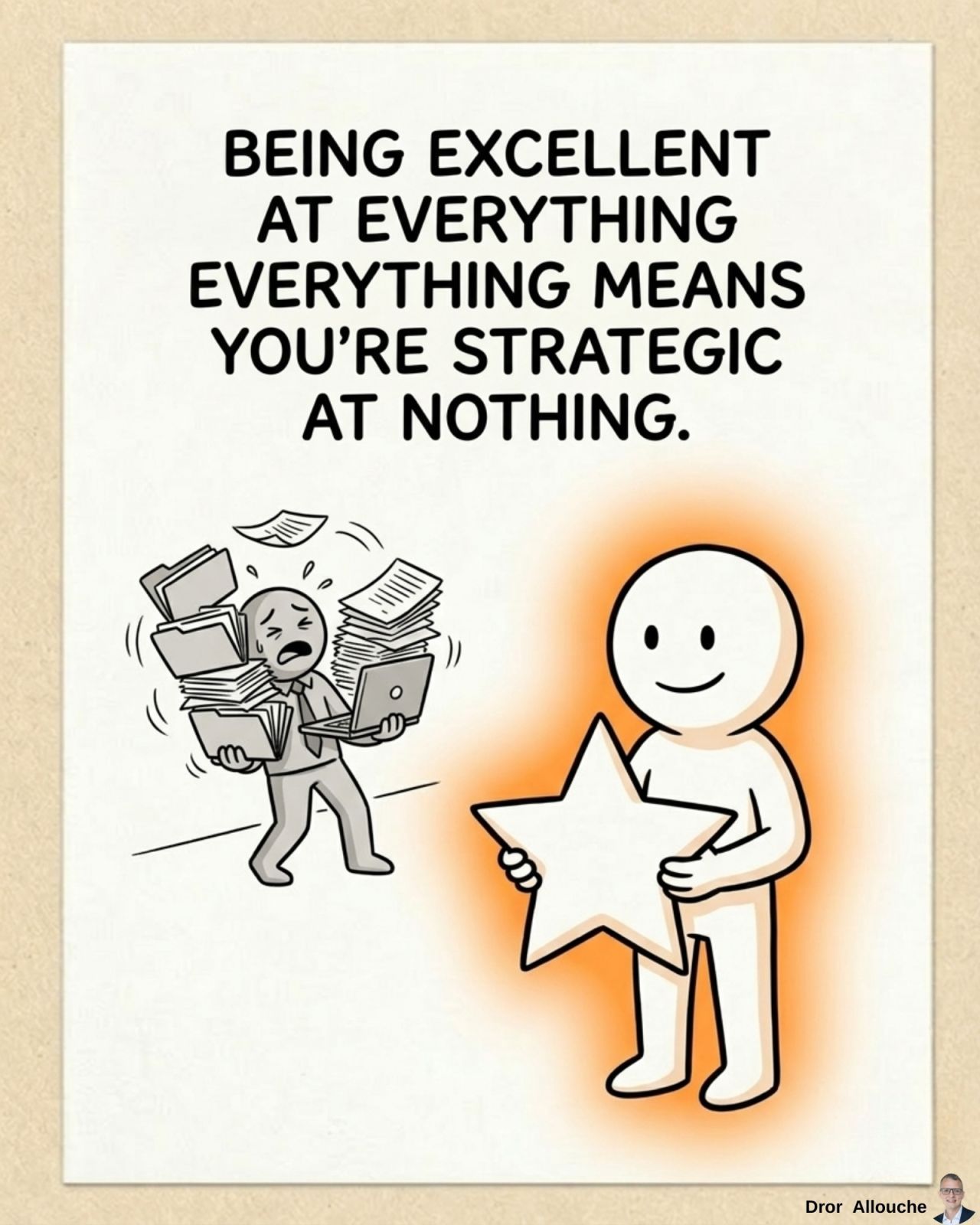
In a recent LinkedIn post, Dror Allouche discusses a common pitfall that can derail executive careers: the tendency for high-performers to become over-involved in operational tasks, mistaking activity for advancement. Dror Allouche argues that this pattern, characterized by running every meeting and reviewing every document, ultimately hinders promotion prospects.
As Dror Allouche points out, the core issue lies in a misunderstanding of what drives C-suite progression. “C-Suite leaders don’t do more. They do less, better,” the post states, emphasizing a strategic shift from breadth of involvement to depth of impact.
The Peril of Being Excellent at Everything
Dror Allouche highlights the paradox faced by many high-achievers. While their peers focus on a few key strategic initiatives and learn to decline other requests, the over-involved executive remains bogged down in tasks that, while demonstrating competence, do not signal strategic leadership. This can lead to a situation where, as Dror Allouche observes, “The executives who get passed over? Still excellent at 15 things.”
Strategic Frameworks for Identifying What to Quit
To combat this career-limiting behavior, Dror Allouche proposes a series of practical tests designed to help leaders identify and relinquish non-strategic activities. These frameworks aim to shift focus from mere activity to genuine impact and career growth.
The Leverage Test
Dror Allouche suggests evaluating tasks based on their ability to multiply impact. “Does this multiply my impact or just add to it?” is the key question. The post differentiates between activities that add work, like running individual meetings, and those that multiply results, such as building scalable systems. “If it doesn’t scale beyond you, stop,” advises Dror Allouche.
The Delegation Filter
A crucial aspect of leadership development is effective delegation. Dror Allouche poses the question, “Could someone two levels below me do this well?” If the answer is yes, it indicates an opportunity not only to delegate but also to foster the growth of others. “Leaders build leaders, not to-do lists,” is the guiding principle here.
The Visibility Question
Dror Allouche stresses the importance of ensuring that strategic work is visible to those who influence promotion decisions. “Does the person who promotes me see this work?” As the post explains, “Perfecting internal processes won’t move you up.” Instead, leaders should focus on work that has a clear audience and strategic relevance.
The Future Role Audit
Advancement requires looking beyond the current role. Dror Allouche prompts leaders to ask, “Does this build skills for my next job or keep me great at this one?” The distinction is made between tactical tasks, like reviewing decks, and strategic work that positions an individual for higher-level responsibilities. “Stop polishing. Start positioning,” is the call to action.
The Calendar Truth and Replacement Rule
To gain clarity on daily practices, Dror Allouche recommends a “Calendar Truth” exercise: marking the week in green for strategic activities and red for reactive ones. “If your week is mostly red, you’re training for the wrong job,” the post warns. Complementing this is the “Replacement Rule,” which mandates identifying an activity to quit before accepting new responsibilities, reinforcing the idea that “Every yes to something small is a no to something strategic.”
Ultimately, Dror Allouche concludes that true career advancement in the C-suite comes not from doing more, but from doing fewer, more impactful things exceptionally well. “The ones who advance? World-class at 3,” the post summarizes, contrasting with those who remain “excellent at 15 things” but fail to progress.
📝 About This Content
This article is based on insights shared by Dror Allouche on LinkedIn.
📅 Originally posted on August 5, 2026 | View original post on LinkedIn →