
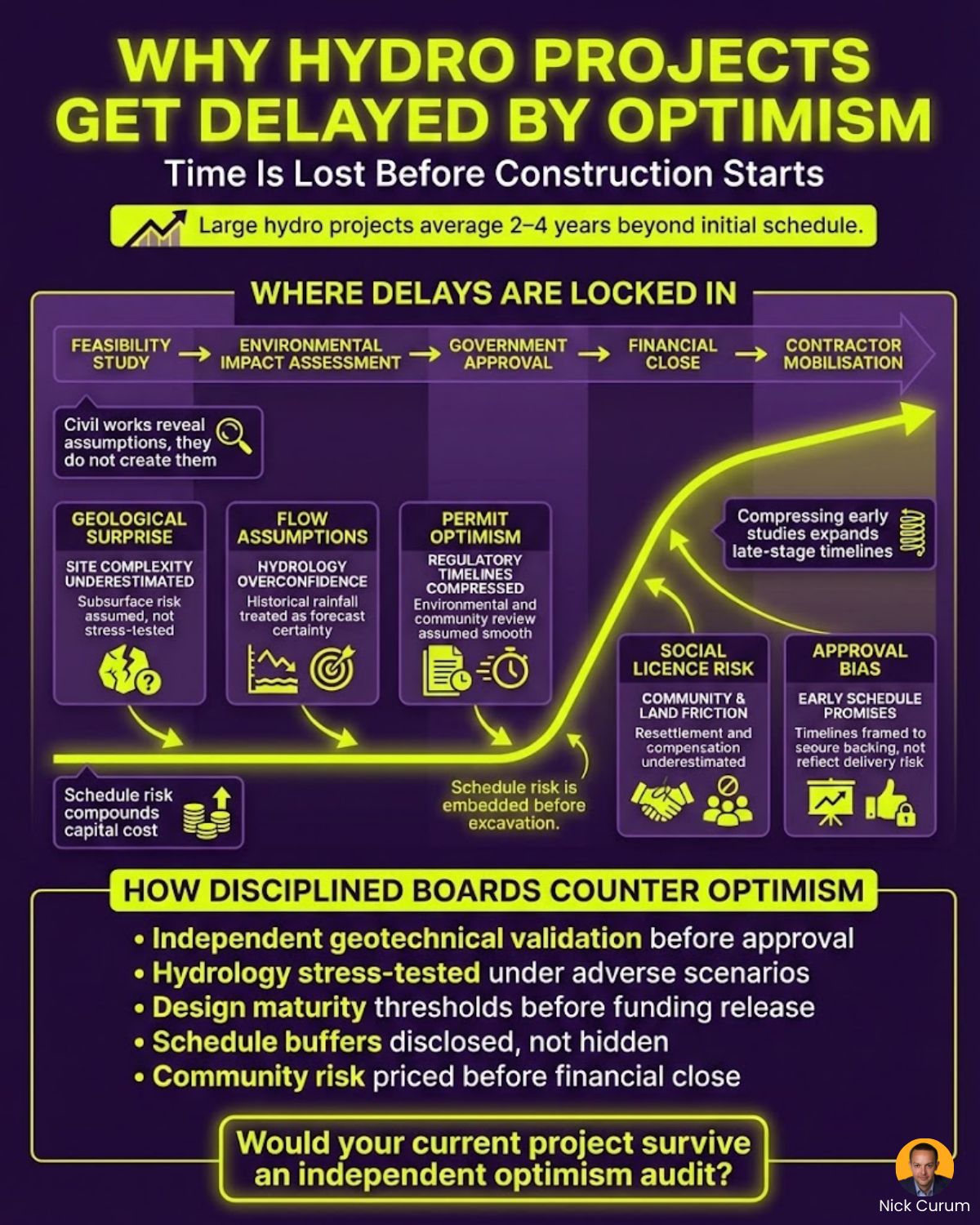
In a recent LinkedIn post, Nick Curum delves into the often-overlooked reasons behind significant schedule delays in large hydropower projects. Rather than pinpointing construction as the primary culprit, Curum argues that the seeds of these delays are sown much earlier, deeply embedded within the approval processes.
According to Curum, the typical pattern reveals that these massive projects frequently run two to four years over their initial schedules. He asserts that the root cause isn’t usually found on the ground during construction, but rather in the foundational assumptions made during the project’s nascent stages.
“Schedule risk behaves differently from cost risk. Cost overruns are visible. Schedule assumptions are quieter and compounding.”
The Hidden Compounding of Schedule Risk
Curum distinguishes between schedule and cost risks, noting that while cost overruns are readily apparent, schedule assumptions often go unnoticed until they have compounded into significant delays. He identifies several critical junctures where variance is effectively locked in, often before a project is truly ready to proceed.
Key Factors Influencing Project Timelines
Curum outlines a series of conditions that, if not adequately addressed early on, contribute disproportionately to timeline variances:
- Feasibility that has not been rigorously stress-tested against adverse scenarios.
- Hydrology models that do not extend beyond historical rainfall data.
- Underestimation of regulatory friction, treating it as an assumption rather than an experienced hurdle.
- Failure to explicitly price the complexity of obtaining social license.
- Design maturity that has not reached a defensible, well-vetted threshold.
- Commitment of capital without realistic contingency buffers.
“By the time civil works begin, the trajectory is largely set,” Curum states. “Construction reveals uncertainty. It does not create it.” He emphasizes that the most significant bending of the schedule curve happens *before* mobilization, during the early planning and approval phases.
Governance Mismatch: Scrutiny vs. Flexibility
A core point of Curum’s analysis is the misapplication of governance intensity. He points out an uncomfortable implication for boards and decision-makers: the initial 30-40% of a programme holds the most significant influence over the total timeline variance. However, he observes that governance intensity often peaks towards the end of a project, when flexibility to make meaningful changes is at its lowest.
“If governance intensity rises as flexibility falls, you may be reviewing history rather than shaping outcomes.”
Curum suggests that effective governance should be front-loaded. For those involved in early-stage approvals, he provides a critical checklist to ensure a project’s timeline is realistically set:
- Are assumptions independently stress-tested?
- Is optimism clearly separated from verifiable evidence?
- Are contingency buffers visible and accounted for, not politically obscured?
- Would the proposed schedule withstand an external audit?
“Save this before your next gate review,” Curum advises, prompting readers to consider where their own organizations apply the most scrutiny – during the crucial front-end stages or solely during delivery.
Curum’s insights underscore the need for a paradigm shift in how large capital projects, particularly in the energy sector, are planned and governed, advocating for a more rigorous and realistic approach from the very outset.
📝 About This Content
This article is based on insights shared by Nick Curum on LinkedIn.
📅 Originally posted on February 25, 2026 | View original post on LinkedIn →