
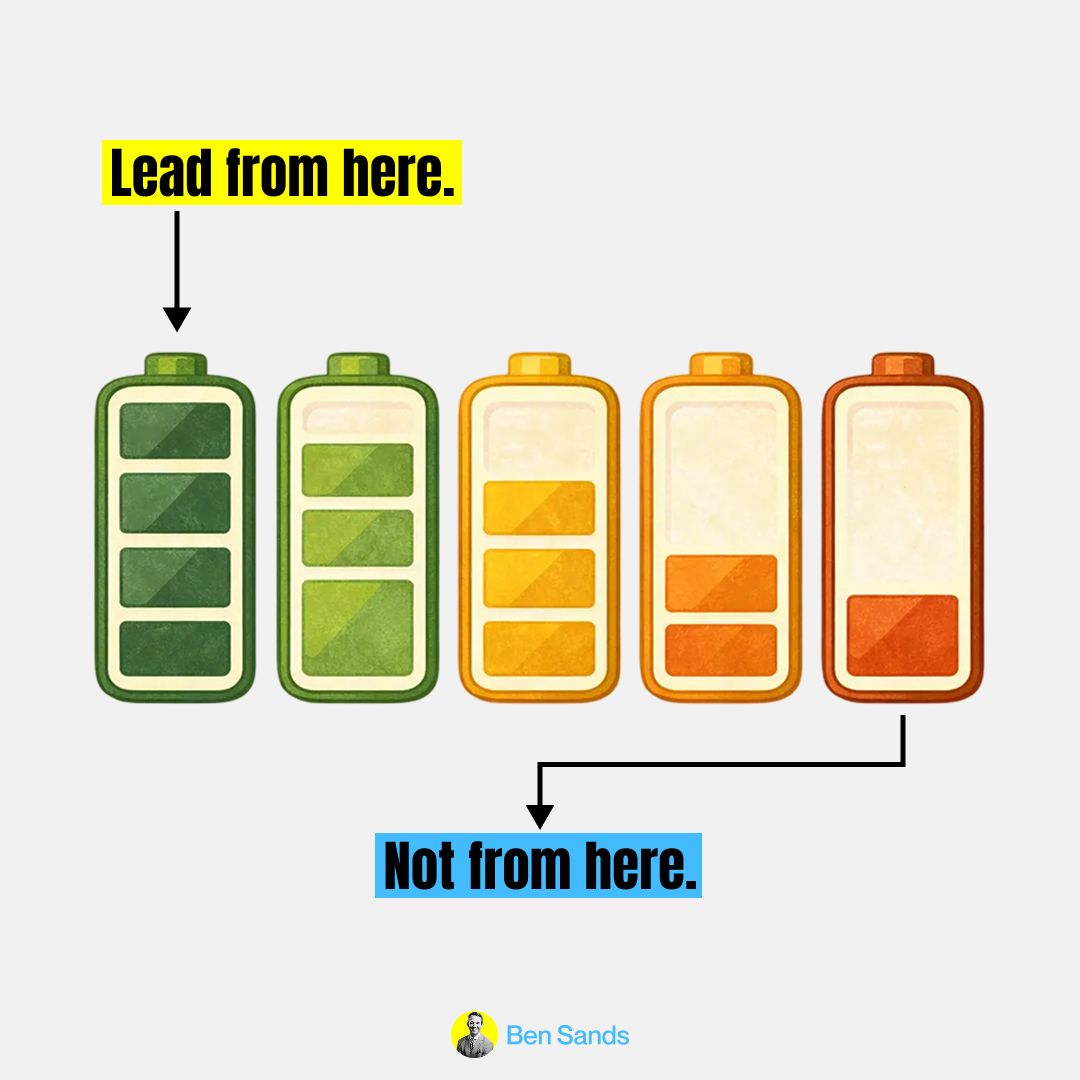
In a recent LinkedIn post, Ben Sands explores the critical, often overlooked, link between a leader’s personal energy levels and the overall performance and capacity of their organization. Sands contends that many leaders operate in a state of “functional exhaustion,” performing adequately but at a significantly reduced capacity, which he argues sets a “ceiling for your entire organization.”
He highlights that this state is not necessarily burnout but a chronic depletion that impacts cognitive functions essential for leadership.
“Clear thinking, sound judgment, and real presence all draw from the same source. And leadership roles are uniquely good at draining it.”
Sands identifies common leadership demands that contribute to this energy drain, including the constant barrage of decisions, perpetual context switching, and the pressure of urgency that crowds out necessary reflection. He posits that when leaders push through this depleted state, the cost is subtle but significant, leading to increased reactivity, more frequent reversals of decisions, and a general increase in organizational “noise” over clarity.
The Energy-Performance Link
Ben Sands emphasizes that a leader’s energy is not merely a personal attribute but a foundational element that dictates the effectiveness of their leadership. He draws a parallel to a “lead domino,” suggesting that when a leader’s energy is depleted, their leadership capabilities inevitably degrade, even if their effort remains high.
According to Sands, this depletion leads to leading “from the wrong place,” which the organization absorbs, resulting in slowed momentum, increased friction, and a thinning of trust. He refutes the notion that overcoming this is a matter of sheer toughness, instead framing it as a problem of capacity.
“No leader can consistently lead well from a depleted state.”
This perspective underscores the idea that sustainable high performance in leadership is impossible without adequate energy reserves.
Managing Energy as an Operating System
A key takeaway from Sands’s post is that energy is a manageable resource, akin to an “operating system” rather than a fleeting personal preference. He outlines three core practices that strong leaders employ to maintain and manage their energy effectively:
1. Designing Days Around Energy
This involves proactively structuring the workday to align with natural energy rhythms. Sands suggests prioritizing sleep, strategically cutting low-value meetings, and scheduling high-leverage work during peak cognitive periods.
2. Removing Drains Before Adding Discipline
Sands advocates for an approach that focuses on eliminating energy-sapping activities before attempting to impose additional discipline. This includes reducing context switching, clarifying priorities to minimize ambiguity, and eliminating unnecessary noise or distractions.
3. Building Recovery into the System
He argues that recovery is not a luxury but essential “infrastructure” for sustained leadership performance. This means integrating regular breaks and restorative activities into the workflow.
“If energy is an afterthought, leadership becomes reactive by default. If it’s managed deliberately, everything else gets easier.”
Sands concludes by noting that by treating energy as a deliberate management priority, leaders can foster greater clarity, improve outcomes, and reduce friction within their organizations. He also announced an upcoming live session for senior leaders focused on the “7 Core Skills of Healthy, High-Growth Leaders,” designed to help attendees build leverage and achieve better results.
📝 About This Content
This article is based on insights shared by Ben Sands on LinkedIn.
📅 Originally posted on February 9, 2026 | View original post on LinkedIn →