
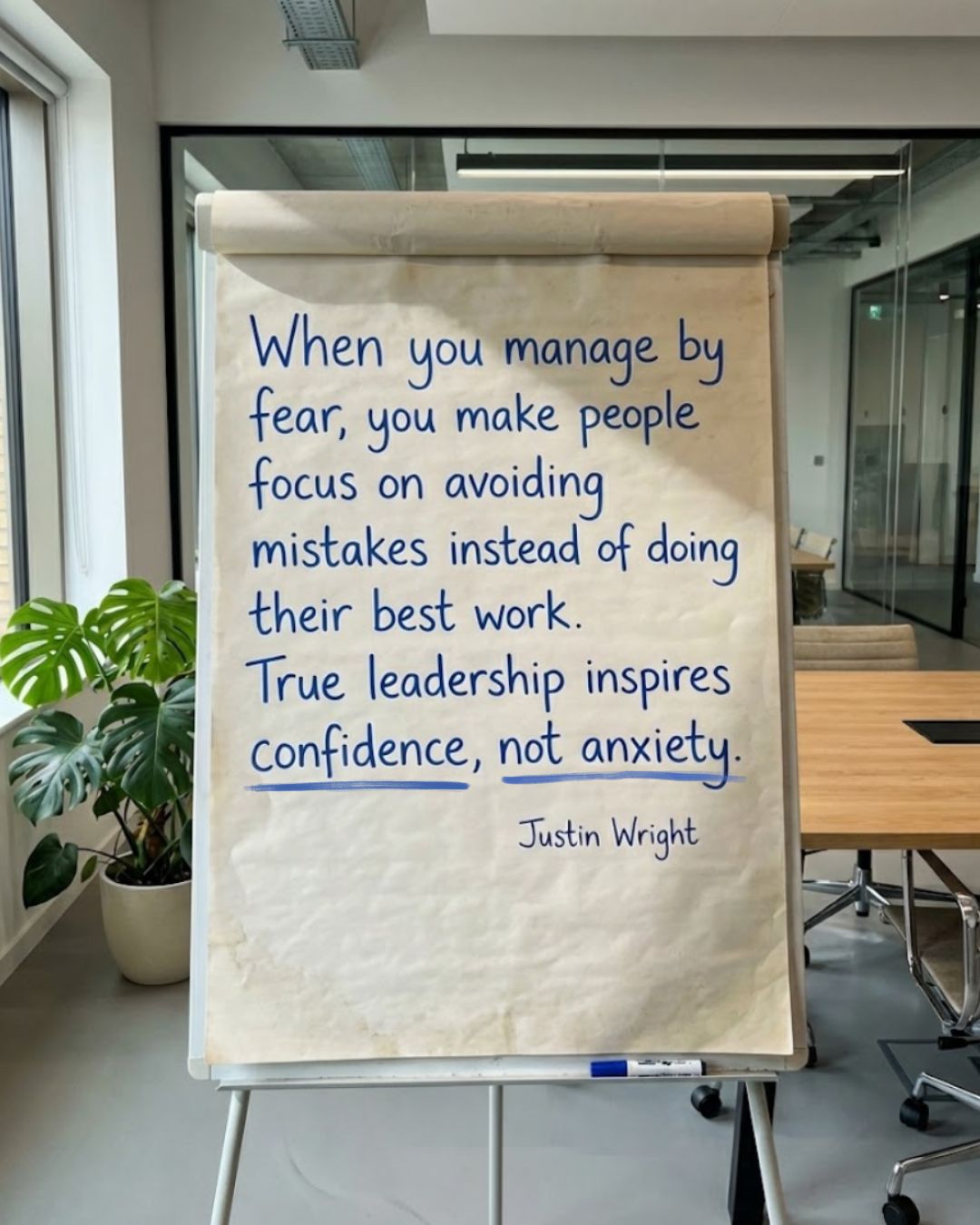
In a recent LinkedIn post, Justin Wright discusses the detrimental impact of fear in the workplace and advocates for a leadership style rooted in empathy and support. Wright argues that fear, often employed as a tool for control, ultimately stifles innovation, hinders growth, and erodes team potential.
Wright begins by painting a stark picture of workplaces where fear prevails, highlighting common symptoms such as leaders who rule by intimidation, teams hesitant to innovate, and meetings characterized by silence rather than idea exchange. He contends that this approach, while it might achieve short-term compliance, is fundamentally a form of control, not leadership.
“The moment fear enters your workplace, something valuable walks out.”
The High Cost of Fear-Based Management
According to Justin Wright, when leaders manage by fear, the focus shifts from productivity and innovation to self-preservation. He elaborates on the negative consequences:
- People focus on avoiding mistakes.
- Energy is diverted to self-protection.
- Growth becomes impossible.
Wright asserts that this environment is antithetical to true leadership, which he defines by its ability to foster positive outcomes through support and kindness. He contrasts this with the destructive nature of fear, stating, “Fear might get short-term compliance. But it kills long-term excellence.”
Empathy and EQ as Pillars of Effective Leadership
In contrast to fear-based tactics, Wright champions leadership that is built on empathy, support, and emotional intelligence (EQ). He posits that these qualities are not just beneficial but essential for sustainable success and team cohesion. As Justin Wright notes, true leaders understand that support yields better results than threats, and kindness builds stronger teams than fear.
“True leaders understand that: Support produces better results than threats; Kindness builds stronger teams than fear; EQ spots problems before they grow.”
Wright further supports his argument by referencing data that indicates teams led with empathy consistently outperform those in fear-driven environments. He highlights several key advantages observed in empathetic workplaces:
- Enhanced creative problem-solving.
- Improved performance under pressure.
- Greater adaptability to change.
- Increased team longevity and loyalty.
This data underscores Wright’s central thesis: while fear can enforce obedience, it cannot unlock the full potential of a team. He concludes with a powerful call to action, urging leaders to choose a path of compassion and encouragement.
“Lead with fear, and watch people shrink. Lead with heart, and watch them soar.”
In Wright’s view, a leader’s primary role is to create an environment where individuals feel safe to contribute their best work. He emphasizes that a team’s brilliance can only emerge when the inhibiting factor of fear is removed, allowing them to truly shine.
📝 About This Content
This article is based on insights shared by Justin Wright on LinkedIn.
📅 Originally posted on January 8, 2026 | View original post on LinkedIn →