
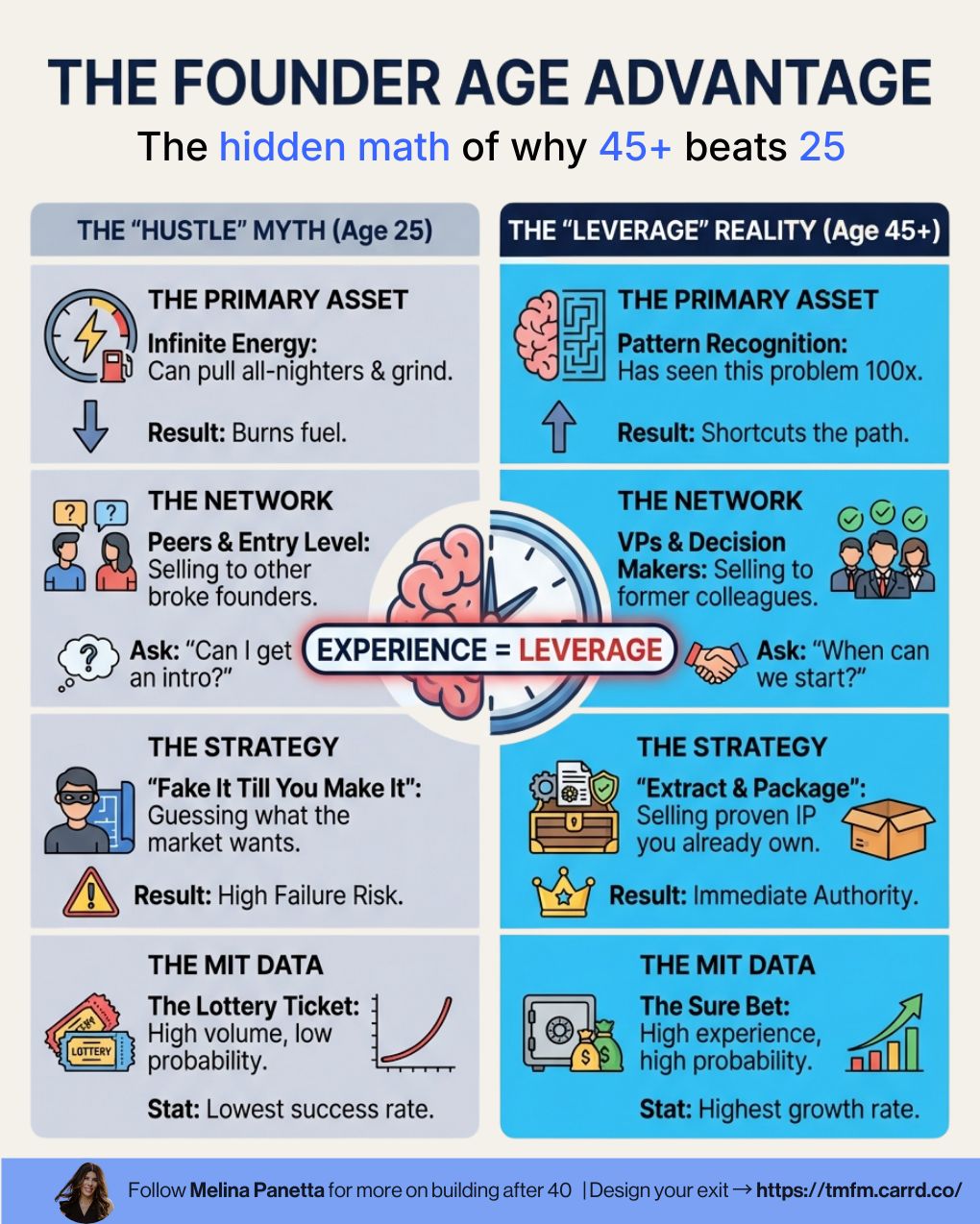
In a recent LinkedIn post, Melina Panetta challenges the popular narrative that startup success is dominated by young entrepreneurs. Instead, Panetta highlights research and her own experience to argue that founders in their mid-40s often possess unique advantages that lead to higher-growth ventures.
Panetta begins by directly confronting the common misconception about founder age: “The average age of a successful startup founder is not 22. It’s 45.” She shares her personal journey, admitting to feeling “too late” when she launched her business at 47, comparing herself to younger founders embracing a “hustle culture.”
“And for a long time, I secretly felt I was ‘too late.’ I looked around and saw 20-somethings moving faster, breaking things, and living the hustle culture. I felt behind.”
This personal reflection, however, sets the stage for a data-driven revelation. Panetta points to MIT research that indicates the highest-growth startups are founded by individuals in their mid-40s. This finding, she explains, shifted her perspective entirely.
Leveraging Experience as a Strategic Asset
Panetta argues that what many perceive as “lost time” in corporate careers is, in fact, invaluable “inventory” for a founder. She frames her two decades in corporate roles not as a delay, but as a period of intense learning and data accumulation.
“Every year I spent in corporate wasn’t ‘lost time.’ It was ‘inventory,’” Panetta states. She details her own career progression, illustrating how earlier roles provided crucial skills and validation:
- Age 42: Leading $150M teams, learning to sell at scale.
- Age 44: Coaching school and securing initial clients, validating her offer.
- Age 47: Full-time business launch, executing with a safety net.
According to Panetta, this timeline demonstrates that success wasn’t about being younger, but about accumulating the “pattern recognition that only comes from two decades in the trenches.”
From Corporate Experience to Startup Capital
Panetta elaborates on how specific corporate experiences translate directly into startup advantages. She contends that seasoned professionals don’t need to start from scratch but can leverage their established networks, problem-solving skills, and reputations.
“The relationships I built became my distribution channel. The problems I solved became my product. The reputation I earned became my marketing.”
This perspective is crucial for those in corporate roles who feel they might have “missed the boat” on entrepreneurship. Panetta encourages them to re-evaluate their professional history not as a disadvantage, but as a significant asset.
“If you are sitting in a corporate seat thinking you missed the boat… look at the data. You aren’t old. You are just fully loaded.”
She contrasts the common “hustle” mentality of younger founders with the approach she advocates for experienced individuals: “You don’t need to ‘hustle’ like a 20-year-old. You need to extract like a 45-year-old.” In her view, the struggle for many founders isn’t a lack of skill, but a failure to recognize the value of their “boring” corporate experience, which she terms a “premium product.”
Panetta concludes by urging potential founders not to “let 20 years of inventory go to waste,” emphasizing that age and experience are powerful levers for building successful, high-growth ventures.
📝 About This Content
This article is based on insights shared by Melina Panetta on LinkedIn.
📅 Originally posted on January 30, 2026 | View original post on LinkedIn →