
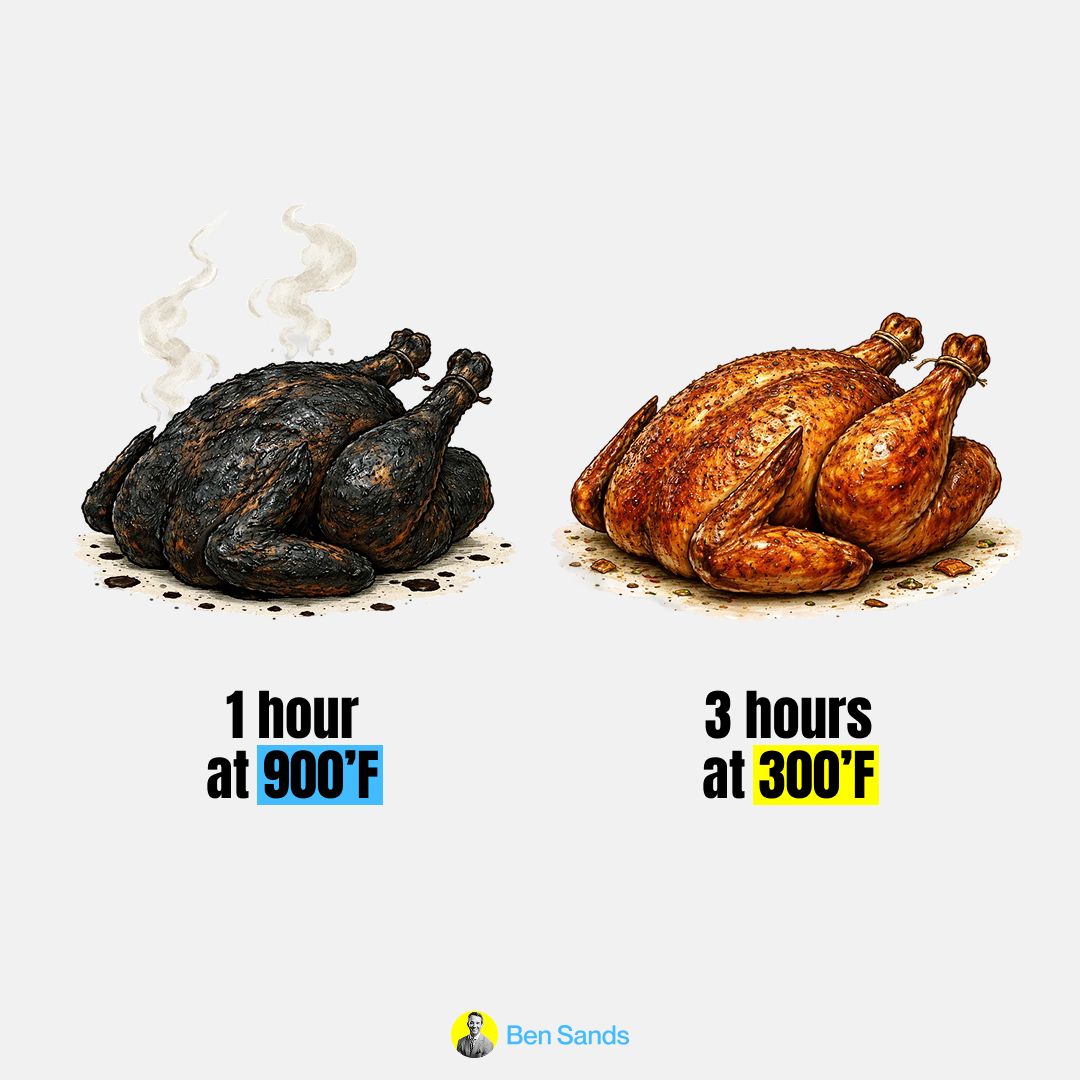
In a recent LinkedIn post, Ben Sands challenges the conventional wisdom that leaders must constantly accelerate to succeed, arguing instead for the critical importance of patience. Sands suggests that the pressure to move quickly can often lead to detrimental outcomes, likening the situation to cooking a turkey where excessive heat, or impatience, results in a burnt product.
The Perils of Rushing in Leadership
Ben Sands highlights that while speed is often associated with effective leadership, the line between being fast and being reckless is frequently crossed, especially under pressure. This impatience, according to Sands, has significant negative consequences for both individuals and teams.
“Most leaders think they need to go faster. But actually need to hit the brakes.”
As Sands points out, the drive for speed without a corresponding sense of measured progress can manifest in several ways. He outlines these as:
- Rushing leads to more mistakes.
- Leaders may endure excessively long workdays.
- Personal health declines as it is sacrificed for work demands.
- Constant stress stifles creativity.
These factors, Sands argues, ultimately lead to a slowdown in overall effectiveness, despite the outward appearance of high activity.
The Power of Patience for Predictable Performance
Conversely, Ben Sands advocates for a more patient approach, suggesting it leads to superior and more sustainable results. He uses the analogy of a perfectly cooked chicken, achieved through the right balance of time and controlled intensity, to illustrate his point.
“But when you match speed with patience, you get a perfectly cooked chicken.”
According to Sands, embracing patience allows leaders to achieve both short-term objectives and long-term goals. He elaborates on the benefits:
- The team gains the necessary time and space to produce their best work.
- Motivation and execution are enhanced across the organization.
- Leaders become more effective not only in their professional lives but also in their personal lives.
Sands posits that this balanced approach is the key to creating a “healthy, high-impact environment” that fosters sustainable, predictable performance. He emphasizes that true leadership effectiveness lies not in unchecked acceleration, but in the judicious application of speed tempered with patience.
A Tool for Self-Assessment
To assist leaders in evaluating their own approach, Ben Sands has developed a brief quiz. He offers this tool as a resource for those seeking to cultivate a more balanced and effective leadership style. As Sands concludes his post:
“If you’re wondering how to create that healthy, high-impact environment, I built a free 2-minute quiz to help: 👉 bit.ly/ExecutiveQuiz”
Sands concludes by posing a question to his audience, inviting further discussion on the relative importance of speed versus patience in leadership.
📝 About This Content
This article is based on insights shared by Ben Sands on LinkedIn.
📅 Originally posted on February 20, 2026 | View original post on LinkedIn →