
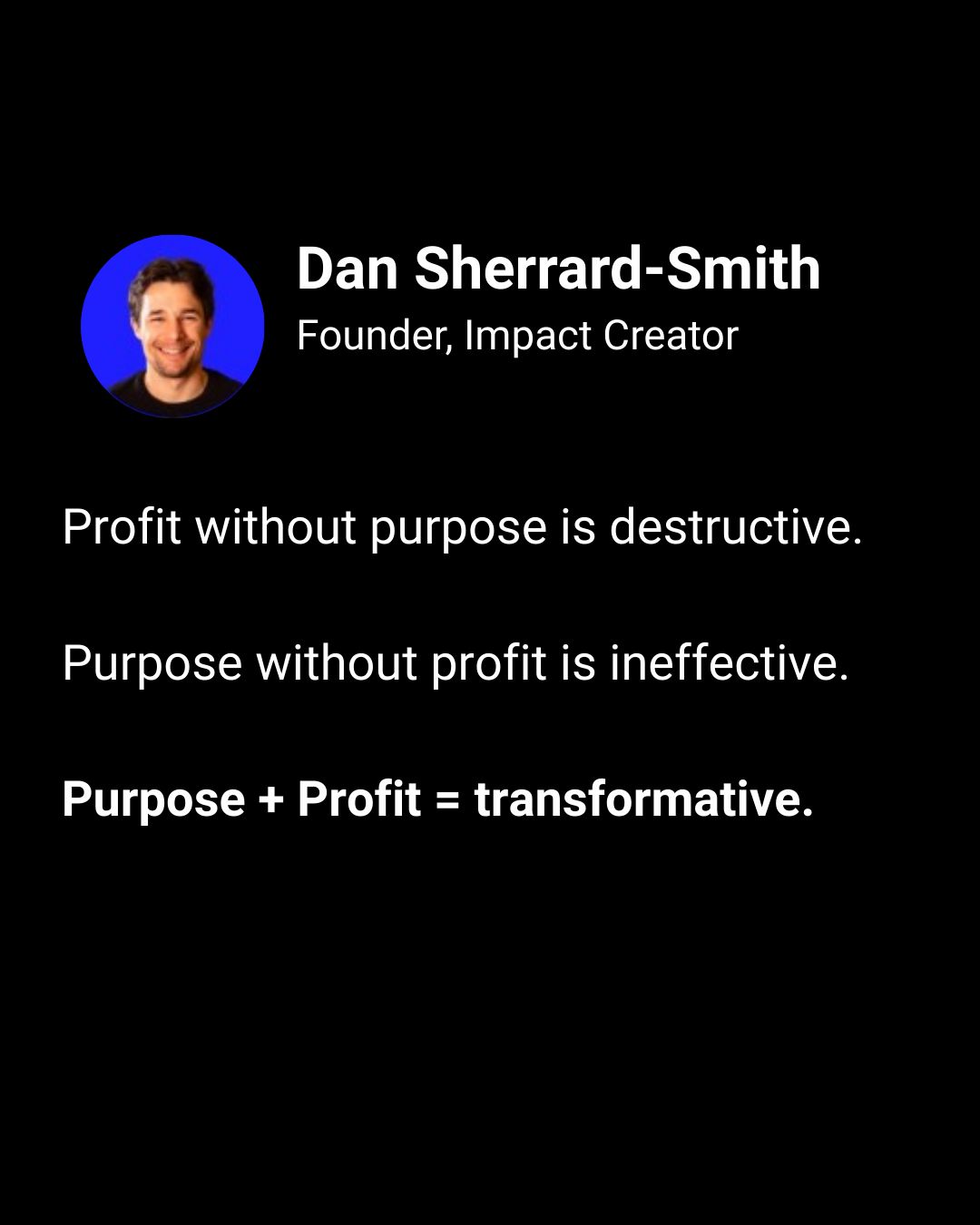
In a recent LinkedIn post, Dan Sherrard-Smith challenges conventional business wisdom, arguing that the future of enterprise success hinges not solely on profit, but on a powerful combination of purpose and profit. Sherrard-Smith posits that a well-defined purpose is becoming an indispensable driver of growth, customer loyalty, and employee engagement.
The business strategist begins by presenting a bold assertion: “The future of business is not profit.” This statement sets the stage for an analysis that reframes the traditional profit-centric model. Sherrard-Smith then backs this up with compelling data points, outlining four key facts about scaling businesses in 2026.
“Brands with purpose score 27% higher in customer loyalty.”
As Sherrard-Smith highlights, the evidence suggests a strong correlation between a company’s mission and its market performance. He points to the tangible benefits of integrating purpose into a business’s core identity, citing that companies with a strong sense of purpose report significantly higher employee engagement levels.
The Data Behind Purpose-Driven Growth
Sherrard-Smith’s post delves into specific metrics that underscore the financial advantages of purpose-driven strategies. He notes that this approach is not just a feel-good initiative but a strategic imperative for sustainable growth.
Customer Loyalty and Employee Engagement
According to Dan Sherrard-Smith, the impact on customer loyalty is substantial. He states,
“Brands with purpose score 27% higher in customer loyalty.”
Furthermore, Sherrard-Smith emphasizes the internal benefits, noting that companies with a clear purpose tend to foster a more motivated workforce. He elaborates,
“Companies with a strong sense of purpose report 40% higher levels of employee engagement.”
Financial Outperformance
The analysis extends to financial outcomes, where Sherrard-Smith presents data suggesting that purpose-aligned businesses are more profitable. He points out that purpose-driven family businesses, for instance, show superior growth rates compared to traditional models.
“Purpose-driven family businesses outperform their peers, achieving 31% growth vs 21% for traditional models.”
This trend, Sherrard-Smith argues, extends to overall profitability. He concludes this section by stating,
“Purpose-aligned companies report 22% higher pre-tax profit than those that don’t align their work with their values.”
The Synergy of Purpose and Profit
Sherrard-Smith synthesizes these points by defining the essential relationship between purpose and profit. He articulates a balanced perspective, warning against the pitfalls of focusing on one without the other.
In his view, profit devoid of purpose can be detrimental, leading to unsustainable or unethical practices. Conversely, he suggests that purpose without profit is merely a pastime, lacking the scalability and resources to achieve significant impact.
Achieving Business ‘Magic’
The core of Sherrard-Smith’s argument lies in the synergistic potential when purpose and profit are interwoven. He explains that the increase in profit generated by a purpose-driven business amplifies its capacity to make a positive impact. This, in turn, reinforces the business’s mission and can lead to even greater profitability.
“Because the more profit made, the bigger impact the business has. And the bigger the impact, the more profit,” Sherrard-Smith writes, encapsulating this virtuous cycle. He invites discussion on this model, asking his network, “Is this how to run a business or have i missed something?” His post serves as a compelling call to action for business leaders to re-evaluate their strategies and consider the profound role of purpose in achieving long-term success.
📝 About This Content
This article is based on insights shared by Dan Sherrard-Smith on LinkedIn.
📅 Originally posted on February 28, 2026 | View original post on LinkedIn →