
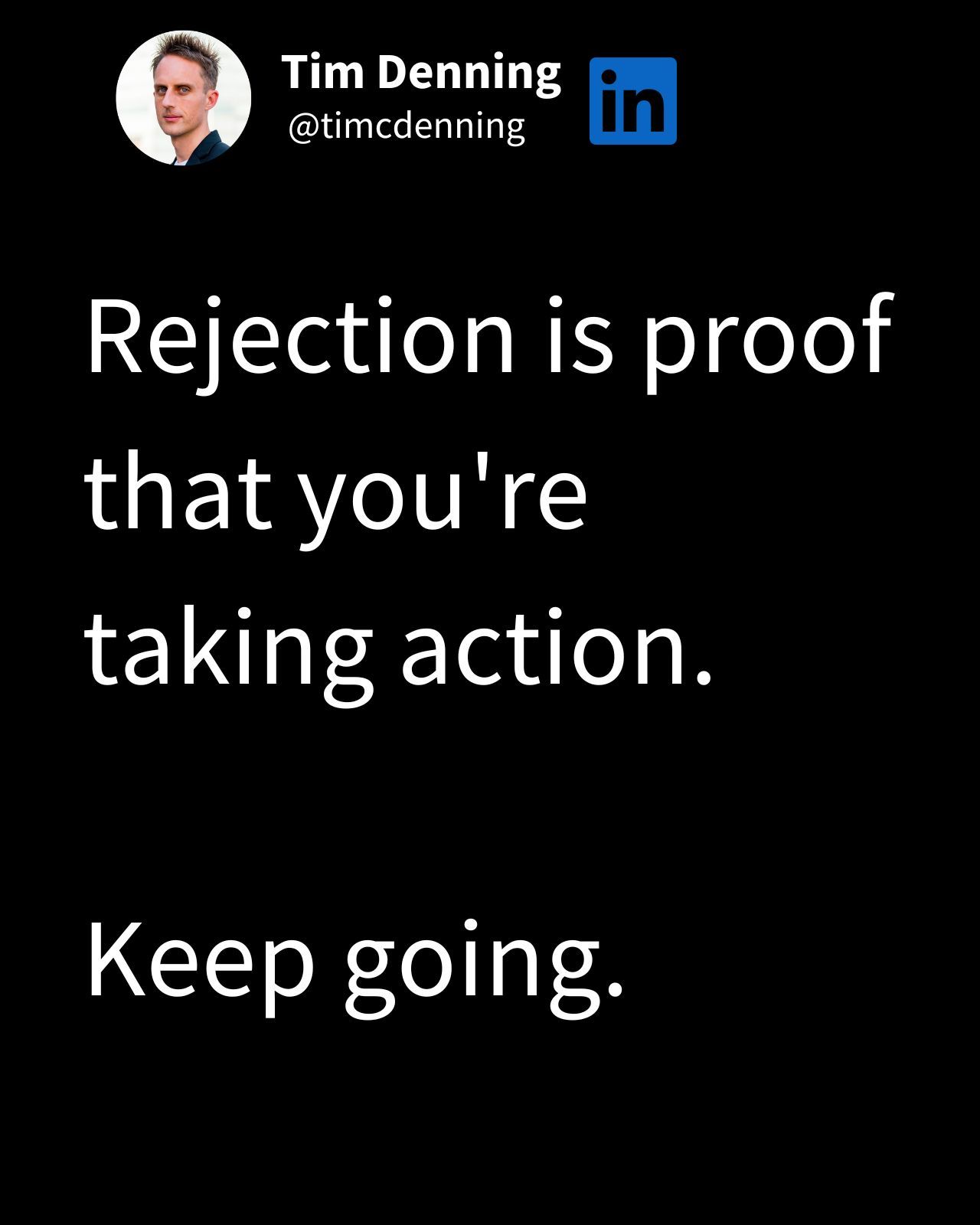
In a recent LinkedIn post, Tim Denning tackles the uncomfortable but often necessary aspect of failure, arguing that experiencing rejection is a fundamental indicator of personal and professional growth. Denning, a prominent voice in business and self-improvement circles, contends that a life devoid of rejection is likely a life where one is not pushing boundaries or taking significant risks.
Denning opens by stating a rather stark premise: “If nobody’s rejecting you, you’re not doing anything with your life.” He elaborates on this by recalling his experiences in corporate banking, where he observed colleagues who actively avoided opportunities for advancement or expressing new ideas. The underlying fear, he suggests, was a desire to avoid looking “desperate” or facing the possibility of a “no.” This self-protective stance, Denning posits, is a form of preemptive self-rejection.
The Unexpected Doors Opened by Rejection
The author shares a personal anecdote from his banking days to illustrate this point. After meticulously preparing and pitching an idea to a senior executive, he was met with a swift dismissal. This initial rejection left him feeling inadequate, replaying the conversation in his mind. However, the situation took an unexpected turn. The same executive later approached him about a different project, remembering him as someone who proactively brings ideas forward. This experience led Denning to conclude that rejection, rather than closing doors, can often open new, unforeseen pathways.
“The rejection didn’t close a door. It opened one I didn’t even know existed.”
Rejection as a Catalyst for Entrepreneurship
Denning further draws on his experience transitioning into entrepreneurship after being laid off. He describes a period where he was constantly pitching his writing to publications and his services to potential clients, facing a high volume of rejections. He notes the stark contrast with his previous corporate life, stating:
“In my first year of building my own business, I probably heard ‘no’ more times than I had in my entire corporate career combined.”
Despite the frequency of rejections, Denning emphasizes that his business still grew. He frames each “no” as tangible proof that he was actively engaged in the process of building something, rather than passively waiting for opportunities.
The Perils of Playing It Too Safe
According to Tim Denning, the individuals who consistently avoid rejection are often those who also avoid asking for anything significant. They remain in their comfort zones, leading to stagnation. He observes this pattern among business owners he has worked with:
Avoiding the Arena Guarantees Failure
Denning argues that the most significant struggles for business owners often stem not from facing rejection, but from refusing to put themselves in situations where rejection is possible. This includes hesitating to send cold emails, publish content, or make offers. He characterizes this fear as a self-imposed limitation that guarantees a lack of progress.
“They’re so afraid of hearing ‘no’ that they guarantee themselves a lifetime of ‘nothing.'”
In his view, rejection serves as a vital sign that one is actively participating in their endeavors. It signifies being “in the arena” rather than a spectator. Denning encourages his audience to actively seek out rejection, viewing it not as an endpoint, but as a starting point for further action and growth. He concludes his post by prompting readers to consider instances where rejection ultimately led to positive outcomes.
📝 About This Content
This article is based on insights shared by Tim Denning on LinkedIn.
📅 Originally posted on March 13, 2026 | View original post on LinkedIn →