
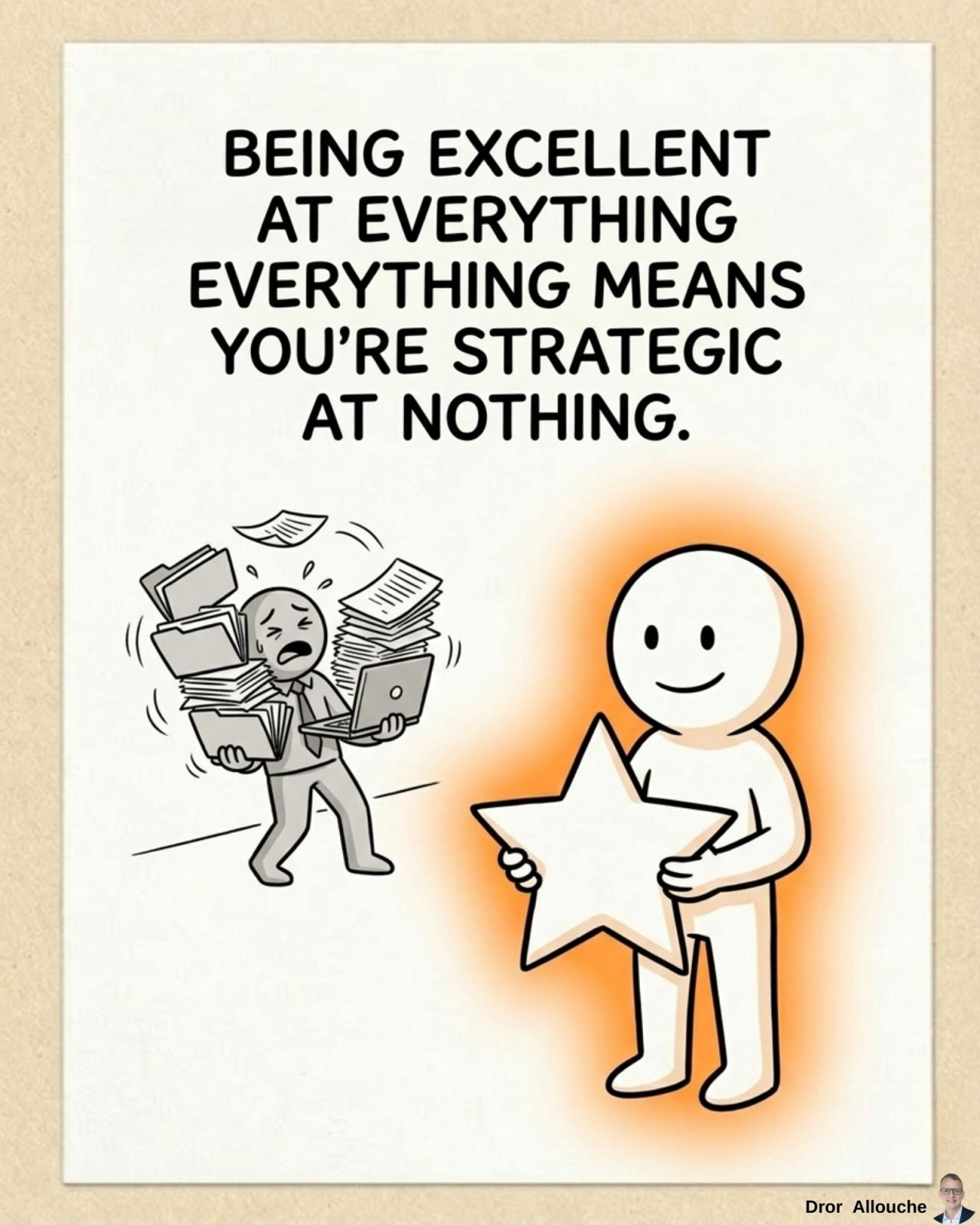
In a recent LinkedIn post, Dror Allouche explores a common pitfall that can derail executive careers: the tendency for high-performers to overcommit and spread themselves too thin. Allouche argues that this widespread habit, often stemming from a desire to be indispensable, paradoxically hinders career progression.
The core of Allouche’s message is a stark contrast between those who get promoted and those who are overlooked. He observes that executives who consistently take on too many tasks, from running every meeting to reviewing every document, often find their peers, who strategically focus on fewer, high-impact initiatives, advancing more rapidly.
“Being excellent at everything means you’re strategic at nothing.”
Allouche contends that many high-achievers confuse constant activity with genuine career advancement. This, he suggests, leads them to say “yes” too often, ultimately diluting their strategic impact and limiting their visibility to the individuals who can influence their promotion.
The Danger of Ubiquity
According to Allouche, the C-suite operates on a principle of focused execution, not sheer volume of work. “C-Suite leaders don’t do more. They do less, better,” he states, emphasizing that true leadership involves strategic prioritization rather than exhaustive task management.
Allouche identifies several key filters leaders can use to determine what activities are hindering their progress and what should be relinquished:
1. The Leverage Test
Allouche asks leaders to evaluate whether a task “multiplies [their] impact or just adds to it.” Activities that don’t scale beyond the individual, such as constantly running meetings, are identified as areas to potentially eliminate. He posits that building systems, rather than simply adding more work, is what truly multiplies results.
2. The Delegation Filter
A crucial aspect of leadership, as highlighted by Allouche, is empowering others. He suggests asking, “Could someone two levels below me do this well?” If the answer is yes, Allouche argues that the leader is not only blocking the growth of their team but also limiting their own advancement. “Leaders build leaders, not to-do lists,” he asserts.
“If it doesn’t scale beyond you, stop.”
3. The Visibility Question
Allouche points out that career advancement is often tied to the perception of one’s contributions by those in positions of power. He questions whether the work being done is visible to the person who promotes them, noting that “Perfecting internal processes won’t move you up.” Strategic work, in his view, requires an audience, unlike mere busywork.
4. The Future Role Audit
A forward-looking approach is essential, according to Allouche. He advises leaders to consider if their current tasks are building skills for their next role or merely reinforcing their proficiency in their current one. “Reviewing decks keeps you tactical. Shaping strategy moves you up,” he explains, urging professionals to “Stop polishing. Start positioning.”
5. The Calendar Truth
Allouche proposes a practical exercise: color-coding a week’s calendar to distinguish between strategic (green) and reactive (red) activities. If the week is predominantly red, he warns that individuals are “training for the wrong job,” as “You become what you practice daily.”
6. The Replacement Rule
Finally, Allouche emphasizes the necessity of making difficult choices when taking on new responsibilities. He recommends implementing a “Replacement Rule”: before saying yes to anything new, one must identify what activity will be dropped. “Every yes to something small is a no to something strategic,” he concludes.
The takeaway from Dror Allouche’s analysis is clear: true career acceleration comes not from doing more, but from doing fewer, more impactful things exceptionally well. The executives who advance are those who master a few critical areas, rather than being merely excellent at many.
📝 About This Content
This article is based on insights shared by Dror Allouche on LinkedIn.
📅 Originally posted on March 10, 2026 | View original post on LinkedIn →