
In a recent LinkedIn post, business leader Ben Sands explores a common paradox faced by many CEOs: working harder than ever, yet finding the company increasingly difficult to manage. Sands highlights that this struggle often stems not from a decline in the CEO’s capabilities, but from a fundamental shift in the demands of the role as the company grows.
According to Sands, the skills that were instrumental in building a company are not necessarily the same ones required to scale it effectively. He notes that leaders often fall into the trap of doubling down on their existing strengths, which may no longer provide the necessary leverage for growth.
“The skills that built the company are not the skills that scale it.”
The Evolving Demands on CEOs
Ben Sands argues that the perception of a CEO’s job changing is a critical realization. As companies expand, the volume of meetings, decisions, and problems landing on the CEO’s desk increases significantly. This escalation of responsibilities can lead to slower growth, not due to a lack of effort or capability from the CEO, but because the nature of the job itself has transformed.
Sands points out that many CEOs misinterpret this challenge as a need for increased personal intensity. They respond by working longer hours, scheduling more meetings, and becoming more involved in day-to-day operations. However, he posits that this approach is fundamentally flawed for scaling.
Identifying Key CEO-Level Gaps
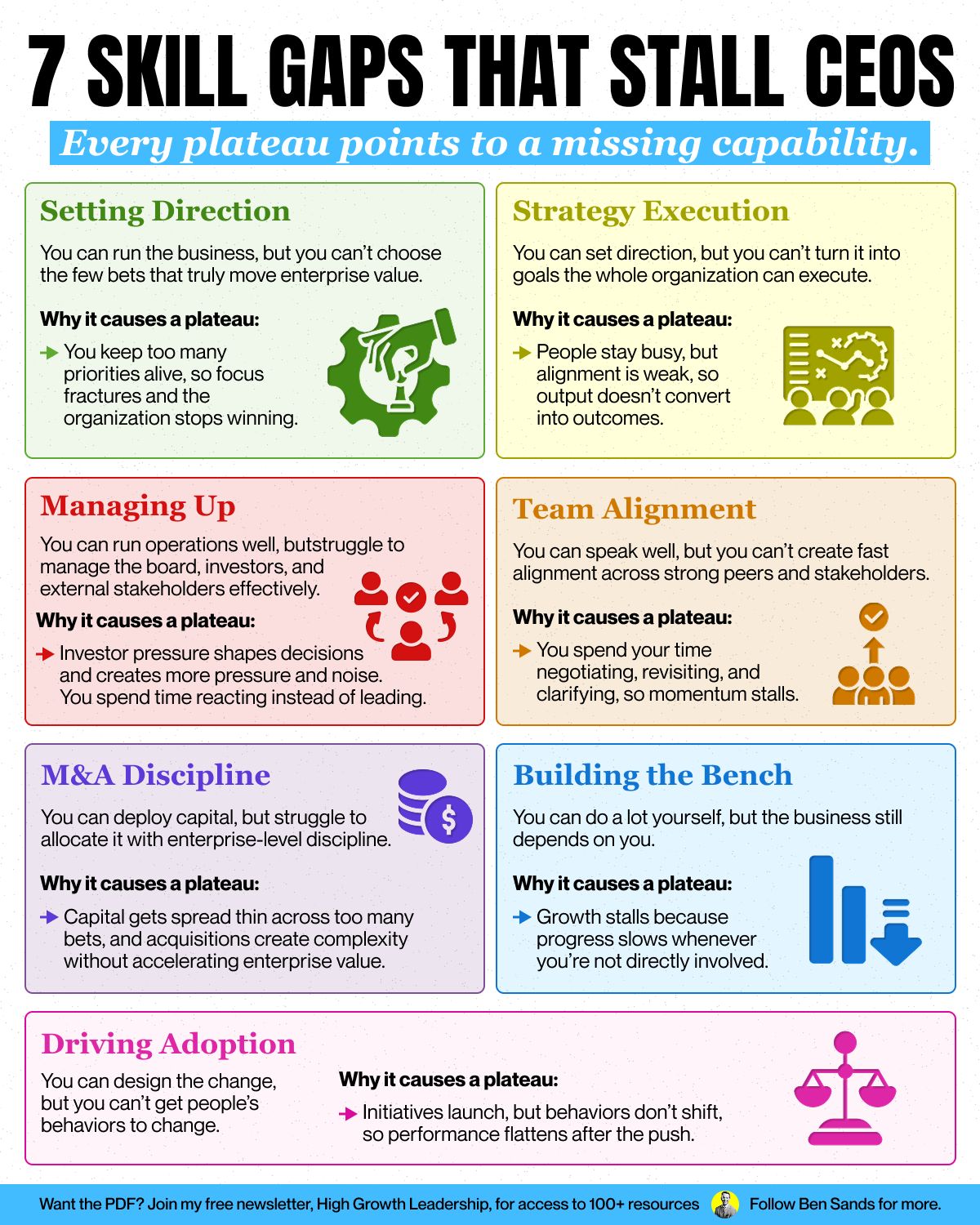
In his post, Ben Sands identifies seven critical leadership gaps that can stall even strong executives. These gaps represent areas where a CEO’s existing skill set may not be sufficient for the demands of a growing enterprise.
Core Leadership Challenges Identified by Sands:
- Setting Direction: The ability to make difficult trade-offs and eliminate distractions at an enterprise level.
- Strategy Execution: Establishing an operating cadence that translates strategy into daily actions.
- Managing Up: Effectively managing investor expectations and power dynamics.
- Team Alignment: Ensuring the leadership team is genuinely unified and not just agreeing in meetings.
- M&A Discipline: Being intentional about resource allocation during acquisitions.
- Building the Bench: Developing leaders capable of running significant parts of the company independently.
- Driving Adoption: Creating genuine behavioral change across the organization.
Sands emphasizes that attempting to overcome these gaps through sheer effort is unsustainable. He contrasts this with the concept of ‘architecture,’ suggesting that building robust systems and capabilities is the key to scalable growth.
“Most CEOs try to solve these gaps with more intensity. Longer hours. More meetings. More personal involvement. But intensity doesn’t scale. Architecture does.”
Shifting from Effort to Architecture
The core message from Ben Sands is a call to re-evaluate the source of scaling challenges. Instead of defaulting to personal effort, leaders should identify the underlying capability gaps that necessitate this extra exertion.
As Sands suggests, the crucial question for a leader experiencing difficulty in scaling is:
“Which capability gap is forcing me to compensate with personal effort?”
He concludes that by addressing these specific gaps through developing new capabilities or implementing better systems, the burden on the CEO can be significantly lightened, leading to more sustainable and effective growth. Sands encourages leaders to reflect on which of these seven areas might be hindering their progress.
📝 About This Content
This article is based on insights shared by Ben Sands on LinkedIn.
📅 Originally posted on March 8, 2026 | View original post on LinkedIn →