
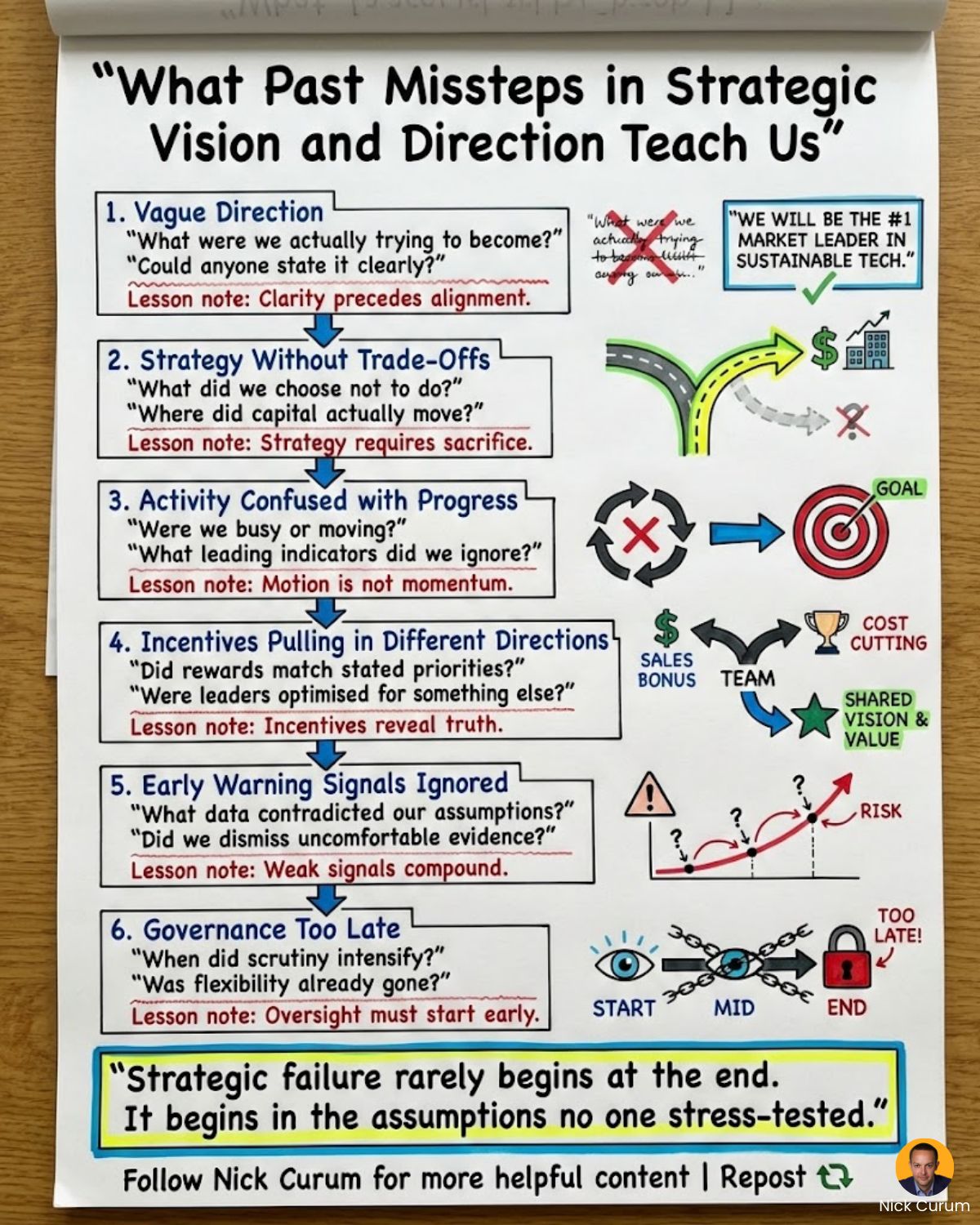
In a recent LinkedIn post, Nick Curum discusses a recurring pattern he’s observed in the failure of major programmes and transformations. Rather than stemming from late-stage execution issues, Curum argues that the seeds of failure are typically sown much earlier, often within the first few weeks of a programme’s inception.
Curum, who has reviewed over 40 major programmes, portfolio resets, and stalled transformations in the past decade, highlights six common early missteps that lead to eventual collapse. He points out that by the time performance visibly slips, the critical errors have long since been made.
“The decision that kills a programme is rarely made in year three. It’s made in week two.”
The Six Early Missteps Undermining Programmes
According to Nick Curum, the problems that lead to a programme’s demise are not usually found in its final stages but in its foundational assumptions and early direction. He outlines six specific areas where critical errors are frequently made:
1. Vague Vision
Curum emphasizes the importance of clarity in the initial vision. He states that if a vision cannot be articulated in a single, concise sentence, it is unlikely to be understood or effectively implemented by the wider organization.
2. Lack of Real Trade-offs
A key point raised by Curum is that effective strategy requires difficult choices. He posits that without making genuine sacrifices or trade-offs, a plan devolves into mere budgeting, lacking the strategic focus needed for success.
“Strategy without sacrifice is budgeting.”
3. Confusing Activity with Progress
Curum observes a common pitfall where teams are busy but not necessarily moving in the right direction. He warns against mistaking constant activity for tangible progress towards strategic goals.
4. Misaligned Incentives
The author highlights the powerful influence of incentive structures. As Curum notes, “What gets rewarded wins. Every time.” If incentives are not aligned with the strategic objectives, they will inevitably pull efforts away from the intended direction.
5. Ignoring Weak Signals
Early indicators of trouble, even if seemingly minor, are crucial. Curum cautions that neglecting these subtle warnings allows discomfort to fester and grow, ultimately leading to a crisis later on.
“Early discomfort compounds into late-stage crisis.”
6. Late Implementation of Governance
Finally, Curum points out the danger of delaying robust governance. By the time formal scrutiny is applied, the costs associated with changing course or exiting the programme are often prohibitively high.
The Uncomfortable Truth About Strategic Failure
Nick Curum concludes by stressing that strategic failure is rarely a sudden event. Instead, it is the result of unexamined assumptions made at the outset.
“Strategic failure rarely begins at the end. It begins in the assumptions no one stress-tested.”
Curum encourages leaders, board members, and capital allocators to save this analysis, suggesting it will be invaluable when programmes unexpectedly go off track. He prompts readers to consider which of these six missteps is most challenging to identify and address early within their own organizations.
📝 About This Content
This article is based on insights shared by Nick Curum on LinkedIn.
📅 Originally posted on February 28, 2026 | View original post on LinkedIn →