
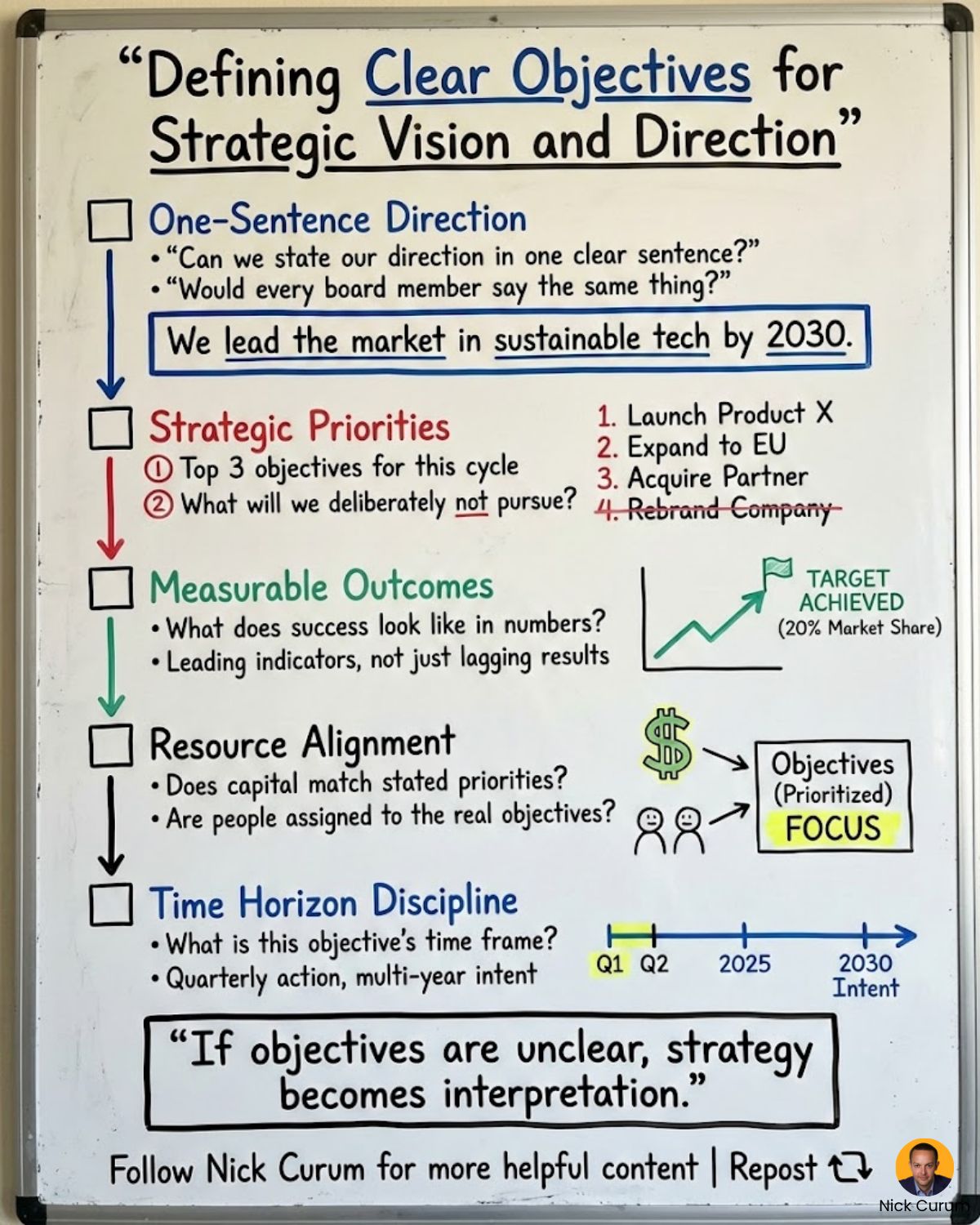
In a recent LinkedIn post, Nick Curum tackles a common corporate ailment: the illusion of strategic clarity. He argues that many organizations mistake vague aspirations for concrete strategies, leading to confusion and misallocated resources. Curum emphasizes that true strategic clarity is not about having a comprehensive deck, but about making difficult choices and establishing clear constraints.
Curum opens by recounting an anecdote that illustrates his point: “I asked a CEO to describe their strategy in one sentence. She pulled out a 47-slide deck. That’s the problem.” This vivid example sets the stage for his core argument that strategy becomes unclear not due to a lack of vision from leadership, but because that vision fails to become a limiting factor.
“Strategy isn’t unclear because boards lack vision. It’s unclear because vision never became a constraint.”
The author contends that phrases like “Be the market leader,” “Drive innovation,” or “Dominate our core” are not strategies themselves, but rather broad directives that allow for individual interpretation. As Curum puts it, these are “permission slips for everyone to pursue their own interpretation.” This lack of a defined path, he explains, leads to a diffusion of effort and resources.
The Uncomfortable Truth About Strategic Choice
Curum’s central thesis is that genuine strategic clarity is an uncomfortable process because it necessitates elimination. “Real strategic clarity does something uncomfortable: It eliminates options,” he states. This focus on what *not* to do is often overlooked in favor of defining what to achieve.
A Five-Part Framework for Strategic Clarity
To help leaders test the clarity of their objectives, Curum outlines a five-part framework:
- One-Sentence Direction: Can every key stakeholder articulate the strategic goal identically and without notes? Curum provides an example: “We lead the market in sustainable tech by 2030.” If this isn’t universally understood, he warns, “you have 5 different strategies.”
- Strategic Priorities (Top 3): This component challenges organizations to identify what they are deliberately *not* pursuing. Curum provocatively suggests, “If everything is a priority, nothing is.” He even offers a ‘bonus’ test: if crossing out a fourth potential priority hurts, the top three aren’t truly defined.
- Measurable Outcomes: Curum stresses the importance of defining success with quantifiable metrics, particularly leading indicators, before a period ends. He contrasts this with vague goals, stating, “20% market share > ‘increased visibility.'”
- Resource Alignment: This point highlights that a company’s budget and headcount allocations are the true indicators of its strategy. “Your budget reveals your real strategy. Money and people don’t lie,” Curum asserts.
- Time Horizon Discipline: Distinguishing between short-term actions (e.g., Q1 goals) and long-term intent (e.g., 2030 vision) is crucial to avoid confusion and organizational whiplash.
“When these five elements aren’t explicit, I see the same pattern: → Teams optimise for local wins → Resources drift toward the loudest voice → Metrics multiply to justify everything → Strategy becomes 17 different interpretations”
Curum argues that without these clear parameters, teams tend to focus on short-term, localized wins, resources get diverted to the most vocal stakeholders, and metrics become a tool for justification rather than a measure of progress. This ultimately results in strategy becoming a matter of subjective interpretation.
The Brutal Test of Real Strategy
To truly gauge strategic clarity, Curum proposes a stark exercise: hide the strategy deck and examine where resources are actually allocated, who is promoted, and what behaviors are measured and rewarded. “Can someone outside your company identify your strategic direction?” he asks. If the answer is no, Curum concludes, the issue is not unclear communication, but “unclear thinking.”
“Clarity isn’t a PowerPoint exercise. It’s an allocation decision made visible.”
Ultimately, Curum defines true strategic clarity as the ability to decline a good idea because it does not align with the established direction. He invites readers to share their organization’s one-sentence direction for a collective ‘pressure test,’ underscoring that effective strategy is about making and communicating deliberate choices, not just about presentation.
📝 About This Content
This article is based on insights shared by Nick Curum on LinkedIn.
📅 Originally posted on February 14, 2026 | View original post on LinkedIn →