
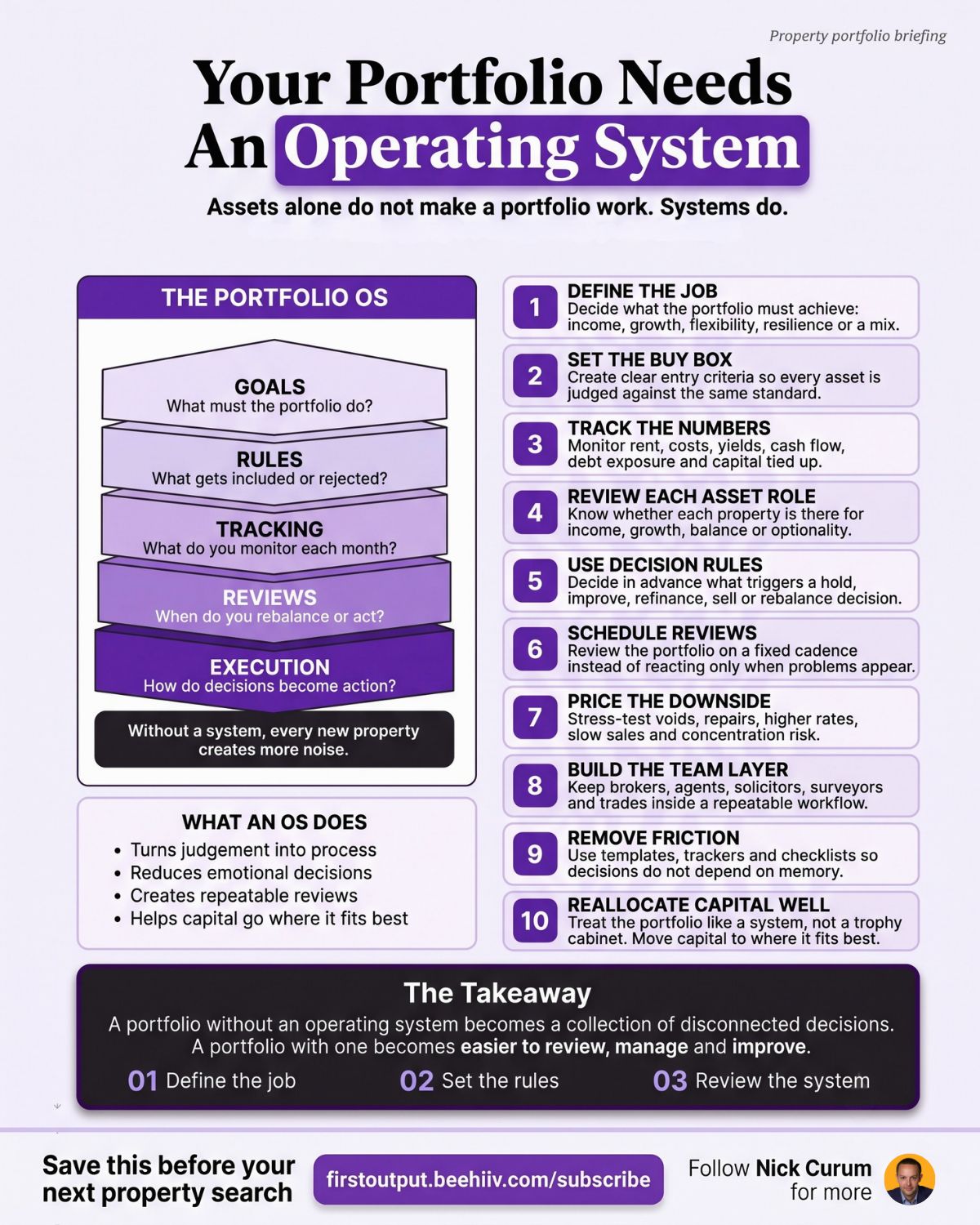
In a recent LinkedIn post, Nick Curum challenges the conventional notion of what constitutes a real estate portfolio, arguing that sheer volume of properties is insufficient without a robust underlying system. Curum asserts that simply owning multiple assets does not equate to a strategic portfolio, but rather a series of individual risks.
The core of Curum’s argument is that a collection of properties, without a unifying operational framework, becomes increasingly complex and difficult to manage effectively. He emphasizes that relying solely on personal judgment becomes untenable as the number of assets grows.
“Ten properties without a system is not a portfolio. It’s ten separate gambles you happen to own.”
Curum posits that a well-defined system brings structure and predictability that gut feeling alone cannot provide. He outlines four key functions that a system performs, which are beyond the capability of intuition:
Defining the Portfolio’s Purpose
A fundamental role of a system, according to Curum, is to assign a clear objective to the entire portfolio. Without this stated mission, individual assets risk being evaluated inconsistently, leading to suboptimal decision-making across the board. As Curum notes, “Without one, every asset gets judged by a different standard.” This highlights the need for a unified vision that guides all property-level decisions.
Replacing Subjectivity with Rules
Curum argues that implementing a system replaces subjective ‘feel’ with objective rules. This transition, he explains, leads to quicker and more consistent decision-making processes. “Decisions get faster, and far more consistent,” Curum states, underscoring the efficiency gains from a rule-based approach.
Scheduled Reviews Over Reactive Management
The post emphasizes the importance of scheduled reviews rather than reactive, panic-driven assessments. Curum suggests that a systematic approach ensures that potential issues are identified and addressed proactively. “Problems get caught before they compound,” he writes, illustrating how regular, planned evaluations prevent minor issues from escalating into major crises.
Driving Execution and Action
Furthermore, Curum points out that a system is crucial for ensuring that plans translate into tangible action. He believes that a plan without execution is merely a document, devoid of practical value. “A plan with no movement is just a document,” Curum asserts. A system, therefore, is designed to drive the necessary execution to achieve portfolio goals.
The Imperative of Building Systems Early
Curum’s central thesis is that the development of these systems should precede further acquisitions, not follow the occurrence of problems. He views these systems not as bureaucratic paperwork, but as the mechanism by which good decisions are replicated and scaled. “It’s how a good decision repeats itself,” Curum explains. He concludes by inviting discussion on operational rules, suggesting that proactive system implementation is key to long-term success in real estate investment.
📝 About This Content
This article is based on insights shared by Nick Curum on LinkedIn.
📅 Originally posted on July 28, 2026 | View original post on LinkedIn →