
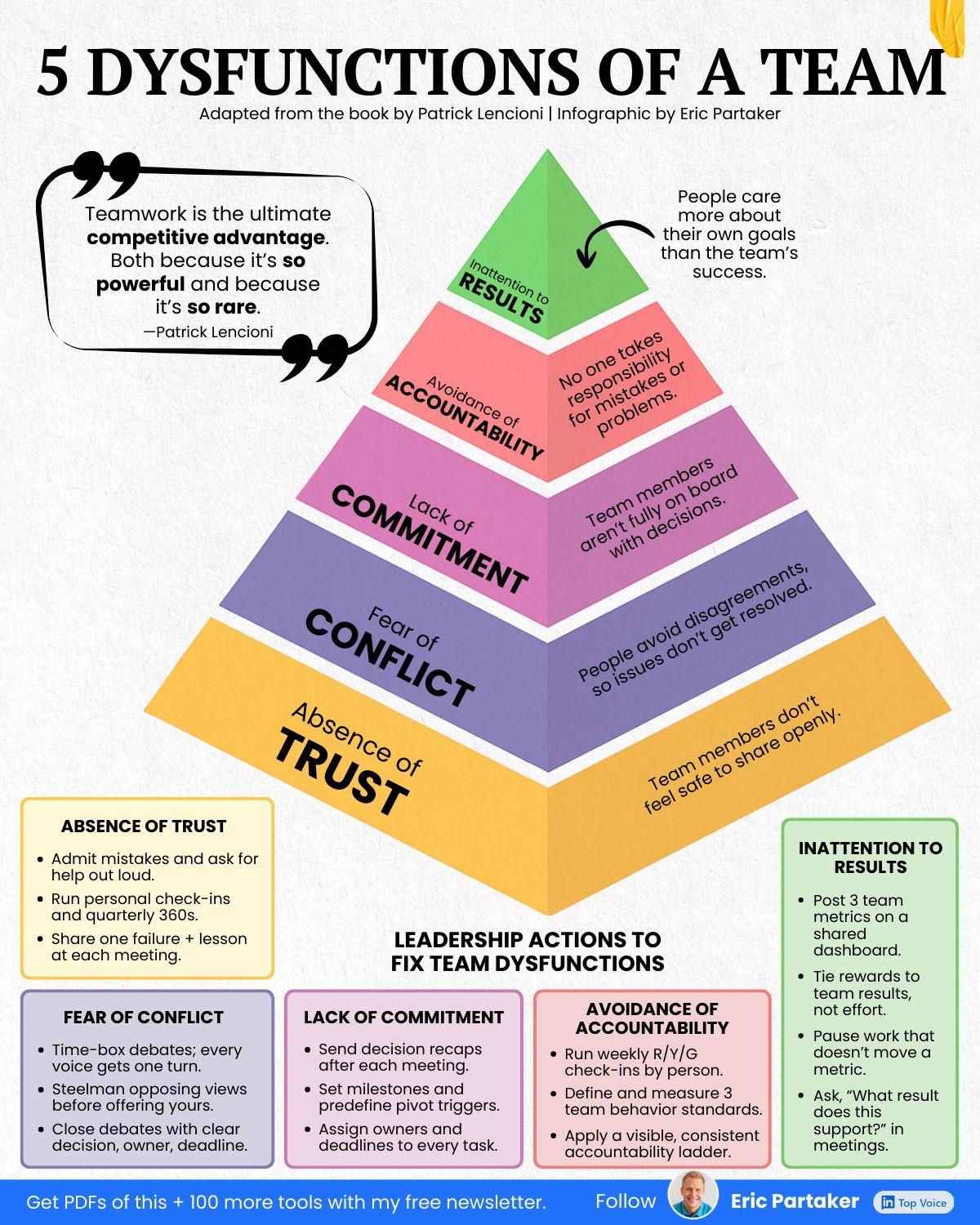
In a recent LinkedIn post, Eric Partaker delves into the common reasons why seemingly capable leadership teams struggle to achieve their goals, arguing that the root cause often lies not in overt dysfunction but in what remains unsaid.
Partaker highlights a pervasive issue in many organizations: a facade of agreement that masks underlying disagreements and a lack of genuine progress. He points out that while teams may appear functional on the surface, a closer examination often reveals subtle but significant misfires.
“Most leadership teams aren’t dysfunctional because of drama. They’re dysfunctional because of what’s not being said.”
According to Partaker, this silence can manifest in several ways, including team members avoiding candid feedback, deadlines slipping without acknowledgment, and innovative ideas failing to gain traction. He observes that this environment can lead to smart, capable individuals feeling disengaged, while less effective members remain comfortable, ultimately hindering overall team performance.
The Silent Killer: Unspoken Disagreements
Eric Partaker emphasizes that the absence of open, honest dialogue is a primary driver of team stagnation. He suggests that the common scenario where people smile in meetings but privately disagree is a critical indicator of this underlying issue. As he notes:
“People smile in meetings… then privately disagree”
This lack of candor, Partaker argues, prevents teams from engaging in the necessary conflict that leads to robust decision-making. Without the willingness to challenge ideas constructively, decisions can become watered down, lacking the conviction needed for effective execution.
Leveraging Lencioni’s Framework for Team Health
To provide a structured approach to diagnosing and addressing these issues, Partaker references Patrick Lencioni’s renowned model, ‘The 5 Dysfunctions of a Team.’ He breaks down the model, explaining how each layer builds upon the previous one, starting with trust and culminating in results. The hierarchy is presented as:
- Without trust, people avoid being real.
- Without conflict, decisions get watered down.
- Without commitment, nothing sticks.
- Without accountability, no one follows through.
- And without all four? Results stall.
Partaker asserts that understanding this framework is crucial for leaders seeking to improve their team’s effectiveness. He stresses that the responsibility for addressing these dysfunctions begins with the leader.
Actionable Steps for Leaders
Partaker outlines several practical steps leaders can take to foster a healthier team dynamic:
- Model Vulnerability: Admit mistakes first to encourage openness.
- Facilitate Real Debates: Conduct structured, time-boxed discussions where every voice is heard.
- Clarify Decisions: Issue brief recaps detailing what was decided, why, who is responsible, and by when.
- Ensure Accountability: Make performance visible and follow through on missed commitments.
- Focus on Results: Continually ask what tangible outcome each action or decision supports.
He concludes by emphasizing that even the best strategy is ineffective if the team cannot execute it collaboratively. As Partaker puts it:
“Because great strategy means nothing if your team can’t execute it together.”
Ultimately, Partaker encourages leaders to reflect on their own modeling behavior and identify where their team might be ‘stuck in the pyramid,’ suggesting that a team that tells the truth, supports healthy debate, commits fully, holds each other to high standards, and wins together is fundamental to business scalability.
📝 About This Content
This article is based on insights shared by Eric Partaker on LinkedIn.
📅 Originally posted on February 14, 2026 | View original post on LinkedIn →