
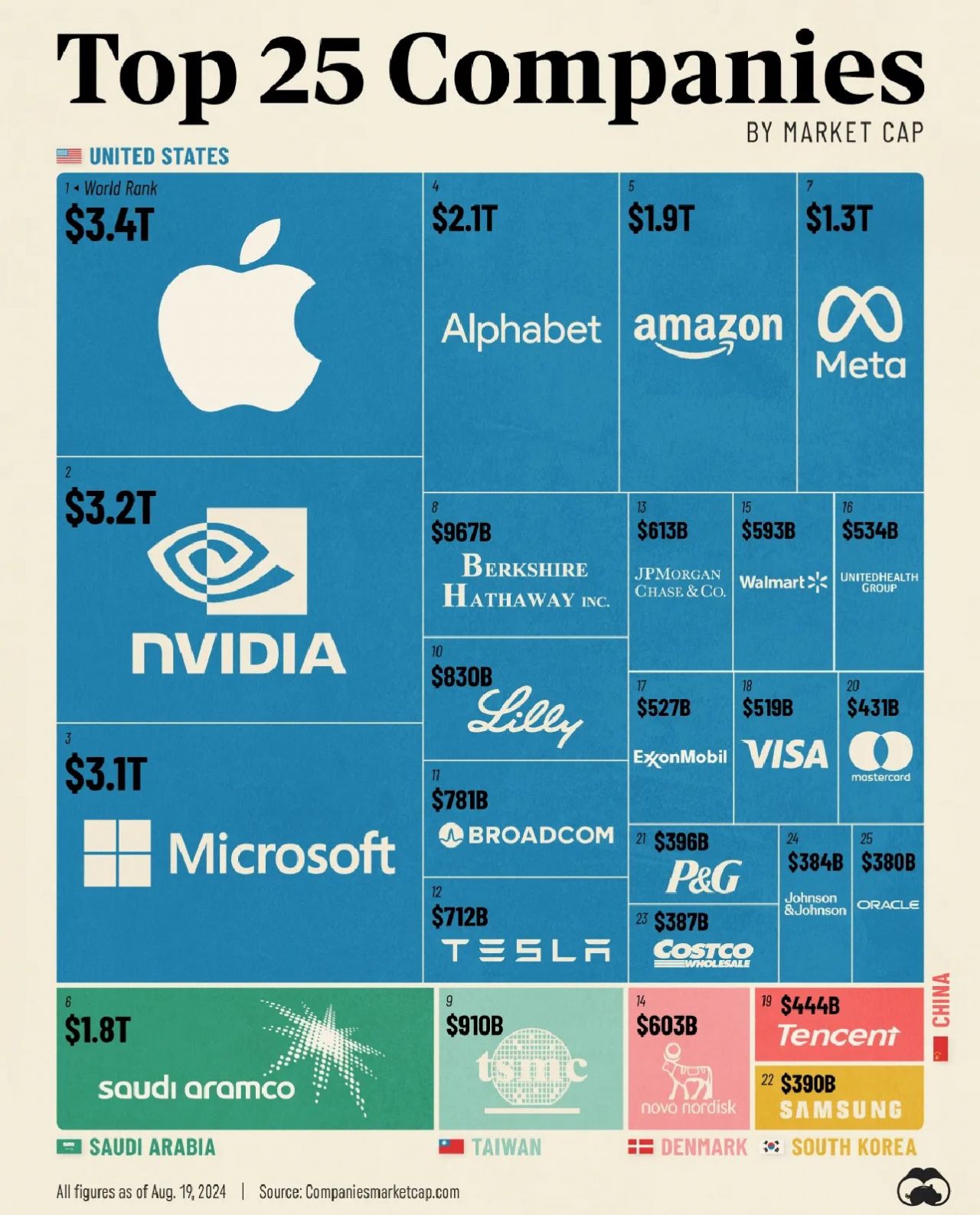
In a recent LinkedIn post, Nathan Crockett, PhD examines the striking concentration of the world’s most valuable companies within the United States, posing a question about the underlying reasons for this economic phenomenon. He highlights that 20 of the 25 largest companies globally, by market capitalization, are headquartered in the U.S.
Crockett, PhD points out the significant disparity when comparing the U.S. to other major economies. According to his analysis, countries like Saudi Arabia, Taiwan, Denmark, China, and South Korea each host only one of these top-tier corporations. This stands in stark contrast to a substantial list of developed nations that do not feature any companies in the top 25.
“Not a single Top 25 Company (by Market Cap) is found in: Germany 🇩🇪, Japan 🇯🇵, the UK 🇬🇧, India 🇮🇳, France 🇫🇷, Spain 🇪🇸, Russia 🇷🇺, Australia 🇦🇺, Belgium 🇧🇪, Brazil 🇧🇷, Italy 🇮🇹, the Netherlands 🇳🇱”
The U.S. Economic Outlier
Nathan Crockett, PhD prompts readers to consider the drivers behind the United States’ overwhelming presence in the top echelon of global corporations. He frames this as a critical question, especially given the U.S. population constitutes only about 4% of the world’s total.
Factors Contributing to U.S. Dominance
While Crockett, PhD poses the question without providing his own definitive answers within the post, his framing invites discussion on several potential factors that economists and business analysts frequently cite. These could include:
- A robust venture capital and innovation ecosystem that fosters the growth of new, high-value companies.
- A large, relatively unified domestic market that allows companies to scale rapidly.
- A legal and regulatory environment that, while complex, is often seen as supportive of business growth and intellectual property protection.
- A culture that encourages entrepreneurship and risk-taking.
- The historical development of key industries and technological advancements originating in the U.S.
Crockett, PhD’s data serves as a powerful starting point for a broader conversation about global economic power, technological leadership, and the conditions necessary for creating and sustaining globally dominant enterprises.
A Global Economic Snapshot
The stark geographical distribution of market cap leaders, as presented by Nathan Crockett, PhD, underscores significant global economic trends. The absence of companies from major European economies like Germany, France, and the UK, as well as from rapidly developing nations such as India and Brazil, in the top 25 suggests that while these regions have strong economies, they may not be producing companies at the same scale of market valuation as the U.S.
“20 of the world’s richest companies are in the United States. 🇺🇸 Saudia Arabia, Taiwan, Denmark, China, and South Korea each have 1.”
As Nathan Crockett, PhD implies, this concentration is not merely a statistical curiosity but points to deeper structural differences in how economic value is created and captured globally. His post effectively uses data to highlight a key aspect of the current global economic landscape, encouraging followers to engage with the ‘why’ behind these numbers.
The post concludes with a call to action for his audience to share the insights and follow for more data-driven observations. Nathan Crockett, PhD is clearly positioning himself as a source for understanding macro-level business and economic trends through accessible data points.
📝 About This Content
This article is based on insights shared by Nathan Crockett, PhD on LinkedIn.
📅 Originally posted on April 4, 2026 | View original post on LinkedIn →