
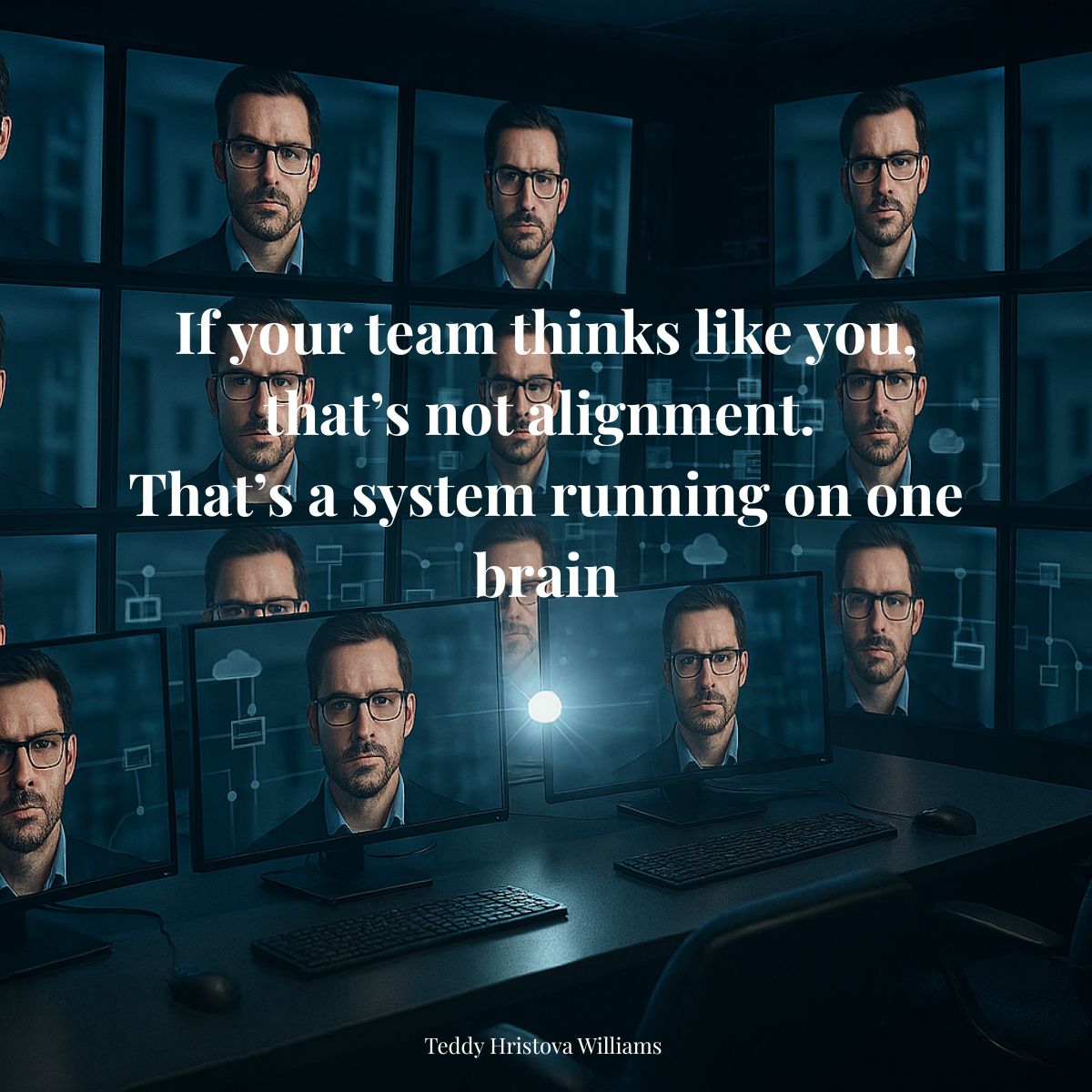
In a recent LinkedIn post, Teddy Hristova Williams offers a critical perspective on a common founder’s pride: having a team that “thinks like them.” Rather than viewing this as a sign of strong alignment or effective hiring, Williams argues it can be a detrimental state of “cognitive collapse.” The post challenges the notion that a team mirroring a founder’s thoughts represents true efficiency or loyalty, suggesting instead that it stifles innovation and critical thinking.
The Illusion of Alignment
Williams begins by highlighting the surface-level appeal of a team that seems to be on the same wavelength as its leader. Founders often feel validated when their team’s thinking aligns perfectly with their own. This perceived efficiency can feel like proof of successful recruitment and strong company culture. However, Teddy Hristova Williams posits that this is a dangerous misconception.
“If your team thinks like you, that’s not alignment. That’s a system running on one brain.”
As Teddy Hristova Williams elaborates, this environment, while appearing competent and loyal on the outside, can lead to a team that refrains from offering dissenting opinions or novel ideas. The system, according to Williams, inadvertently trains employees to prioritize mirroring the leader’s thoughts over developing their own unique perspectives. This creates a culture where the safest option is to echo the founder’s viewpoint, rather than to challenge or innovate.
Cognitive Collapse and Its Consequences
The core of Teddy Hristova Williams’s argument centers on the concept of “cognitive collapse.” This occurs when a team’s collective thinking becomes too homogenous, essentially acting as an echo chamber for the founder’s ideas. Williams stresses that such a team cannot effectively pressure-test strategies, identify blind spots, or provide the diverse perspectives necessary for robust decision-making.
The Need for Independent Thinkers
Williams contrasts the desire for a team that “thinks like you” with the actual needs of a scaling business. Instead of seeking employees who function as “agentic mode” – predicting preferences like an AI – founders require individuals with independent thought processes. These team members can generate perspectives that are invisible from the founder’s unique vantage point.
“You need independent thinkers who generate perspectives you can’t see from your vantage point.”
The implication is that true business scaling relies not on a single brilliant mind, but on the integration of multiple, differentiated mental models. These models allow a business to handle complexity and adapt without constant direction from the top. According to Teddy Hristova Williams, the focus should shift from asking why team members aren’t stepping up, to understanding how the existing system might be discouraging independent thought.
Rethinking Team Dynamics
Teddy Hristova Williams challenges founders to re-examine their team-building and management strategies. The goal should not be to create clones of oneself, but to cultivate an environment where diverse thinking is not only welcomed but actively encouraged. This involves creating psychological safety for team members to voice different opinions and propose alternative solutions.
“A team that thinks like you isn’t a team. It’s an extension of your nervous system.”
In essence, Teddy Hristova Williams argues that a truly effective and scalable business is built on a foundation of varied cognitive approaches. By fostering an environment that encourages independent thinking and constructive dissent, founders can unlock the full potential of their teams, moving beyond the limitations of a single perspective and avoiding the pitfalls of cognitive collapse.
📝 About This Content
This article is based on insights shared by Teddy Hristova Williams on LinkedIn.
📅 Originally posted on March 5, 2026 | View original post on LinkedIn →