
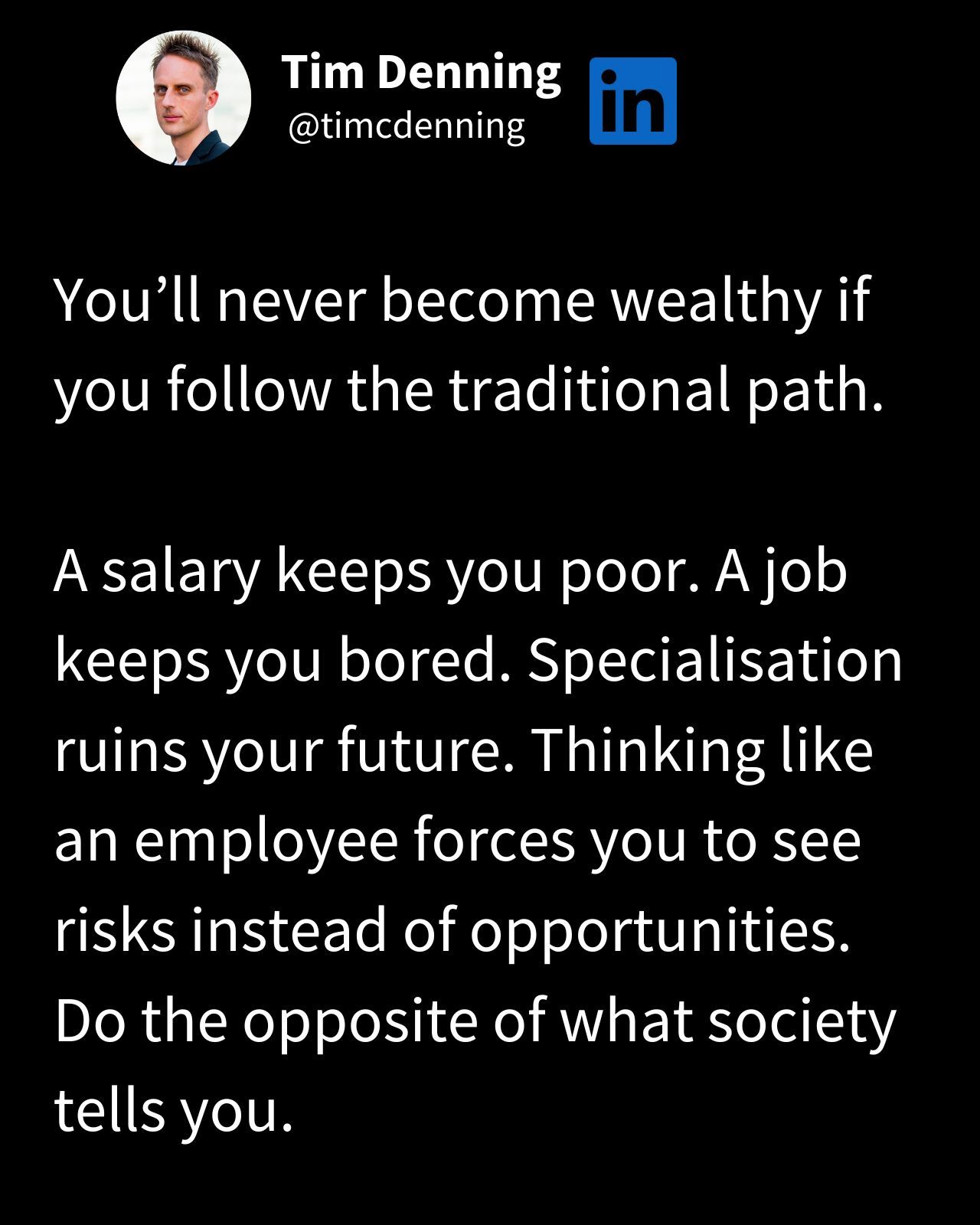
In a recent LinkedIn post, Tim Denning offers a critical perspective on traditional employment, challenging the notion that a stable salary equates to genuine security or long-term wealth. Denning, who spent over a decade in banking, contends that the structure of salaries is intentionally designed to foster dependency, keeping individuals just comfortable enough not to seek more fulfilling or financially rewarding paths.
He begins by highlighting the systemic issues within conventional jobs. According to Denning, the primary function of a salary is not to propel an individual forward but to maintain a status quo.
A salary is designed to keep you just comfortable enough not to quit.
Denning elaborates on this, arguing that the financial rewards offered are often just sufficient to cover basic living expenses and minimal savings, creating an illusion of progress without fostering true wealth accumulation. This structure, in his view, encourages employees to rent out their time rather than build assets.
The Dangers of Occupied, Not Fulfilled, Employment
Denning further dissects the nature of modern jobs, suggesting they are engineered to keep individuals occupied rather than fulfilled. He points to common workplace scenarios as evidence of this systemic flaw.
Jobs are designed to keep you occupied, not fulfilled. You sit in meetings about meetings. You create reports nobody reads. You optimize processes that don’t matter.
This environment, Denning warns, can be detrimental to personal and professional growth. He posits that the resulting boredom is not merely an inconvenience but a significant impediment to ambition and creativity, potentially diminishing an individual’s belief in the possibility of alternative career trajectories.
Generalists as the Key to Wealth, Not Specialists
A significant portion of Denning’s post is dedicated to debunking the conventional advice of specialization. He argues that in a rapidly changing world, deep specialization can paradoxically lead to greater replaceability.
The Specialization Trap
As technology and industries evolve, skills that were once highly valued can quickly become obsolete. Denning contrasts this with the strategies of the wealthiest individuals he knows, whom he describes as generalists.
The wealthiest people I know are generalists. They can adapt. They can pivot. They refused to put all their skills in one basket.
In Denning’s analysis, this adaptability and breadth of skill allow generalists to navigate market shifts and identify new opportunities more effectively than hyper-specialized individuals.
Rethinking Employee Mindset and the Path to Ownership
Denning identifies what he terms ’employee thinking’ as a core barrier to financial and mental freedom. This mindset, he explains, frames every potential venture outside of traditional employment as an unacceptable risk.
Employee thinking is the real poverty. When you think like an employee, every opportunity looks like a risk. Starting a business? Too risky. Investing in yourself? What if it doesn’t work?
This perspective, according to Denning, perpetuates a cycle of financial and mental limitations. He shares a personal turning point: his own firing in 2019, which he now views as a catalyst for profound change. This forced reevaluation, Denning notes, compelled him to shift from ‘renting his time’ to ‘building instead of renting’ and to recognize opportunities where he previously saw only risks.
Ultimately, Tim Denning concludes in his post that the traditional career path is not a safe harbor but a form of ‘slow bleed.’ He advocates for a paradigm shift, asserting that true wealth originates from ownership rather than employment. His message encourages individuals to question societal norms and consider alternative approaches to career and financial growth.
📝 About This Content
This article is based on insights shared by Tim Denning on LinkedIn.
📅 Originally posted on February 10, 2026 | View original post on LinkedIn →