
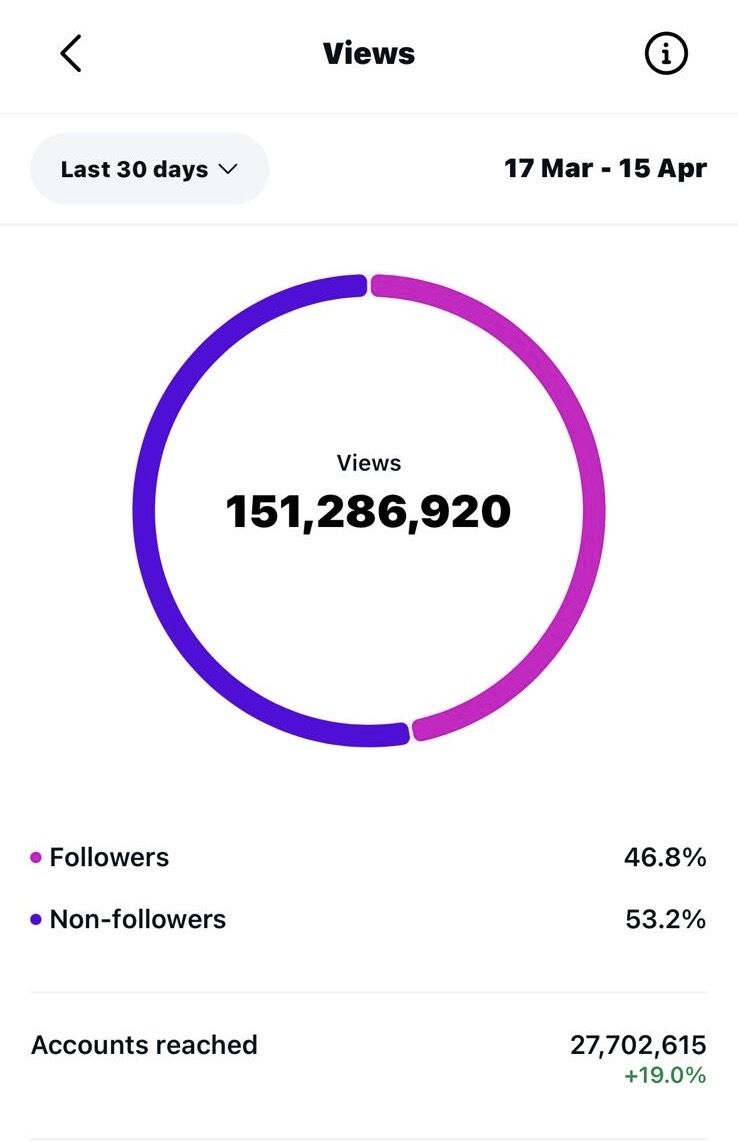
In a recent LinkedIn post, Karishma Mehta delves into the remarkable performance of Humans of Bombay’s content on Instagram, highlighting how a single month yielded over 150 million organic views. Mehta, the driving force behind the popular storytelling platform, shared her analysis of what propelled their reels to achieve millions of views, often from non-followers, indicating a deep content resonance.
Mehta expressed her initial astonishment at the numbers, noting the significant reach beyond their existing audience. She stated:
“And that’s when you realise the content isn’t just reaching people, it’s connecting deeply enough to be shared, saved, and discovered by people who actually care!”
Deconstructing Viral Success: What Connects with Audiences
Mehta’s analysis breaks down the key elements that contributed to the viral success of certain posts. She identifies specific strategies that proved effective, emphasizing the power of narrative framing and emotional hooks.
The Power of Provocation and Raw Emotion
One of the top-performing reels, according to Mehta, was a piece about road rage. Its success was attributed to its provocative opening, challenging common perceptions. As Karishma Mehta explains, the reel didn’t begin with a story but with a statement designed to elicit an immediate reaction: “People say Mumbai is the safest city.” This approach, Mehta argues, hooks the viewer by presenting a point of contention they feel compelled to engage with.
Another highly impactful story, Mehta points out, was the raw account of a son recounting an incident where armed men broke into his elderly parents’ home. The lack of dramatic embellishment and the straightforward, empathetic retelling resonated deeply. Mehta notes:
“No dramatic twists, just a raw retelling that leaves you with a sense of helplessness and empathy.”
Similarly, a story about a family unofficially adopting their househelp’s daughter garnered significant shares. Mehta believes this success stemmed from its relatability and the immediate impulse it created for viewers to tag friends or share with someone they knew. “The story did the forwarding for us,” she observed, highlighting how the content itself became a catalyst for organic distribution.
Identifying Content That Falls Flat
Mehta also sheds light on content that underperformed, offering valuable lessons on what not to do. She contrasts the successful emotional narratives with examples that, despite their objective merit, failed to capture widespread attention.
The Pitfalls of Low-Emotion and Resolved Narratives
The analysis includes a critique of ‘good news carousels’ that presented only headlines without accompanying stories. This led Mehta to a crucial realization: the issue isn’t short attention spans, but rather a low tolerance for content lacking emotional depth. “People don’t have short attention spans. They have low tolerance for low-emotion content. Give them feeling, they’ll stay,” she asserts.
Furthermore, Mehta examines a story about a young individual who chose the Indian Army over a Harvard PhD offer. While inspiring, the post garnered only around 400,000 views, a number that, while substantial, was lower than expected. Mehta posits that the story’s complete and resolved nature left viewers with nowhere to go emotionally or conversationally. She elaborates:
“The story was complete. Resolved. The reader had nowhere left to go with it.”
A similar observation was made about a birthday tribute to actor Vikrant Massey. Despite highlighting his remarkable journey from a background dancer to a National Award winner, the framing as a simple birthday wish, rather than a revelation of his arc, limited its reach. Mehta feels this approach made the content feel like a mere greeting card, missing the opportunity for deeper engagement.
The Algorithm Agrees: Open Ends Drive Engagement
Mehta concludes by identifying a consistent pattern in high-performing content: an open end that evokes an unnamed emotion, prompting viewers to share not to explain, but to make others feel it too. This insight, honed over years of experience, appears to be validated by the platform’s algorithms. She summarizes her key takeaway:
“The best-performing content has an open end… unresolved in a way that makes you feel something you haven’t fully named yet. It makes you want to share it. You share it because you want someone else to feel it too, not because you want to explain it.”
Even the least successful posts during this period achieved significant reach, reinforcing Mehta’s point that the challenge lies not in avoiding failure, but in understanding the dynamics of resonance and shareability.
📝 About This Content
This article is based on insights shared by Karishma Mehta on LinkedIn.
📅 Originally posted on April 17, 2026 | View original post on LinkedIn →