
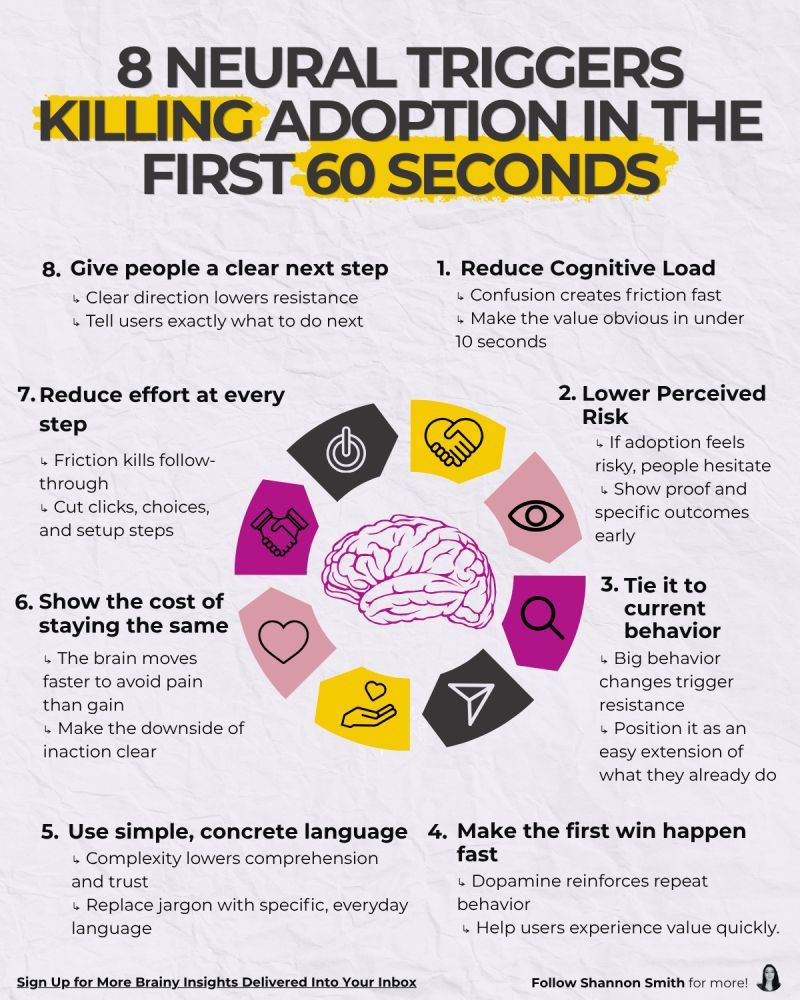
In a recent LinkedIn post, Shannon Smith, J.D., M.S. delves into the often-overlooked subconscious reasons why potential users might resist adopting a product, even when it addresses a clear need. Smith, J.D., M.S. argues that product adoption hinges less on the product’s inherent quality and more on how the user’s brain perceives it. According to Smith, J.D., M.S., adoption occurs when the user’s brain signals that the product “feels clear. This feels safe. This feels easy enough to try.” This perspective challenges the common assumption that a superior product automatically guarantees user uptake.
Understanding the Brain’s Role in Adoption
Shannon Smith, J.D., M.S. outlines eight key subconscious factors that influence user adoption, framing them as a “neural map to stronger user adoption.” The core principle, as explained by Smith, J.D., M.S., is that the brain is constantly evaluating for effort, risk, and reward. If a product appears difficult, unclear, or threatening, adoption rates will naturally decline. Conversely, a product perceived as easy, familiar, and rewarding is more likely to be embraced.
“The brain resists what feels mentally heavy. Confusion creates friction fast.”
This emphasis on cognitive ease is a central theme in Smith, J.D., M.S.’s analysis. To combat this, Smith, J.D., M.S. advises companies to make the product’s value immediately apparent, ideally within ten seconds. This principle of reducing cognitive load is crucial for overcoming initial user hesitation.
Strategies for Enhancing User Adoption
Minimizing Perceived Risk and Maximizing Familiarity
Shannon Smith, J.D., M.S. highlights the importance of lowering the perceived risk associated with trying a new product. The amygdala, Smith, J.D., M.S. explains, is constantly scanning for threats, and any uncertainty can lead to hesitation. To mitigate this, showcasing proof and tangible outcomes early in the user experience is recommended. Furthermore, Smith, J.D., M.S. points out that the brain favors familiarity over disruption. Therefore, positioning a new product as a natural extension of existing behaviors, rather than a radical departure, can significantly reduce resistance.
“The brain prefers familiarity over disruption. Big behavior changes trigger resistance.”
The Power of Early Wins and Clear Communication
A key strategy proposed by Shannon Smith, J.D., M.S. is to facilitate a rapid first win for the user. This quick experience of value is essential because early rewards, driven by dopamine, reinforce the desire for repeat behavior. Smith, J.D., M.S. also stresses the critical role of language. “The brain processes clarity faster than abstraction,” Smith, J.D., M.S. writes, advocating for the use of simple, concrete language over jargon to enhance comprehension and build trust.
Leveraging Loss Aversion and Reducing Effort
Further elaborating on the psychological drivers, Shannon Smith, J.D., M.S. suggests harnessing loss aversion. By clearly demonstrating the costs or downsides of *not* adopting the product, companies can tap into a powerful motivator, as the brain is often more driven to avoid pain than to pursue gain. Smith, J.D., M.S. also emphasizes the need to minimize effort at every stage of the user journey, cutting down on clicks, choices, and setup steps to prevent friction from derailing engagement. Finally, providing a clear, unambiguous next step for the user is vital, as ambiguity can delay action and increase resistance.
“If your product feels hard, unclear, or threatening, adoption drops. If it feels easy, familiar, and rewarding, adoption rises.”
Shannon Smith, J.D., M.S.’s insights provide a valuable framework for businesses looking to improve product adoption by aligning their strategies with fundamental principles of human psychology.
📝 About This Content
This article is based on insights shared by Shannon Smith, J.D., M.S. on LinkedIn.
📅 Originally posted on July 28, 2026 | View original post on LinkedIn →