
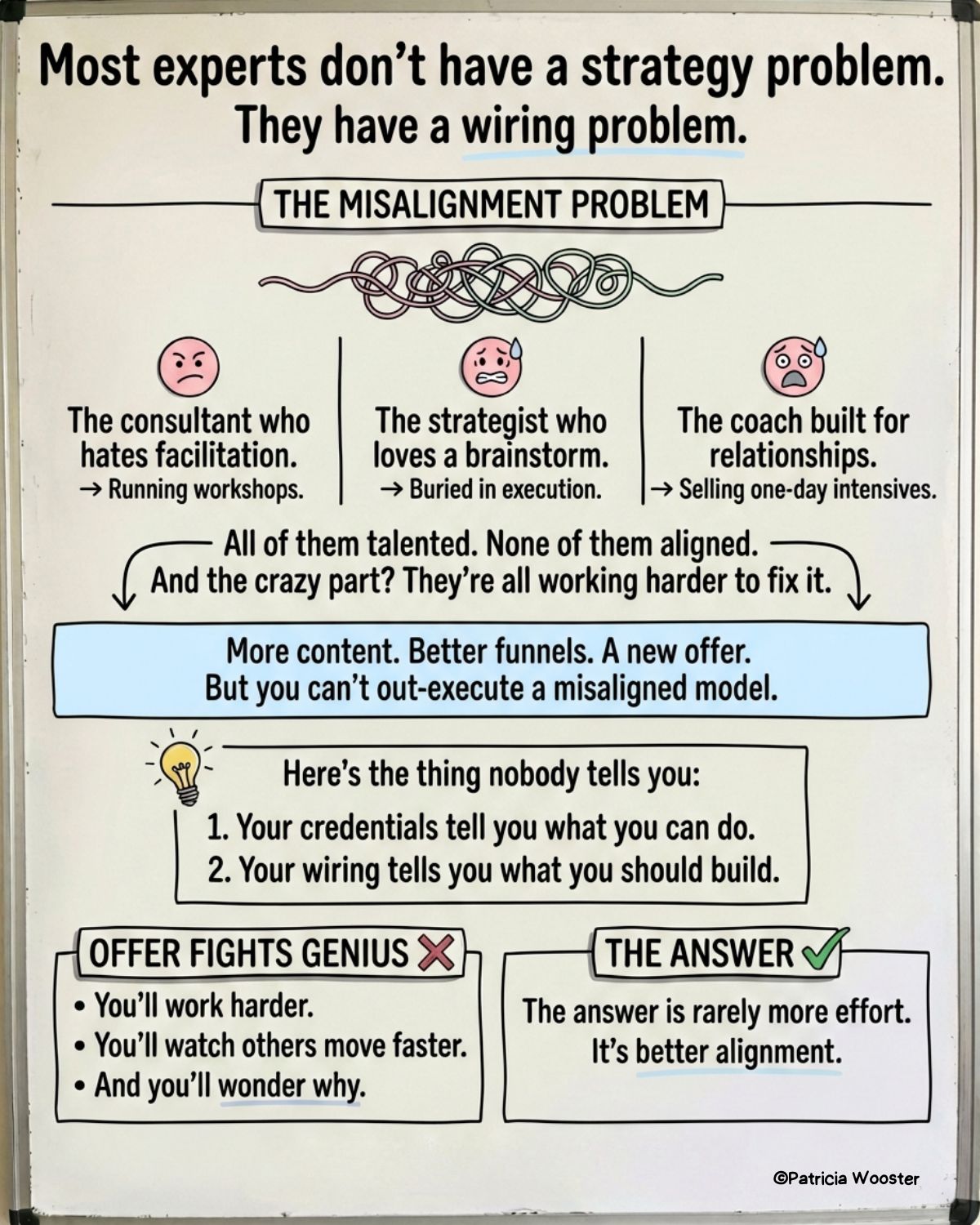
In a recent LinkedIn post, Patricia Wooster delves into a common pitfall for many experts and consultants: the disconnect between their innate talents and their business models. Wooster argues that the core issue is often not a lack of strategy, but a fundamental misalignment with their inherent ‘wiring’ – their natural strengths and inclinations.
Wooster highlights how talented individuals can find themselves working harder and achieving less because their chosen path conflicts with their core capabilities. She uses several examples to illustrate this point:
“The consultant who hates facilitation. → Running workshops. The strategist who loves a brainstorm. → Buried in execution. The coach built for relationships. → Selling one-day intensives.”
This misalignment, according to Wooster, leads to unnecessary struggle and slower progress compared to peers who are more aligned. She observes that many experts try to compensate by increasing their efforts, which is often a misdirected approach.
The Misconception of Strategy Problems
Wooster contends that the prevailing belief that experts face strategy problems is often inaccurate. Instead, she posits that the real challenge lies in understanding and honoring one’s natural aptitudes, or ‘wiring.’ This internal alignment, she suggests, is more critical to sustainable success than external strategic maneuvers.
“Most experts don’t have a strategy problem. They have a wiring problem,” Wooster states in her post. This core assertion reframes the common understanding of business challenges for solo practitioners and consultants.
Credentials vs. Wiring
A key distinction Wooster draws is between what credentials signify and what one’s ‘wiring’ dictates. While credentials demonstrate acquired knowledge and capabilities, Wooster argues that wiring reveals where true potential and natural aptitude lie for building a business.
“Your credentials tell you what you can do. Your wiring tells you what you should build.”
She elaborates that pursuing offers or business models that fight against one’s inherent genius, even if successful, comes at a significant cost. This includes working harder, seeing others advance more quickly, and a pervasive sense of confusion about why progress is slower.
Alignment as the Key to Efficiency
Wooster’s central thesis is that true efficiency and faster progress stem from better alignment between an individual’s natural talents and their business model. She criticizes the tendency to believe that more effort, more content, or more sophisticated funnels can fix a foundational misalignment.
“You can’t out-execute a misaligned model,” Wooster asserts. This powerful statement underscores her belief that foundational alignment is a prerequisite for effective execution. The solution, in her view, is not typically found in doubling down on effort but in recalibrating the business to match the individual’s innate strengths.
Ultimately, Patricia Wooster’s insights on LinkedIn encourage experts to look inward and assess whether their business activities are in harmony with their natural wiring, suggesting this is the most effective path to sustainable and less strenuous success.
📝 About This Content
This article is based on insights shared by Patricia Wooster on LinkedIn.
📅 Originally posted on March 3, 2026 | View original post on LinkedIn →