
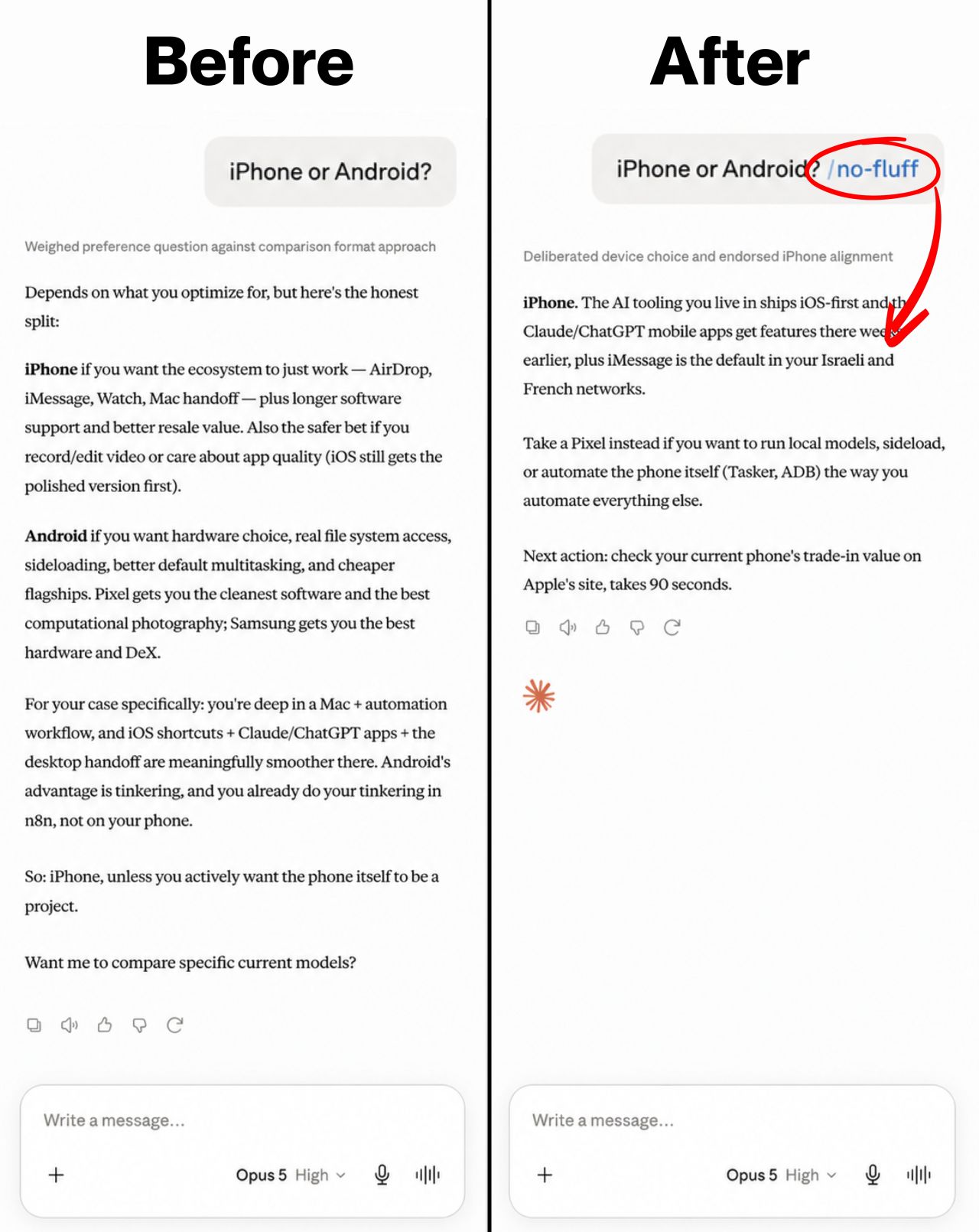
In a recent LinkedIn post, Yonathan Cohen discusses the often verbose and indirect nature of AI-generated responses, advocating for a more direct and actionable communication style. Cohen highlights how current AI models, like Claude, can sometimes take an unnecessarily long route to deliver information, frustrating users who seek concise answers.
Cohen illustrates the issue with an example of an AI response that was significantly shortened by providing it with a specific instruction file. He notes the contrast between a lengthy, meandering explanation and a brief, to-the-point answer that still reached the same conclusion.
“Same verdict. It just took 200 words to get there instead of 20.”
The core of Cohen’s argument centers on a set of principles for more effective AI communication, which he shared as a set of instructions for the AI. These principles are designed to transform how AI delivers information, making it more user-friendly and efficient for business contexts.
The Principles of Direct AI Communication
Yonathan Cohen outlines several key rules that his instruction file enforces to make AI responses more impactful. These rules aim to cut through the fluff and deliver value immediately.
Prioritize the Answer
A fundamental principle Cohen champions is answering first, explaining second. He argues against starting with context, stating that the decision or the main point should be presented upfront.
“→ never the context first. The decision, then the why.”
Eliminate Ambiguity
Cohen’s approach explicitly bans phrases like “it depends.” Instead, the AI is instructed to state what it depends on in a single line, then commit to a likely outcome or answer that specific condition.
Declare a Winner in Comparisons
When comparing options, Cohen’s framework demands a clear winner. Rather than presenting a balanced table, the AI should pick one option and then identify who the alternative option might be best suited for.
Conciseness and Clarity
The post emphasizes the importance of brevity and specificity. Cohen suggests that comparisons should not result in lengthy discussions but should lead to a single winner and a clear alternative. Furthermore, he advocates for using concrete numbers and specific durations instead of vague terms.
“→ not ‘this takes a while’ but ’40 minutes’. Not ‘cheaper’ but ‘half the price’.”
Directness in Disagreement
Cohen also touches upon how AI should handle disagreements. He suggests that if the AI needs to contradict the user’s premise, it should do so directly and early, rather than burying the disagreement in paragraphs of polite agreement.
Actionable Next Steps
Finally, Cohen insists that every AI response should conclude with a clear, actionable next step that the user can complete quickly. He dismisses vague closings like “let me know if you have questions” in favor of concrete, time-bound actions.
Implementing Directness with AI
Yonathan Cohen frames these guidelines as a skill that can be implemented once through a custom instruction file for AI models like ChatGPT and Claude. This approach, he suggests, permanently alters the AI’s response style to be more efficient and direct.
“It’s a Skill. A file you drop in once, and every answer after that changes.”
By adopting these principles, Cohen argues that users can receive more valuable and immediately applicable information from AI tools, transforming them from verbose assistants into efficient problem-solvers. This method of refining AI output is presented not just as a technical tweak but as a strategic enhancement for business communication.
📝 About This Content
This article is based on insights shared by Yonathan Cohen on LinkedIn.
📅 Originally posted on August 5, 2026 | View original post on LinkedIn →