
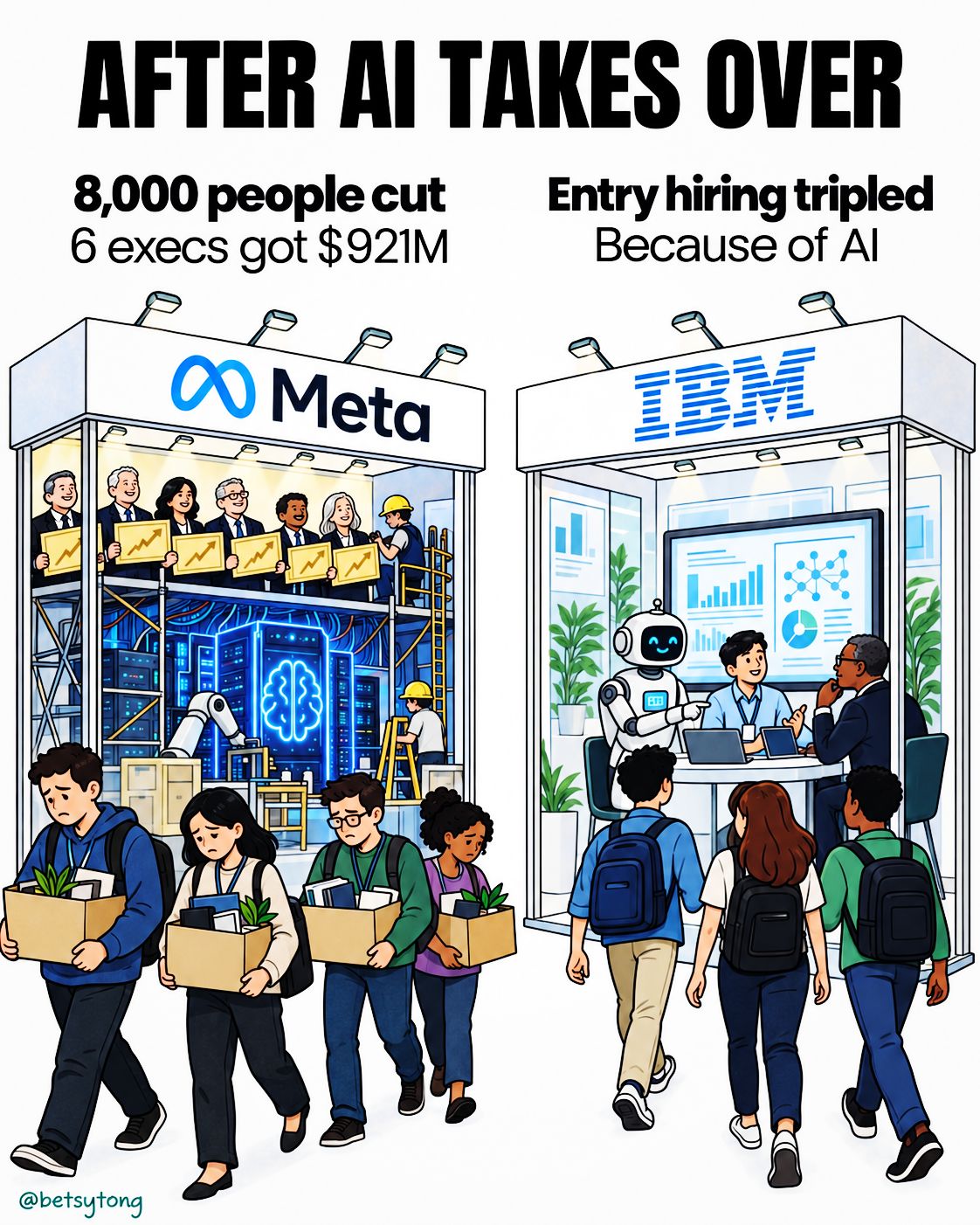
In a recent LinkedIn post, Betsy Tong highlights a critical divergence in how companies are approaching artificial intelligence, presenting two distinct strategies: one focused on headcount reduction and another centered on job redesign.
Tong contrasts the approaches of Meta and IBM, framing them as exemplars of these opposing philosophies. She points out Meta’s significant investment in AI, coupled with substantial layoffs and hiring freezes, as an example of a company prioritizing AI funding over its workforce.
“Meta: Cut 8000. Gave 6 execs $921M in options”
According to Tong, Meta’s strategy involved spending between $130 to $145 billion on AI, while simultaneously laying off 8,000 employees and freezing 6,000 open positions to finance these investments. She notes the company even recorded keystrokes to facilitate AI learning. Tong suggests that in Meta’s case, the financial rewards for executives were prioritized before the AI’s full delivery, a sequence she implies is problematic.
The Two Paths of AI Adoption
Betsy Tong identifies a fundamental split in corporate AI strategies. On one side are companies that, like Meta, appear to bet on reducing their human workforce to fund ambitious AI projects.
The Headcount Reduction Model
Tong’s analysis of Meta’s approach suggests a model where significant capital is allocated to AI development, with workforce reductions serving as a means to offset these costs. She posits that this strategy prioritizes the acquisition and implementation of AI technology, potentially at the expense of existing employees. As Tong observes:
“One used people to fund exorbitant AI investments. The other used AI to redesign.”
This method, in Tong’s view, leads to a scenario where the rewards of AI investment are realized by a select few, even as the broader workforce is downsized.
The Job Redesign Model
In stark contrast, Tong presents IBM as a company adopting a different paradigm. IBM is reportedly tripling its entry-level hiring for 2026, a move directly linked to its AI integration strategy. Tong quotes IBM’s CHRO, emphasizing the need to fundamentally rethink job roles in the age of AI.
“You have to rewrite every job. The new roles change where human value sits. Not executing, translating between the client and the machine.”
According to Betsy Tong, IBM’s approach recognizes that AI can automate entry-level tasks. Instead of cutting staff, the company is focusing on redefining human roles, shifting the emphasis from task execution to higher-value functions like client-to-machine translation. This strategy, as Tong outlines, leverages AI to augment human capabilities and redesign work, rather than simply replace workers.
Rethinking Human Value in the AI Era
Tong challenges business leaders to consider which of these two paths their own organizations are following. She argues that the distinction lies not just in the adoption of AI, but in the underlying philosophy guiding that adoption. Is the goal to shrink the workforce to accommodate AI, or to redesign work to incorporate AI while valuing human contribution?
As Betsy Tong concludes, the way companies navigate the AI revolution will define their future. The choice between cutting people to fund AI or using AI to redesign jobs and create new human value is a critical strategic decision.
📝 About This Content
This article is based on insights shared by Betsy Tong on LinkedIn.
📅 Originally posted on September 12, 2026 | View original post on LinkedIn →