
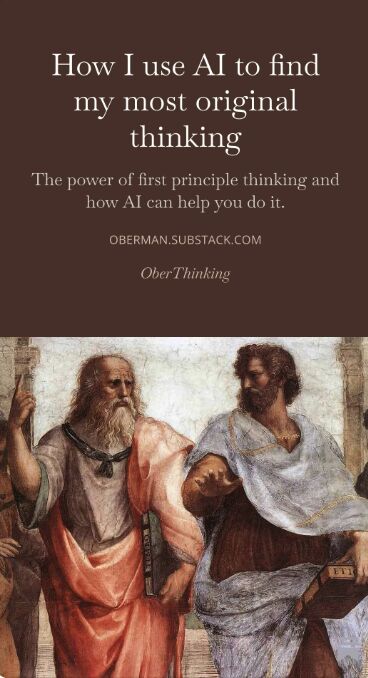
In a recent LinkedIn post, Justin Oberman explores a novel approach to leveraging Artificial Intelligence for first principles thinking, challenging conventional expectations of AI as a generative or reasoning engine. Oberman frames his journey of discovery, which involved months of experimentation, as a critical re-evaluation of how AI can best serve complex cognitive processes.
Rethinking AI’s Capacity for First Principles
Oberman begins by detailing his initial attempts to use AI for first principles thinking, which consistently yielded unsatisfactory results. He posits that the core issue lies in a misunderstanding of AI’s fundamental nature. According to Oberman, AI is primarily a sophisticated pattern recognition machine, trained on the vast corpus of human knowledge, established practices, and existing frameworks.
“AI is a pattern recognition machine trained on everything humans have ever written, agreed on, taken for granted, baked into a brief, called best practice, turned into a framework, and published.”
This foundational understanding led Oberman to a crucial realization: asking AI to perform first principles thinking, which requires generating novel ideas from scratch, is akin to asking someone who has only studied existing recipes to invent a new cuisine. Their entire conceptualization of food is derived from what already exists.
Shifting the Question: From ‘How To Get AI To Do X’ to ‘How To Get AI To Help Me Do X Better’
The turning point for Oberman came when he shifted his central question. Instead of asking, “How do I get AI to do first principles thinking for me?” – a question he deemed unanswerable – he began to ask, “How do I get AI to help me do first principles thinking better?” This subtle but significant change in perspective unlocked new possibilities.
Oberman argues that the true challenge of first principles thinking isn’t the theoretical act of reasoning from scratch. The real difficulty, he notes, is recognizing when one is *not* actually doing it. Inherited frames of reference and assumptions often masquerade as clarity and common sense, making them invisible to the thinker.
“The hardest part of first principles thinking has never been reasoning from scratch. Anyone can do that in theory. The hard part is noticing that you’re not doing it.”
This is where AI, paradoxically, becomes an invaluable tool. Oberman contends that because AI is built entirely on recognizing existing patterns and assumptions across industries and human thought, it is uniquely positioned to identify these inherited biases in an individual’s thinking.
AI as a Mirror: Identifying Inherited Thinking
Oberman proposes a new paradigm for AI’s role: not as a mind to generate ideas, but as a mirror to reflect ingrained assumptions. As a pattern-recognition system, AI can detect the “of course” thinking, the category conventions, and the playbook assumptions that shape our perspectives.
“As a pattern-recognition machine, it can recognize the inherited patterns in my thinking better than anyone else because your thinking is made of the same material.”
He elaborates that when set up correctly, AI can serve as an editor or a colleague that relentlessly pushes back against ideas that sound conventional or predictable. Its value lies in its ability to flag when an output is too similar to existing thought, thereby forcing the user to refine their thinking until something genuinely novel emerges.
“It can push back the moment your answer sounds like something anyone in your position would say. And it can hold the door closed until you produce something it doesn’t recognize.”
This reframing positions AI as a powerful ally in the pursuit of original thought, helping individuals break free from the constraints of inherited frameworks and achieve a deeper level of first principles reasoning. Oberman suggests this shift in perspective is key to unlocking AI’s true potential in cognitive enhancement.
📝 About This Content
This article is based on insights shared by Justin Oberman on LinkedIn.
📅 Originally posted on March 26, 2026 | View original post on LinkedIn →