
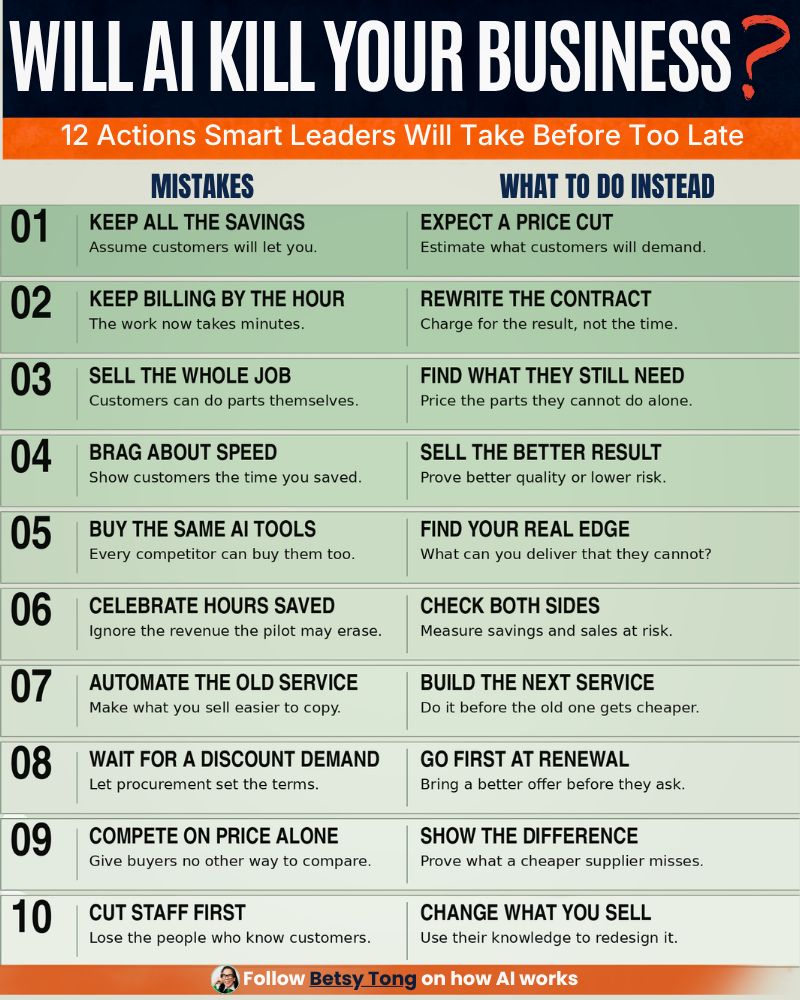
In a recent LinkedIn post, Betsy Tong offers a stark warning about the potential business repercussions of widespread AI adoption, even as companies report significant cost savings. Tong argues that the very efficiencies gained through AI are creating a powerful incentive for customers to renegotiate existing contracts, potentially dismantling traditional business models.
Tong highlights the current landscape where many businesses are embracing AI, citing McKinsey data that indicates 9 out of 10 companies are now utilizing the technology, with AI pilot programs expected to double by 2027. This adoption is leading to tangible results, such as Walmart’s AI-enabled supplier negotiator reducing costs by approximately 3% and DHL improving forecast accuracy by up to 40%. Tong notes the common client reaction: “Most of my clients look at Walmart and DHL’s results and say: AI is finally starting to justify the cost. 👍 We want that too!”
The Customer’s Perspective on AI Savings
However, Tong pivots to the customer’s viewpoint, suggesting that these reported savings are not being viewed favorably by clients. “Your customers hear something different,” Tong writes, illustrating the potential for renegotiation demands. “Them: Wait⁉️ The same output now costs a fraction? They send the text: We need to renegotiate.” This dynamic, according to Tong, means that “Every AI savings reported is evidence for a contract restructuring demand.”
The Crumbling of Old Business Models
Despite this looming threat, Tong observes that many businesses are not yet adequately prepared. She states, “Most of my clients aren’t worried enough.” While they are still in the vendor selection phase for AI automation, they are underestimating the speed at which established business models are becoming obsolete. Tong points to broader industry shifts as evidence:
- Consulting firms like McKinsey are being pressured to move away from the billable hour model.
- Salesforce is exploring new pricing structures, such as $2 per conversation.
- Financial institutions are pushing for resets in contracts with Big Law firms.
McKinsey’s report that approximately 25% of $16 billion in revenues is now outcome-based further underscores this trend, according to Tong.
Rethinking Business in the Age of AI
Tong poses critical questions for leaders to consider as they navigate this disruptive period, which she terms the “AI-pocolypse.” She emphasizes the need for a fundamental business redesign rather than merely extending existing operations with AI. The core questions leaders must ask themselves include:
Strategic Questions for Survival
- If AI cuts delivery time by 80%, what happens to our price?
- If the customer believes they can do “good enough,” will they still hire us?
- What part of our solution becomes harder to replicate?
- If an AI agent becomes the buying interface, why would it select us?
- Do we redesign the business, vs extend AI into the old one?
Betsy Tong concludes by urging leaders to confront these challenges proactively. “The question for every leader is whether they can move as quick,” she writes, suggesting that only those committed to survival will ask the necessary, potentially uncomfortable, questions about their future business strategies.
📝 About This Content
This article is based on insights shared by Betsy Tong on LinkedIn.
📅 Originally posted on September 14, 2026 | View original post on LinkedIn →